










Allied Digital reports 65% automated SOC-alert triage results
Key highlights
- Allied Digital reported 65% automated SOC-alert triage in a live cybersecurity operations deployment.
- Allied Digital reported 32% L1 ticket deflection and 44% faster MTTR in managed services.
- A live industrial vision case reported 18% higher line productivity and 97% detection accuracy.
- A live finance workflow reported 99.2% field-level accuracy and 5,400 annual hours saved.
powered by IRIS
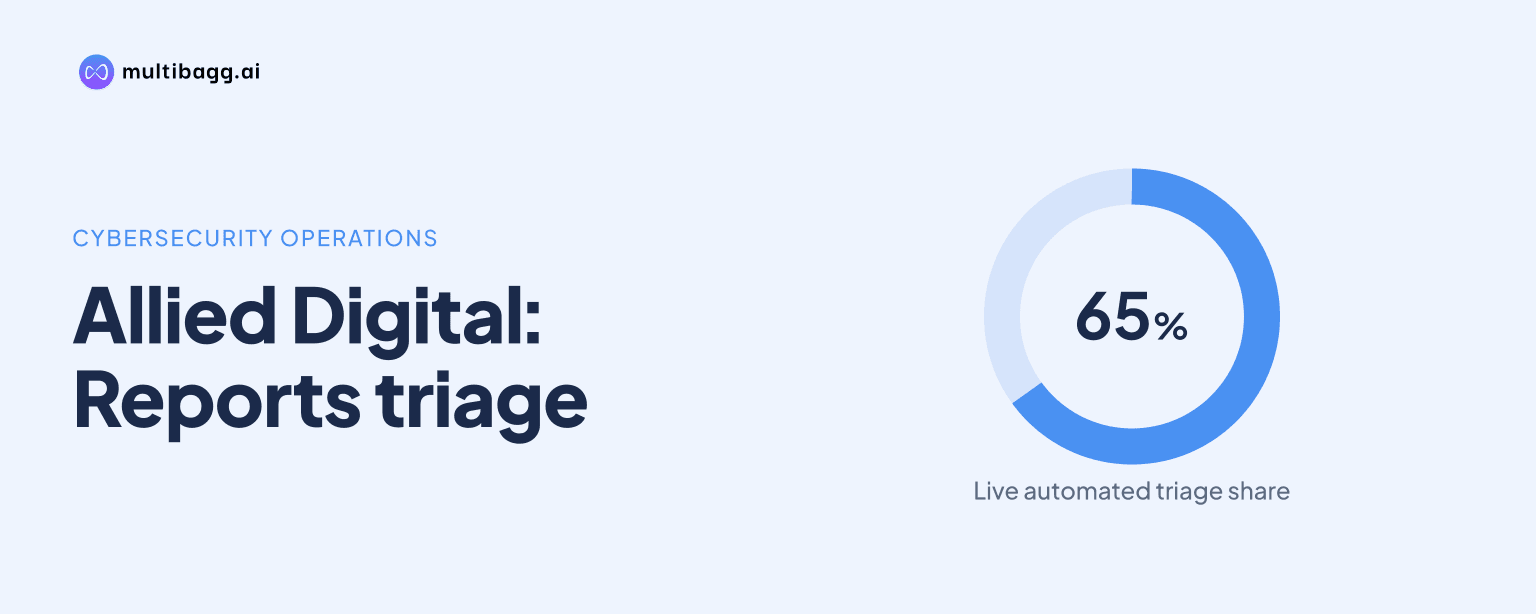
Allied Digital Services Limited reported that a live cybersecurity operations deployment auto-triaged 65% of security operations centre (SOC) alerts, while its live managed-services deployment achieved 32% first-line (L1) ticket deflection. The company also reported 99.2% field-level accuracy in document intelligence and 97% detection accuracy in industrial computer vision.
Know Allied Digital Services inside out
Results, valuation, peers and who's buying, in one view.
What did Allied Digital report from live AI deployments?
Allied Digital reported five production case studies labelled LIVE, spanning automotive manufacturing, managed services, digital workplace software, cybersecurity operations and finance operations. Their stated results included 18% higher assembly-line productivity, 32% L1 ticket deflection, 27% knowledge-worker productivity improvement, 65% automated SOC-alert triage and 85% straight-through processing in finance workflows.
The measures apply to distinct tasks and should not be read as a common platform-wide benchmark. The 65% alert-triage figure is 33 percentage points above the 32% ticket-deflection figure, but the former concerns cybersecurity alerts and the latter concerns support tickets across managed-services accounts. The presentation separately labels an insurance use case as ROADMAP rather than LIVE.
How does Allied Digital apply AI to enterprise support?
Allied Digital described an AI-led enterprise-support framework for a major Indian fast-moving consumer goods conglomerate and edible-oil processor that combines a single interaction layer with automated workflows. The support interface spans web, mobile and collaboration platforms, while the automation covers password resets, account unlocks and guided troubleshooting across a distributed operating environment.
For a personal-care and healthcare-products conglomerate, Allied Digital said it embedded an agentic-AI support layer in Microsoft Teams. The deployment combines multilingual conversational support, guided issue resolution and workflow automation with Allied Digital’s in-house information technology service management platform, identity-management systems and enterprise applications; the presentation did not provide a percentage outcome for this case.
Both enterprise cases focus on reducing repetitive L1 activity rather than reporting the managed-services portfolio’s 32% ticket-deflection result. Allied Digital said the frameworks are designed to support standardised service delivery across locations and to operate on scalable AI-as-a-service infrastructure, without customer-side AI infrastructure requirements in the Microsoft Teams case.
Which managed-services and cybersecurity results were measured?
Allied Digital reported 32% L1 ticket deflection, 44% faster mean time to resolution (MTTR) and a 21% reduction in cost to serve in its live managed-services portfolio. The company attributed these results to a multi-modal chatbot, machine-learning-based classification and intelligent routing deployed across managed-services accounts.
The disclosed managed-services mechanism combines self-service with ticket classification and routing. That distinction matters because 32% measures deflected L1 tickets, whereas the 44% MTTR improvement concerns tickets that proceed through the resolution process. The presentation does not state ticket volumes, baseline handling times or the measurement period for either metric.
In cybersecurity operations, Allied Digital reported that 65% of alerts were auto-triaged, mean time to contain was four times faster and 30% of analyst time was recovered. The deployment integrates threat triage, endpoint detection and response-driven automation, and policy-compliance checks with existing CrowdStrike, Palo Alto and Sentinel client tooling.
Allied Digital described the cybersecurity deployment as operating under bounded autonomy. That stated design places the reported 65% figure in the triage and response workflow rather than presenting it as unrestricted autonomous security action. The company did not disclose the number of alerts processed or the baseline containment time behind the four-times comparison.
Got a follow-up? Ask IRIS
What did Allied Digital report for industrial and workplace AI?
Allied Digital reported an 18% increase in line productivity and 97% detection accuracy for industrial computer vision on manual assembly lines at a global European auto-parts manufacturer. The live system uses an edge-deployed vision pipeline for object detection, activity recognition and counting, with environment-trained models and full manufacturing execution system integration.
The wider vision platform described by Allied Digital includes production-cycle monitoring, conveyor-throughput analysis, fire and smoke detection, unsafe-behaviour detection, automated licence-plate recognition and video synopsis. These capabilities are presented for industrial operations, smart cities and public infrastructure, where the stated objective is real-time event detection rather than manual surveillance alone.
In digital workplace software, Allied Digital reported a 27% increase in knowledge-worker productivity, nine hours saved per user per month and first measured value in under eight weeks. The live deployment covers governed Microsoft 365 Copilot use in Outlook, Word, Excel, PowerPoint and Teams, with role-based enablement, data-loss-prevention controls and responsible-AI controls.
The industrial and workplace results use different measures: the 97% figure concerns vision detection accuracy, while the 27% figure concerns knowledge-worker productivity. The presentation therefore supports evidence of separate use cases, not a direct comparison between computer-vision performance and Microsoft 365 Copilot adoption.
What were the finance results and insurance roadmap targets?
Allied Digital reported 85% straight-through processing, 99.2% field-level accuracy and 5,400 annual hours saved in a live financial-services invoicing process. The document-intelligence workflow uses generative-AI extraction, validation and exception routing for invoices and contracts, built on Digital Desk Plus and integrated with the client’s existing enterprise resource planning system.
The 99.2% field-level figure is the highest accuracy percentage reported among the production proof points, exceeding the 97% detection accuracy cited for industrial computer vision by 2.2 percentage points. The measures are nevertheless different: field-level accuracy applies to document extraction, while detection accuracy applies to the assembly-line vision pipeline.
The insurer deployment is the only case study marked ROADMAP. Allied Digital said its AIMS architecture is intended for closed-loop remediation of end-user, data-centre and network operations centre tickets through predictive sensing, an autonomy scorer and reinforcement learning.
Allied Digital presented more than 70% automation, an 80% MTTR reduction versus baseline and a three-month production-launch period as targets for the insurance plan. These are planned outcomes rather than delivered results, unlike the five case studies marked LIVE. The presentation does not identify the insurer or provide the baseline used for the MTTR target.
Conclusion
Allied Digital’s case studies present operational AI across five live workflow categories rather than a single product scorecard. The 65% SOC-alert auto-triage result concerns cybersecurity, the 32% L1 ticket-deflection measure concerns managed services, and the 99.2% field-level accuracy measure concerns financial document processing; each reflects a different mechanism and operating task.
The next disclosed item to watch is the insurance roadmap, where Allied Digital plans a production launch within three months. Management’s stated targets are more than 70% automation and an 80% MTTR reduction versus baseline, while the presentation leaves the baseline volumes, measurement periods and customer identities for the live proof points unresolved.