










Amagi turns adjusted cash-flow positive at ₹94 crore in H1
Key highlights
- Amagi generated ₹94 crore of adjusted operating cash flow in H1 FY27, versus a ₹98 crore adjusted outflow in H1 FY26.
- H1 FY27 adjusted operating cash flow represented 67% of ₹139 crore in adjusted EBITDA.
- Amagi held ₹1,774 crore of cash, bank balances and treasury investments and reported zero debt on 30 September 2026.
- IPO-related vendor payments of ₹25 crore reduced reported H1 FY27 operating cash flow to ₹69 crore.
powered by IRIS
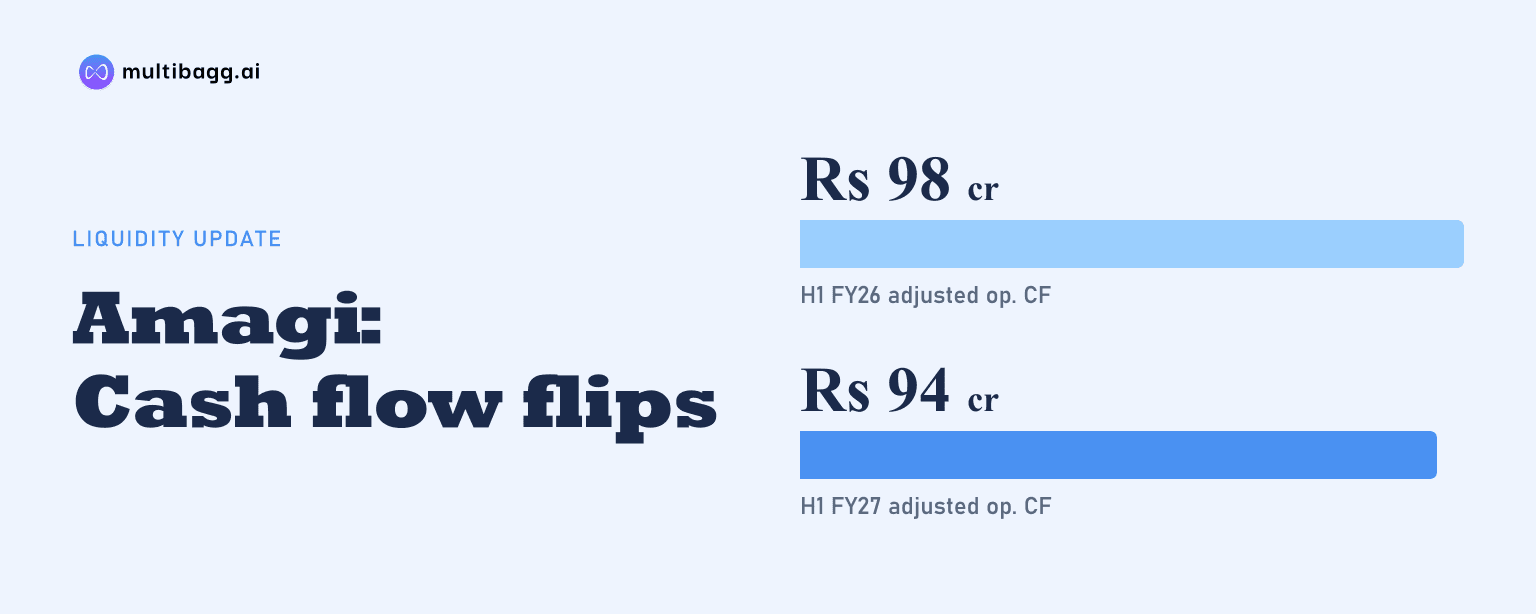
Amagi Media Labs Limited generated ₹94 crore of adjusted operating cash flow in H1 FY27, equal to 67% of adjusted EBITDA, reversing a ₹98 crore adjusted outflow in H1 FY26. Amagi also reported ₹1,774 crore of cash, bank balances and treasury investments, with zero debt, as of 30 September 2026.
Know Amagi Media Labs inside out
Results, valuation, peers and who's buying, in one view.
How did Amagi's operating cash flow change in H1 FY27?
Amagi moved to adjusted operating cash flow of ₹94 crore in H1 FY27 from an adjusted outflow of ₹98 crore in H1 FY26. Adjusted EBITDA, meaning earnings before interest, tax, depreciation and amortisation under the company's adjustment methodology, rose to ₹139 crore from ₹58 crore across the two six-month periods. The adjusted cash-flow swing was therefore ₹192 crore.
Reported operating cash flow was ₹69 crore in H1 FY27, compared with a reported outflow of ₹201 crore in H1 FY26. The reported FY27 figure equalled 49% of adjusted EBITDA, while the adjusted measure equalled 67% after excluding specified one-time working-capital items. Adjusted free cash flow was ₹85 crore, or 61% of adjusted EBITDA, after ₹9 crore of capital expenditure.
Amagi's H1 FY27 cash result accompanied revenue of ₹913 crore, up 30% year on year, and adjusted EBITDA growth of 139% year on year. The adjusted EBITDA margin increased by 7.0 percentage points to 15.3%. The presentation identifies these H1 figures as facts rather than guidance, so the 67% conversion rate does not constitute a full-year forecast.
What caused the gap between reported and adjusted cash flow?
Amagi's adjusted operating cash flow of ₹94 crore excluded ₹25 crore of IPO-related vendor payments settled during H1 FY27. These payments were included in reported working capital, resulting in reported operating cash flow of ₹69 crore. Working-capital movement was an outflow of ₹39 crore on a reported basis and ₹14 crore excluding the one-time IPO-related item.
The equivalent adjustment in H1 FY26 was ₹103 crore and related to an ESOP/SAR buyback. ESOP means employee stock option plan, while SAR means stock appreciation rights. Reported working-capital movement in H1 FY26 was an outflow of ₹248 crore, narrowing to ₹145 crore after excluding that item; reported operating cash flow was an outflow of ₹201 crore, versus an adjusted outflow of ₹98 crore.
The comparison therefore reflects both higher operating profit and smaller one-time working-capital payments. Non-cash and operating items changed from a positive ₹1 crore in H1 FY26 to a negative ₹5 crore in H1 FY27, while income tax paid increased to ₹26 crore from ₹12 crore. Capital expenditure declined to ₹9 crore from ₹14 crore, leaving adjusted free cash flow ₹9 crore below adjusted operating cash flow in H1 FY27.
Got a follow-up? Ask IRIS
How much cash and debt did Amagi have at September 2026?
Amagi held ₹1,774 crore of cash, bank balances and treasury investments and had zero debt on 30 September 2026. The cash and treasury balance increased by ₹110 crore from ₹1,664 crore on 31 March 2026, and the company stated that it was 161% higher year on year following the IPO.
Amagi's stated cash total includes fixed deposits reported under other current assets, which were ₹217 crore at 31 March 2026. This means the ₹1,774 crore measure extends beyond cash in bank accounts. The presentation does not provide a debt maturity schedule, interest-income figure or cash-deployment plan alongside the zero-debt disclosure.
The ₹110 crore increase in cash and treasury investments should not be treated as identical to the ₹85 crore adjusted free cash flow generated in H1 FY27. The presentation defines free cash flow as operating cash flow less net capital expenditure, but does not provide a line-by-line reconciliation between the six-month movement in cash and the adjusted free-cash-flow figure.
What has Amagi said about FY27 cash conversion?
Amagi has retained cash conversion as one of its three FY27 priorities, alongside durable revenue growth and operating leverage. Management describes cash conversion as turning profit into operating cash flow. In its say-do comparison, Amagi cited a full-year operating-cash-flow conversion range of 50% to 60% of adjusted EBITDA as what it had said, against H1 FY27 adjusted conversion of 67%.
The latest quarter provided a higher conversion result, with adjusted operating cash flow equal to 151% of adjusted EBITDA in Q2 FY27. Q2 FY27 revenue was ₹476 crore, up 27% year on year, while adjusted EBITDA was ₹89 crore and the margin was 18.7%. These quarterly results contributed to H1 revenue of ₹913 crore and adjusted EBITDA of ₹139 crore.
Management's FY27 operating-leverage priority is for costs to grow more slowly than revenue, while its growth priority is expansion-led growth in a stable band. The presentation also identifies risks to forward-looking statements, including earnings and revenue fluctuations, competition, growth management, technology and artificial-intelligence developments, customer concentration, currency movements, regulation and economic conditions.
Conclusion
Amagi's H1 FY27 result marked a change in underlying cash generation: adjusted operating cash flow reached ₹94 crore, compared with a ₹98 crore adjusted outflow a year earlier, as adjusted EBITDA increased to ₹139 crore from ₹58 crore. Reported operating cash flow also became positive at ₹69 crore, although the comparison includes ₹25 crore of IPO-related vendor payments in FY27 and a ₹103 crore ESOP/SAR buyback in FY26. The company ended September with ₹1,774 crore of cash and treasury investments and no debt.
The next disclosure to watch is whether Amagi sustains cash conversion through the remaining FY27 periods while pursuing its unchanged priorities of expansion-led growth, operating leverage and cash conversion. Management had cited a 50% to 60% full-year operating-cash-flow conversion range, while H1 adjusted conversion was 67% and Q2 conversion was 151%. Subsequent results can also clarify working-capital movements, capital expenditure and any plan for the ₹1,774 crore cash and treasury balance.