










Amagi lifts adjusted EBITDA margin to 18.7% in Q2 FY27
Key highlights
- Amagi reported Q2 FY27 revenue of Rs 476 crore, up 27% year on year.
- Amagi’s Q2 FY27 adjusted EBITDA was Rs 89 crore, producing an 18.7% margin.
- Amagi converted 47% of its Rs 101 crore year-on-year revenue increase into adjusted EBITDA.
- Amagi held Rs 1,774 crore of cash and treasury investments on 30 September 2026 with zero debt.
powered by IRIS
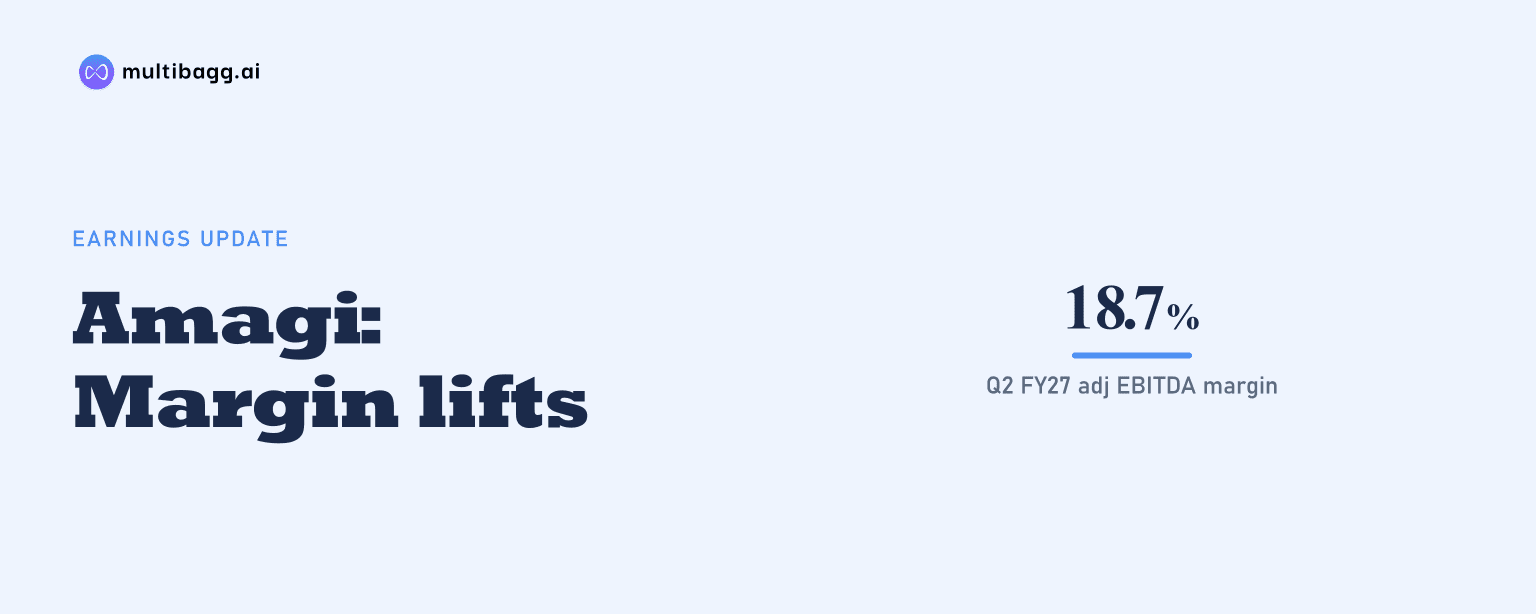
Amagi lifted its adjusted EBITDA margin to 18.7% in Q2 FY27 from 11.1% a year earlier, as Rs 47 crore of its Rs 101 crore revenue increase flowed into adjusted EBITDA. Revenue rose 27% to Rs 476 crore, while adjusted EBITDA increased 114% to Rs 89 crore.
Know Amagi Media Labs inside out
Results, valuation, peers and who's buying, in one view.
How did Amagi reach an 18.7% adjusted EBITDA margin?
Amagi reached an 18.7% adjusted earnings before interest, tax, depreciation and amortisation (adjusted EBITDA) margin by increasing adjusted EBITDA to Rs 89 crore in Q2 FY27 from Rs 42 crore in Q2 FY26. Revenue rose by Rs 101 crore to Rs 476 crore, while operating cost increased by Rs 54 crore to Rs 387 crore, leaving Rs 47 crore of additional adjusted EBITDA.
Amagi defines flow-through as the year-on-year change in adjusted EBITDA divided by the year-on-year change in revenue. Its 47% Q2 FY27 flow-through means Rs 47 of every Rs 100 of incremental revenue became additional adjusted EBITDA. Operating cost excludes employee stock option plan (ESOP) expense, depreciation and amortisation, finance cost and tax.
The comparison shows Amagi moving from a Rs 2 crore adjusted EBITDA loss in Q2 FY25 to Rs 89 crore of adjusted EBITDA in Q2 FY27. Revenue increased by Rs 198 crore over the two years, compared with a Rs 107 crore rise in operating cost, consistent with the company’s description of a progression from break-even to scaling.
Which costs drove Amagi's Q2 FY27 operating leverage?
Amagi attributed its 7.6-percentage-point year-on-year adjusted EBITDA margin expansion to lower relative spending in general and administrative costs, research and development, and sales and marketing. General and administrative costs contributed 3.5 percentage points, research and development 2.9 percentage points, and sales and marketing 2.8 percentage points, while gross margin reduced the gain by 1.6 percentage points.
Amagi reported a gross margin of 68.1% in Q2 FY27, equal to Rs 324 crore on revenue of Rs 476 crore. The gross margin was 0.8 percentage points higher quarter on quarter and within management’s stated 67% to 69% range. The 1.6-percentage-point year-on-year gross-margin effect means the net margin increase came from indirect operating-cost leverage rather than gross-margin expansion.
Amagi’s Q2 FY27 summary also showed indirect operating expenses declining to 49.3% of revenue from 58.6%, while ESOP expense was 5.3% of revenue. Profit after tax was Rs 75 crore, or 14.9% of total income, and its margin rose by 14.3 percentage points year on year. Amagi attributed 7.6 percentage points of that increase to adjusted EBITDA and 6.7 percentage points to ESOP, as Q2 FY26 included a one-time pre-initial public offering ESOP catch-up.
Got a follow-up? Ask IRIS
How did revenue and segment mix support Amagi's margin gain?
Amagi’s Q2 FY27 revenue grew 27% year on year to Rs 476 crore, or 33% excluding a Q2 FY26 revenue-recognition timing benefit in Cloud Modernization estimated at about 600 basis points. Constant-currency growth was 15%, rising to 21% on the same ex-base measure. The adjusted EBITDA margin increased to 18.7% from 11.1% alongside that revenue growth.
Streaming Unification represented 55% of Q2 FY27 revenue, up from 52% in Q2 FY26, and grew 35% year on year. Monetization & Marketplace remained 25% of revenue and grew 28%, while Cloud Modernization declined to 20% of revenue from 23% and grew 9% reported, or 36% excluding the prior-year timing effect.
Amagi reported trailing-12-month net revenue retention of more than 125% and had 15 customers generating more than US$1 million each in H1 FY27, compared with 11 in H1 FY26. Its top 10 customers represented 41% of revenue, unchanged year on year. For H1 FY27, revenue was Rs 913 crore, up 30%, while adjusted EBITDA was Rs 139 crore, up 139%, at a 15.3% margin.
Is Amagi converting higher profit into cash?
Amagi generated Rs 94 crore of adjusted operating cash flow in H1 FY27, equal to 67% of its Rs 139 crore adjusted EBITDA, compared with negative Rs 98 crore in H1 FY26 excluding one-time items. Adjusted free cash flow was Rs 85 crore, or 61% of adjusted EBITDA, after Rs 9 crore of capital expenditure.
Reported operating cash flow was Rs 69 crore and reported free cash flow was Rs 60 crore in H1 FY27. The adjusted figures exclude Rs 25 crore of initial public offering-related vendor payments settled during the half year. In H1 FY26, Amagi excluded Rs 103 crore of working-capital items related to an ESOP and stock appreciation rights buyback.
Cash, bank balances and treasury investments stood at Rs 1,774 crore on 30 September 2026, up Rs 110 crore from Rs 1,664 crore on 31 March 2026. Amagi reported zero debt at 30 September 2026. Its cash disclosure includes fixed deposits reported under other current assets, including Rs 217 crore at 31 March 2026.
Conclusion
Amagi’s Q2 FY27 profitability inflection reflected a Rs 101 crore year-on-year revenue increase against a Rs 54 crore increase in operating cost, producing Rs 47 crore of additional adjusted EBITDA. The resulting 47% flow-through lifted adjusted EBITDA margin by 7.6 percentage points to 18.7%, while gross margin remained within the stated 67% to 69% range.
The next measures to watch are Amagi’s unchanged FY27 priorities of expansion-led revenue growth, costs rising more slowly than revenue, and profit converting into operating cash flow. Management’s disclosed reference points include maintaining gross margin in the 67% to 69% range and improving cash conversion from the H1 FY27 level of 67% of adjusted EBITDA.