










Amara Raja reports 88% recycled share of lead alloy inputs
Key highlights
- Amara Raja says approximately 88% of its lead and lead alloys come from recycled sources.
- ARCSPL, Amara Raja's lead recycling facility, commenced operations in FY25.
- Amara Raja reports a 37% reduction in Scope 1 and 2 emissions intensity from FY22.
- Amara Raja reports an S&P Global ESG score of 77 out of 100, updated September 19, 2025.
powered by IRIS
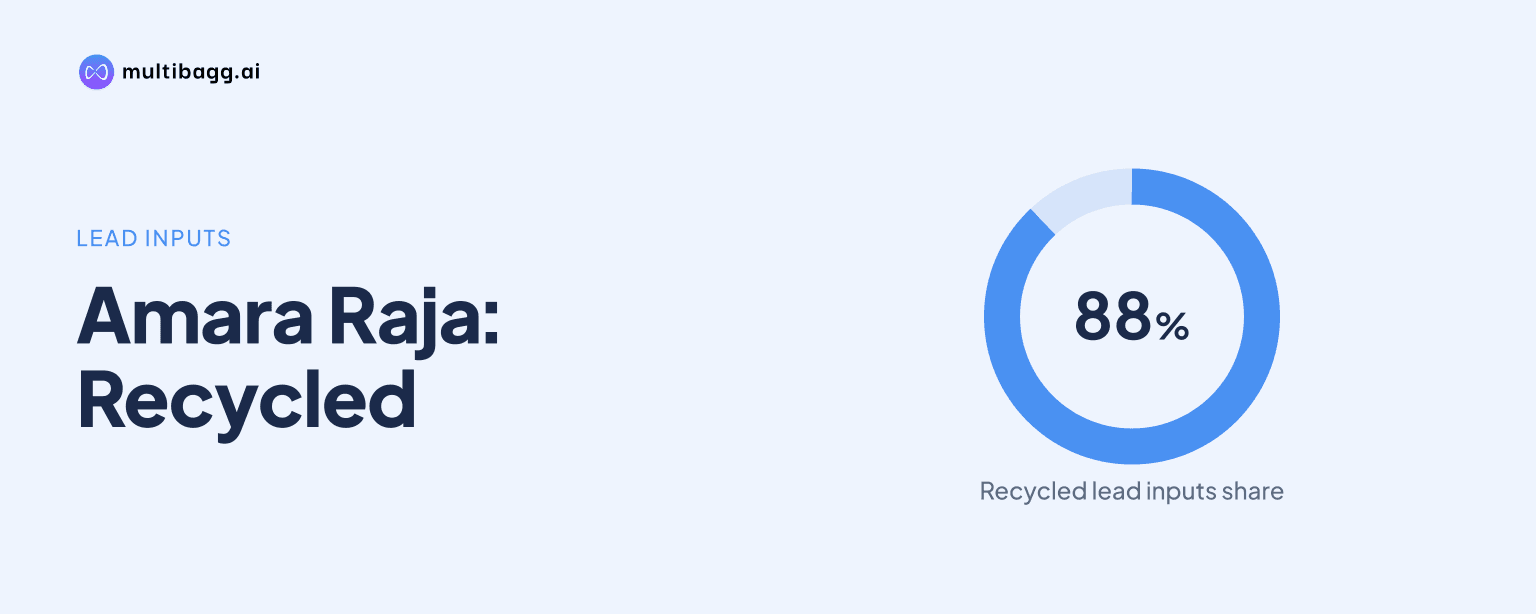
Amara Raja reports that about 88% of its lead and lead alloys come from recycled sources after ARCSPL, its lead recycling facility, commenced operations in fiscal year 2025 (FY25). The company also reports reductions from FY22 of 37% in Scope 1 and 2 emissions intensity, 57% in water intensity and 33% in waste intensity.
Know Amara Raja Energy & Mobility inside out
Results, valuation, peers and who's buying, in one view.
How much lead does Amara Raja source from recycling?
Amara Raja says approximately 88% of its lead and lead alloys come from recycled sources. This is the presentation's specific measure of circular sourcing in its lead-acid battery supply chain. ARCSPL, the company's lead recycling facility, commenced operations in FY25, linking the reported recycled-input share to an operating recycling asset rather than solely to a collection or procurement programme.
Amara Raja does not disclose an earlier recycled-lead percentage, tonnes processed or a recycling-volume target in the presentation. The extent of change in recycled sourcing since ARCSPL began operating therefore cannot be calculated from the available disclosure. The 88% figure applies to lead and lead alloys as material inputs, not to all materials used by the company.
Amara Raja also reports that 99% of manufacturing waste is recycled and that waste intensity has declined 33% from FY22. These are separate measures: the 99% figure concerns manufacturing waste, while the 88% figure concerns lead and lead-alloy inputs. The company also says it complies with the Battery Waste Management Rules, 2022 under Extended Producer Responsibility, which places battery-waste management responsibility on producers.
What environmental intensity changes has Amara Raja reported?
Amara Raja reports a 37% reduction in Scope 1 and Scope 2 emissions intensity from FY22, while renewable energy represented 21.82% of its energy use. Scope 1 covers direct emissions from owned or controlled sources, while Scope 2 covers indirect emissions associated with purchased energy. The company reports 67 megawatts of captive renewable capacity alongside the emissions-intensity reduction.
Amara Raja has committed to net zero by 2050, with its stated plan aligned to the Science Based Targets initiative (SBTi) pathway for limiting temperature increase to 1.5 degrees under the Paris Agreement. This is a management commitment rather than a reported achievement. The presentation does not provide annual absolute emissions, a base-year emissions total or interim emissions targets.
Amara Raja reports a 16% reduction in absolute water consumption and a 57% reduction in water intensity from FY22. The larger reduction in water intensity than in total water consumption indicates that water use per unit of the company's unstated activity measure fell faster than overall consumption. The presentation does not identify the production or revenue denominator used to calculate water intensity.
The company says all its manufacturing plants are zero-liquid-discharge facilities and are not located in water-stressed areas. It also reports third-party certification as a 12-times water-positive organisation and says it is a signatory to the WASH pledge. These water disclosures sit alongside the 57% intensity reduction, rather than providing a quantified year-on-year water-recycling volume.
Got a follow-up? Ask IRIS
How is Amara Raja extending circularity beyond lead recycling?
Amara Raja says it has conducted life-cycle assessments for 117 stock-keeping units (SKUs), representing 50% of total SKUs. A life-cycle assessment evaluates environmental effects across stages of a product's life, making it distinct from a recycled-content measure. The presentation does not disclose the results of the 117 assessments or say which products account for the other 50% of SKUs.
Amara Raja has also conducted trials to eliminate virgin plastic by using compostable plastic for industrial-battery packaging. The company does not state whether the trials have progressed to commercial deployment, quantify the plastic involved or provide a timetable. The disclosure therefore identifies a packaging initiative but does not establish a measured reduction in virgin-plastic use.
Supplier engagement covers more than 75% of domestic and international suppliers by value for engagement, capability building, target setting and assessments, according to Amara Raja. That coverage measure is based on supplier value, not on supplier count or the share that has adopted targets. The presentation does not give supplier assessment outcomes or specify recycled-material requirements for suppliers.
Management also says it is setting up 16 gigawatt-hours of lithium-cell capacity, nearly 5 gigawatt-hours of battery-pack assembly capacity and a 10 gigawatt-hours battery energy storage system (BESS) manufacturing facility. These are planned capacities rather than current operating capacities. The presentation does not provide completion dates, capital expenditure figures or recycled-material targets for these facilities.
How do external ESG assessments rate Amara Raja?
Amara Raja reports an S&P Global environmental, social and governance (ESG) score of 77 out of 100, last updated on September 19, 2025. Its Corporate Sustainability Assessment (CSA) score without modelling was 76 out of 100, compared with an industry CSA-score average of 30 out of 100. The presentation says modelling, used to fill reporting gaps, contributed one point to the ESG score.
Amara Raja reports rankings of first in India, second in Asia Pacific and fifth globally in its sector for the S&P Global assessment. The table shows that its social score of 82 was its highest category score, compared with 77 for environmental and 72 for governance and economic. Each category score was above the corresponding industry average reported in the presentation.
The company also reports a B rating for Climate Disclosure Project (CDP) Climate Change 2025 and an A- rating for CDP Water Security 2025. Amara Raja describes the A- water result as its maiden water disclosure. Its EcoVadis Silver Medal, dated October 2026, placed it in the top 15% of companies assessed globally, according to the presentation.
Other reported assessments include a five-star British Safety Council occupational health and safety audit rating in 2026 and an NSE ESG rating of 71. These external scores and ratings are separate from Amara Raja's operational metrics, such as the 88% recycled lead and lead-alloy share. The presentation does not provide prior-year scorecards for every assessor, so a full comparison of rating trends is not available.
Conclusion
Amara Raja's reported 88% recycled-source share for lead and lead alloys provides a specific circularity measure alongside reductions from FY22 of 37% in Scope 1 and 2 emissions intensity, 57% in water intensity and 33% in waste intensity. ARCSPL's FY25 start supplies an identified recycling operation behind the lead-input disclosure, while the 99% manufacturing-waste recycling figure measures a separate part of operations.
What to watch next is whether Amara Raja publishes recycled-lead volumes, a year-on-year comparison or a target beyond the current approximately 88% share. Management's 2050 net-zero commitment and plans for 16 gigawatt-hours of lithium-cell capacity, nearly 5 gigawatt-hours of pack assembly and 10 gigawatt-hours of BESS manufacturing leave delivery timing and material-sourcing details for future disclosures.