










Amara Raja targets 16 GWh cell capacity by FY2030 at Divitipally
Key highlights
- Amara Raja targets 16 GWh of cell capacity by FY2030 at Divitipally.
- Amara Raja plans 9 GWh of pack assembly and 10 GWh of BESS capacity.
- GIGA 1 is expected to commission in Q2-FY28 with 2 GWh of NMC capacity.
- Amara Raja's E-POSITIVE LAB started in October 2026 with more than 100 engineers and scientists.
powered by IRIS
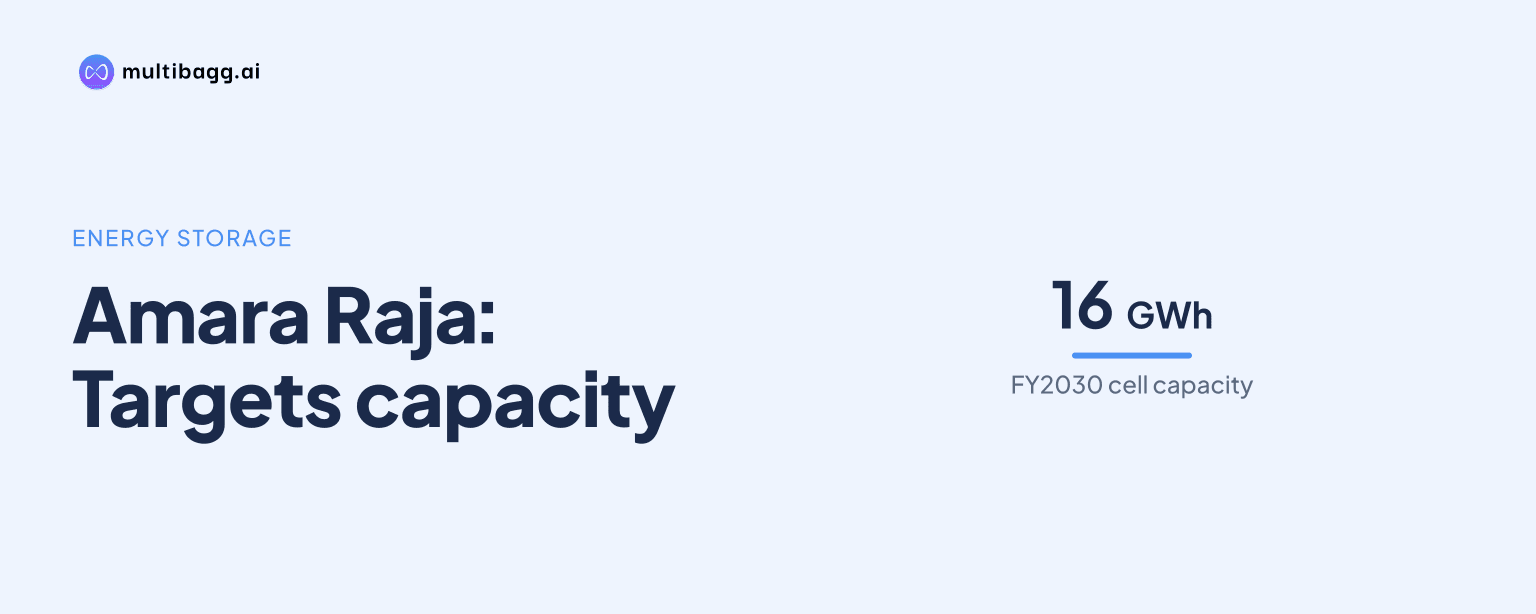
Amara Raja is targeting 16 GWh of cell capacity by FY2030 at Divitipally, alongside 9 GWh of pack assembly and a 10 GWh battery energy storage system facility. The plan includes a 2 GWh nickel manganese cobalt cell project expected in Q2-FY28, a 5 GWh lithium iron phosphate factory, and facilities for customer qualification and testing.
Know Amara Raja Energy & Mobility inside out
Results, valuation, peers and who's buying, in one view.
What capacities is Amara Raja planning at Divitipally?
Amara Raja is planning 16 GWh of cell capacity by FY2030, 9 GWh of pack-assembly capacity and 10 GWh of battery energy storage system, or BESS, capacity at Divitipally. The disclosed facilities span cell production, pack assembly and stationary energy-storage products, rather than a cell-manufacturing project alone.
The 16 GWh cell target is the largest individual capacity figure in the presentation. The 10 GWh BESS facility is 1 GWh larger than the 9 GWh pack plant, while the presentation does not disclose capital expenditure, annual output ramp, customer commitments or a commissioning date for the full 16 GWh target.
Amara Raja says the 9 GWh pack plant is intended to scale the pack business by entering new mobility applications and building a sustainable customer base. The 10 GWh BESS facility has a different stated role, supplying energy-storage solutions for commercial and industrial, or C&I, customers and grid applications.
How will Amara Raja build its 16 GWh cell target?
Amara Raja expects GIGA 1 to commission during Q2-FY28 with 2 GWh of capacity based on nickel manganese cobalt, or NMC, chemistry. This is the only dated cell-manufacturing commissioning milestone disclosed alongside the 16 GWh FY2030 target.
Amara Raja also says it is setting up a 5 GWh cell giga factory based on lithium iron phosphate, or LFP, chemistry. The identified 2 GWh NMC and 5 GWh LFP projects total 7 GWh, leaving 9 GWh of the 16 GWh FY2030 objective not broken out by project, chemistry or timing in the presentation.
The disclosed plan therefore names two cell chemistries: NMC for GIGA 1 and LFP for the 5 GWh factory. Amara Raja does not state whether the 5 GWh LFP facility will start before or after GIGA 1, nor does it allocate either chemistry between the 9 GWh pack operation, the 10 GWh BESS facility and other customers.
Got a follow-up? Ask IRIS
Which markets will Amara Raja's packs and storage systems serve?
Amara Raja says its 9 GWh pack-assembly plant will pursue new mobility applications, while the 10 GWh BESS-Giga Facility will serve C&I and grid applications. The presentation separates mobility-led pack growth from stationary energy-storage products by naming different end markets for the two facilities.
For the 9 GWh pack business, Amara Raja's stated mechanism is entry into new mobility applications and development of a sustainable customer base. The presentation does not identify vehicle categories, named customers, pack formats or a commissioning schedule for this capacity.
For the 10 GWh BESS project, Amara Raja identifies energy-storage solutions for both C&I users and grid applications. It does not disclose whether those BESS products will use NMC, LFP or another chemistry, and it gives no separate commissioning date for the facility.
How is Amara Raja qualifying products before larger-scale output?
Amara Raja says its E-POSITIVE LAB began operations in October 2026 with more than 100 engineers and scientists, a 2.2 lakh square foot E+ Lab research and development centre, and four test and validation labs. The facility can support material development and characterisation, cell and pack testing, and the building of cylindrical and prismatic cells.
The E+ Lab R&D Center has achieved IATF 16949:2016 and ISO 9001:2015 certification for lithium-ion batteries, according to the presentation. These certifications are disclosed alongside the 2.2 lakh square foot centre and four laboratories, not as additions to the 16 GWh cell, 9 GWh pack or 10 GWh BESS manufacturing capacities.
Amara Raja's Customer Qualification Plant, or CQP, commenced operations in July 2026, three months before the October 2026 start of the E-POSITIVE LAB. The CQP is a multi-chemistry, multi-form-factor pilot facility intended to support manufacturing innovation and customer qualification.
The CQP is designed to run pilot production and product optimisation for customer requirements, then validate processes before scaling. In comparison, the E-POSITIVE LAB adds testing and development capabilities across materials, cells and packs; neither facility is assigned a GWh capacity in the presentation.
Conclusion
Amara Raja's new-energy plan combines a 16 GWh FY2030 cell objective with 9 GWh of pack assembly and 10 GWh of BESS capacity at Divitipally. Its disclosed manufacturing programme covers two cell chemistries, NMC and LFP, while the July 2026 CQP start and October 2026 E-POSITIVE LAB start provide pilot-production, qualification and testing capabilities before larger-scale output.
The next disclosed manufacturing marker is GIGA 1's expected Q2-FY28 commissioning with 2 GWh of NMC capacity. The presentation leaves unresolved how the remaining 9 GWh needed for the 16 GWh FY2030 cell target will be added, as well as the timing, customer base and chemistry allocation for the 9 GWh pack and 10 GWh BESS facilities.