










Ambuja Cements Commits Rs 14,500 Crore for 30 MT Expansion
Key highlights
- Ambuja Cements plans about Rs 14,500 crore of spending for 14 projects adding about 30 million tonnes of cement capacity.
- The capacity programme includes 15.2 million tonnes in the West, 11.6 million tonnes in the East and 2.9 million tonnes in the North.
- Ambuja Cements plans 10.3 million tonnes of clinker capacity at Maratha, Umrangso and Mundra.
- Overall capacity utilisation was about 61% to 62% in Q2 FY27, with management targeting about 75% by FY27-end.
powered by IRIS
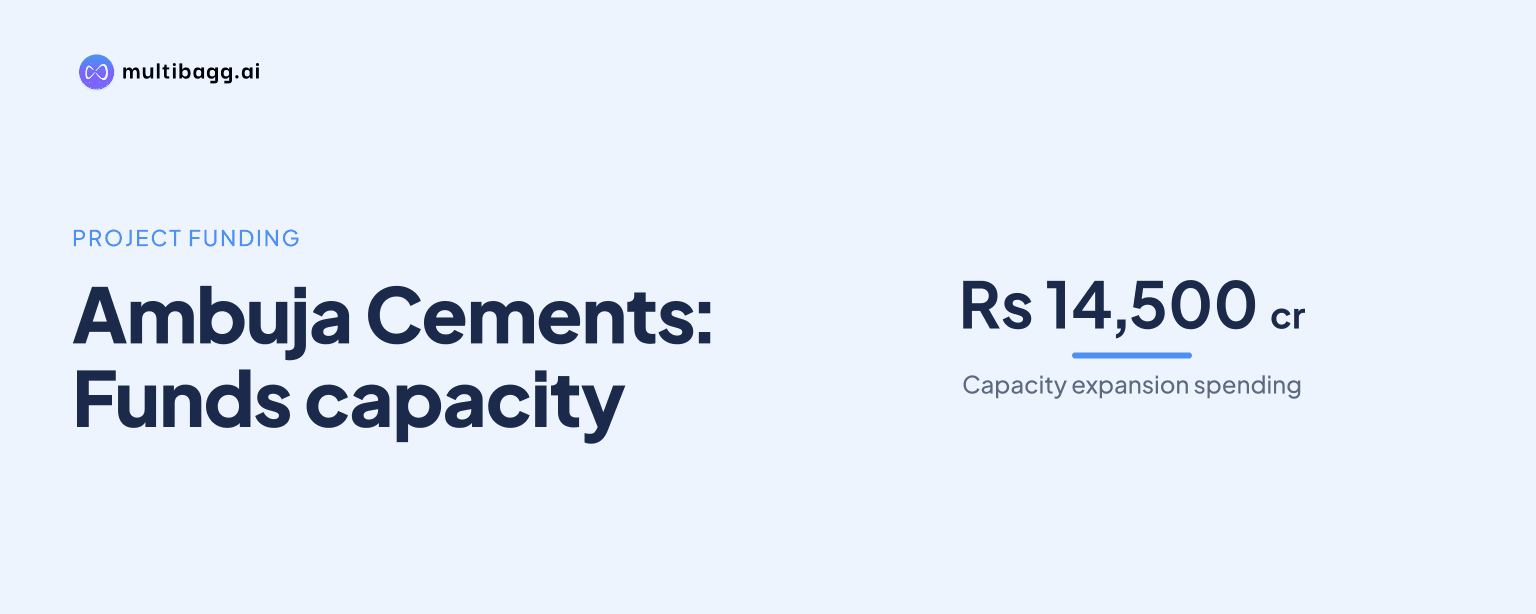
Ambuja Cements Limited plans to invest about Rs 14,500 crore in 14 projects that will add approximately 30 million tonnes of cement capacity and take its capacity to 155 million tonnes by FY30, according to management’s October 29, 2026 earnings call. The programme also includes 10.3 million tonnes of clinker capacity.
Know Ambuja Cements inside out
Results, valuation, peers and who's buying, in one view.
What is Ambuja Cements’ 30 million-tonne capacity plan?
Ambuja Cements is developing 14 projects to add about 30 million tonnes of cement capacity and 10.3 million tonnes of clinker capacity. Management said the programme follows its previously stated pathway, under which capacity is intended to rise from 113.5 million tonnes currently to 149 million tonnes and then 155 million tonnes by FY30.
The cement additions are concentrated in the West, East and North clusters, with the West accounting for just over half of the announced regional capacity. Clinker is the intermediate material used in cement production, and the three new clinker lines are intended to support the broader grinding network. Management described the investments as a mix of integrated units and grinding units.
Management initially said the company would reach 149 million tonnes by FY29 before reaching 155 million tonnes by FY30. In a later answer, however, it referred to 149 million tonnes in FY28 while discussing its cost target. The call transcript does not reconcile those two intermediate dates.
Where will Ambuja Cements add cement and clinker capacity?
Ambuja Cements plans western grinding additions at Mundra and Hazira in Gujarat, and Raigad, Kalyan, Amravati and Dahanu in Maharashtra. Management identified 2.9 million tonnes each at Mundra, Hazira, Raigad, Kalyan and Amravati, plus a 1 million-tonne bulk cement terminal at Dahanu, while describing the West cluster total as 15.2 million tonnes.
The East cluster plan comprises 2.9 million tonnes each at Rangia and Hojai in Assam, Godda in Jharkhand and Muzaffarpur in Bihar. The North cluster will receive a 2.9 million-tonne Dadri Line-2 project in Uttar Pradesh. Management said grinding closer to demand centres can lower the road lead for cement, even if clinker must travel longer distances by rail.
The clinker plan includes 4 million tonnes at Maratha in Maharashtra, 4 million tonnes at Umrangso in Assam and 2.25 million tonnes at Mundra. Management also cited surplus clinker at Sanghi, the operational Penna Jodhpur facility and Maratha Line-2 as inputs that support the planned grinding additions.
How will Ambuja Cements fund and execute the expansion?
Ambuja Cements expects the programme to cost about Rs 14,500 crore and said it should be self-sustainable from business cash flows over three years. Management said the company could use interim funding for specific requirements, but its current projection is for the programme to fund itself through operations.
At the end of Q2 FY27, Ambuja Cements reported net worth of Rs 72,238 crore, cash and cash equivalents of Rs 1,070 crore and no debt. Management cited those figures while discussing financial capacity, but it did not provide a project-level allocation of the Rs 14,500 crore expenditure or a forecast for external borrowing.
Management said it expects a grinding unit to take about 14 months to complete and an integrated unit to take about 18 months. It acknowledged contractor challenges in the earlier expansion phase, but said it has adopted a more robust scheduling approach. It also said many of the projects are brownfield additions at existing sites, which management expects to reduce construction risk.
Got a follow-up? Ask IRIS
Why is Ambuja Cements expanding despite weak first-half volumes?
Ambuja Cements said the latest expansion decision was not driven by a single quarter, but by the completion of the first wave of capital expenditure and a longer-term capacity plan. In Q2 FY27, it commissioned 4.6 million tonnes at Dahej in Gujarat, Salai Banwa in Uttar Pradesh and Kalamboli in Maharashtra.
Another 3.2 million tonnes at Bathinda in Punjab and Jodhpur in Rajasthan was stabilising in Q2 FY27, while 2.4 million tonnes at Warisaliganj in Bihar was expected to be commissioned in the second half of FY27. Management said the additional capacity and higher trade volumes should support volume growth ahead of the industry in that second half.
The sales trend was mixed in Q2 FY27. Consolidated cement sales volume was 16.5 million metric tonnes, while management described total volume as broadly flat year on year because business-to-business sales remained negative. Trade volume rose 8.6% year on year, and trade’s share of sales rose by 6 percentage points to 74%.
Product mix also shifted during the quarter. Premium products represented 37% of trade sales, up from 35% a year earlier, while blended cement rose to 82% of sales from 77%. Management said it aims to sustain an approximately 80:20 blended-cement-to-ordinary-Portland-cement mix, supported by fly ash availability.
What are the key risks and operating measures for Ambuja Cements?
Ambuja Cements’ capacity utilisation and the treatment of older assets are key variables for the expansion plan. Management put overall utilisation at about 61% to 62% in Q2 FY27 and said Penna and Sanghi were operating at roughly 50%. It expects overall utilisation to move closer to 75% by the end of FY27.
Management said some high-cost or less-efficient vintage grinding units could be run down or recalibrated as more efficient capacity comes on stream. It did not name the assets, quantify potential closures or specify how much capacity could be retired. The plan therefore may create surplus grinding capacity before any older units are adjusted.
Cost reduction is another stated part of the strategy. Total cost was Rs 4,410 per metric tonne in Q2 FY27, compared with management’s FY27 target of Rs 4,250 per metric tonne. Management also reiterated a FY28 operating-cost target of Rs 4,000 per tonne for the combined base of existing and new capacity.
Management cited a 20 million-tonne fly ash tie-up with group thermal-power plants, increased renewable-power use, waste-heat recovery and BCFC infrastructure for fly ash movement as mechanisms for cost improvement. Green power represented 61% of consumption in Q2 FY27, while net power cost was Rs 4.8 per unit, below Rs 6 per unit a year earlier but above Rs 4.3 per unit in Q1 FY27.
Conclusion
Ambuja Cements has attached a costed project programme to its planned rise to 155 million tonnes of capacity by FY30. The Rs 14,500 crore plan combines new grinding capacity in western, eastern and northern markets with upstream clinker additions, while management seeks to improve utilisation, increase blended cement sales and lower operating costs.
The next milestones are the second-half FY27 commissioning of Warisaliganj, the ramp-up of Bathinda and Jodhpur, and management’s target of about 75% utilisation by FY27-end. Investors will also watch for clarification of whether the 149 million-tonne milestone falls in FY28 or FY29, progress on the 14-project construction schedule, and any decision on older high-cost grinding assets.