










Ambuja targets 400 electric trucks by March 2027 for cost cuts
Key highlights
- Ambuja expects almost 400 electric trucks to operate by March 2027.
- More than 60% of Ambuja’s fuel mix is domestic, while imported fuel is below 40%.
- Ambuja reported Q2 blended fuel cost of Rs 1.87 per kcal, versus Rs 2.85 per kcal at the time of the call.
- Five Ambuja plants had moved into logistics service-level agreements, according to management.
powered by IRIS
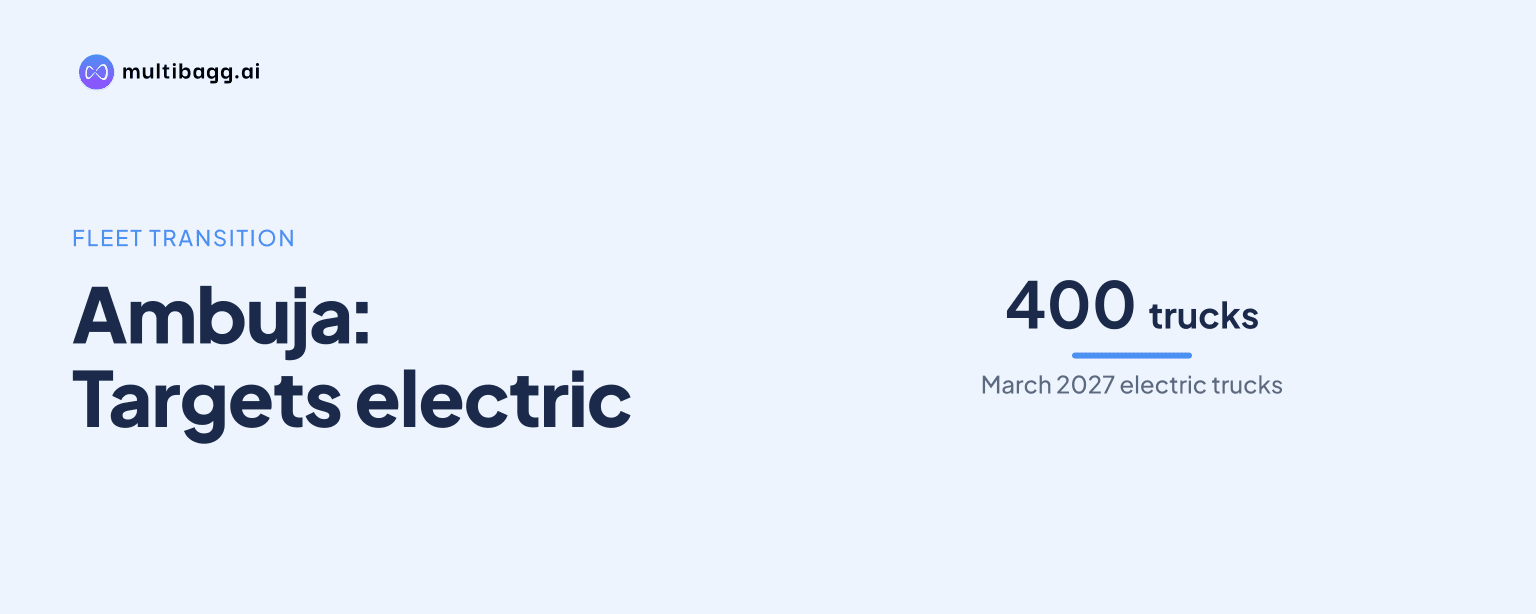
Ambuja Cements Ltd plans to have almost 400 electric trucks operating by March 2027 as part of a cost-reduction programme combining shorter freight leads, domestic coal, rail movement of fly ash and digital logistics. Management said domestic sources account for more than 60% of Ambuja’s fuel mix, providing an offset to higher imported-fuel costs.
Know Ambuja Cements inside out
Results, valuation, peers and who's buying, in one view.
How will Ambuja reduce freight costs?
Ambuja plans to reduce freight costs by lowering delivery distances, deploying almost 400 electric trucks and improving logistics execution. Management said the electric vehicles are expected to operate by March 2027, with some already stationed at Sanghi and further deployment planned from Ambujanagar. It did not disclose the expected saving per truck or per tonne of cement.
The shorter-lead strategy is linked to new facilities located nearer to customers. Management said average lead, the distance products travel to customers, fell in Q2 versus Q1 and should decline further as new facilities ramp up in Q3 and Q4. Ambuja did not disclose either quarter’s average lead distance or the associated freight-cost reduction.
Management described the programme as having investment-led and efficiency-led elements. Its market-facing grinding facilities include Kalyan, Dahanu and Amravati, which management cited while discussing capacity near demand centres. The stated mechanism is that lower transport distances can reduce logistics costs while helping the company serve those markets.
What is Ambuja’s domestic fuel strategy?
Ambuja is increasing its use of domestic fuel, which management said represents more than 60% of the fuel mix, while imported fuel is below 40%. Management put pet coke at about 10% to 12% of the total mix. It did not provide volumes from individual linkages, captive mines or coal blocks.
Management said domestic coal can contain high levels of fly ash, limiting its use for some producers, but said Ambuja has kilns capable of operating with it. The intended benefit is lower exposure to imported-fuel prices rather than protection from all fuel-price movements. Management reported a Q2 blended fuel cost of Rs 1.87 per kcal, versus an estimated Rs 2.2 per kcal spot cost at that time and Rs 2.85 per kcal at the time of the call.
The increase from about Rs 2.2 per kcal to Rs 2.85 per kcal illustrates the cost pressure that domestic fuel is intended to offset. Management said that if fuel costs rise beyond the escalation already factored in, price improvement would be the remaining available offset. It added that Ambuja had realised a Rs 10-per-tonne price increase in the first month discussed on the October 29, 2026 call.
How will Ambuja use rail movement of fly ash?
Ambuja expects rail-based fly-ash movement through BCFC, an acronym management did not define on the call, to support logistics savings. Management cited the movement of fly ash from Tiroda to Kalamboli as an example of a route that provides an advantage. It said it had mapped savings from such logistics routes and referred to a Government of India incentive scheme for BCFC.
Fly ash also supports Ambuja’s blended-cement model. Management said blended cement accounted for about 82% of sales and that it seeks to sustain an 80:20 ratio of blended cement to ordinary Portland cement, or OPC. Fly-ash availability therefore affects both product economics and the rail-routing opportunity, including sales to institutional customers.
Management did not disclose the fly-ash volume moved from Tiroda to Kalamboli, the railway incentive amount or the saving per tonne. It did report Q2 fly-ash sales revenue of Rs 25 crore, which was separate from the freight initiative. Sales revenue is operating income, while the BCFC route was presented as a logistics-efficiency measure.
Got a follow-up? Ask IRIS
Which digital tools and supplier arrangements will Ambuja use?
Ambuja is using Digipin mapping, its Cement Intelligent Network Operating Center, or CINOC, and transporter negotiations to identify logistics inefficiencies. Management said Digipin has been mapped across India and that the refreshed database incorporates historical information from ACC and Ambuja. The system is intended to improve order execution time, or OET, and identify inefficient backloading.
CINOC is intended to make logistics decisions more visible across Ambuja’s network. Management said the technology can help identify inefficiencies and support negotiations with transporters. It did not provide targets for OET, backloading reduction, truck utilisation or cost savings per tonne, so the financial outcome remains an expected benefit rather than a reported result.
Ambuja is also extending service-level agreements, or SLAs, from manufacturing into logistics. Management said new grinding units are being placed under SLA arrangements with vendor partners and named Salai Banwa among the facilities. It separately said five plants had moved into logistics SLAs, with positive feedback on automation and accountability.
Management gave no percentage target for capacity or logistics activity to be covered by vendor partners. It said the arrangements would expand as Ambuja and its partners became comfortable, rather than according to a fixed coverage ratio. The five-plant logistics rollout shows that the programme has started, but no before-and-after operating-cost comparison was disclosed.
Are Ambuja’s logistics measures included in cost guidance?
Yes, management said the electric-vehicle, domestic-fuel, rail, digital and SLA initiatives are already included in Ambuja’s cost guidance. Asked whether these newer measures were incremental to established cost targets, management said they were “all baked in.” It did not assign a separate guidance figure to the 400-truck programme, BCFC routes or logistics SLAs.
Ambuja is seeking to offset fuel inflation through several levers rather than a single measure. Management first identified domestic coal procurement and kiln operation, then potential price improvement if costs rose beyond reasonable levels. It expected progressive industry price increases in coming months, but this was management’s market assessment, not a company-specific pricing commitment.
The wider operating context includes Q2 capacity utilisation of about 61% to 62%, compared with management’s expectation of closer to 75% by the end of FY27. Management did not quantify the cost effect of higher utilisation on the freight programme. Execution will therefore depend on new-facility ramp-up, electric-truck deployment and the ability to maintain a domestic-fuel share above 60%.
Conclusion
Ambuja’s cost-reduction programme combines a target of almost 400 electric trucks by March 2027 with domestic fuel above 60% of the mix, shorter transport leads, BCFC-supported fly-ash rail routes and digital logistics controls. The measures address freight and fuel costs, while blended cement, at about 82% of sales, links fly-ash availability with both product mix and logistics planning.
The next disclosed markers are the March 2027 electric-fleet target, management’s expectation of further lead-distance reductions in Q3 and Q4, and progress at the five plants under logistics SLAs. Management also expects new facilities to help raise utilisation from about 61% to 62% in Q2 towards 75% by the end of FY27, although it has not disclosed a standalone savings target for the logistics measures.