










Annu Projects Limited collects Rs 73 crore, days at 192
Key highlights
- Annu Projects collected about Rs 73 crore in H1 FY27 from revenue recognised in the prior year.
- Annu Projects reduced receivable days by 45 to 192 from 237 in March.
- Trade receivables fell to Rs 142 crore from Rs 156 crore, while unbilled revenue declined to Rs 59 crore from Rs 76 crore.
- Annu Projects had used about Rs 54.4 crore of IPO proceeds for working capital as of September 30.
powered by IRIS
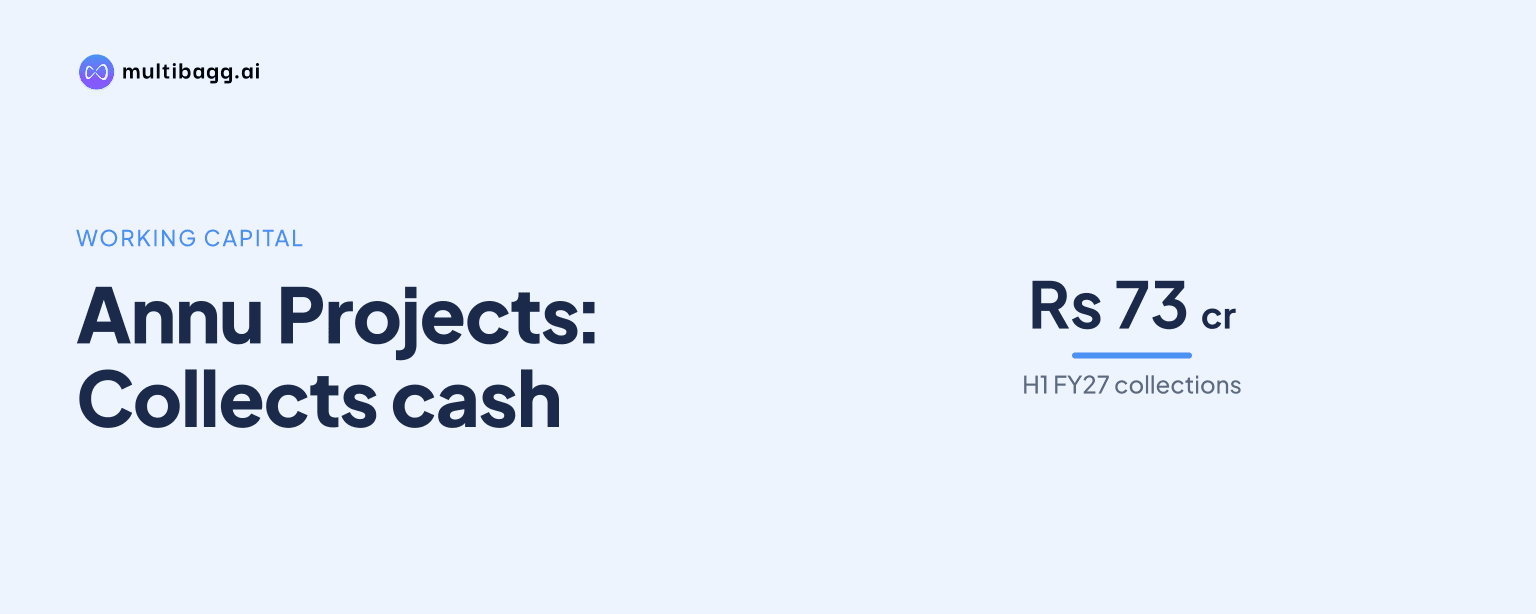
In H1 FY27, Annu Projects collected about Rs 73 crore from revenue recognised in the prior year, helping reduce receivable days to 192 from 237 in March, while trade receivables fell by Rs 14 crore and unbilled revenue declined by Rs 17 crore.
Know Annu Projects inside out
Results, valuation, peers and who's buying, in one view.
How did Annu Projects reduce receivable days in H1 FY27?
Annu Projects reduced receivable days by 45 days, to 192 currently from 237 in March, after collecting about Rs 73 crore during the first half from prior-year revenue. Management said much of that revenue had been recognised in the second half of the previous financial year and was either collected or in the process of collection during H1 FY27.
Trade receivables fell to Rs 142 crore from Rs 156 crore between March and the current period, while unbilled revenue declined to Rs 59 crore from Rs 76 crore. The combined balance of these two working-capital items was therefore Rs 31 crore lower. Management presented collections and lower receivable days as mechanisms to control the working-capital gap while project execution increases.
The Rs 73 crore collection figure and the Rs 31 crore reduction in reported receivables and unbilled revenue measure different movements and should not be treated as directly equivalent. The call did not provide an ageing schedule, project-level collection details, customer concentration, or a year-end target for receivable days.
How much IPO funding can Annu Projects use for working capital?
Annu Projects said Rs 115 crore of approximately Rs 175.06 crore of initial public offering, or IPO, proceeds was earmarked for working capital. Of the total proceeds, Rs 20.5 crore was earmarked for issue expenses and Rs 15.4 crore for machinery purchases, separating the disclosed working-capital allocation from planned equipment spending.
As of September 30, Annu Projects had used around Rs 70.3 crore of IPO proceeds, including Rs 54.4 crore primarily for working capital, with the remaining utilisation directed towards issue expenses. Based on the disclosed figures, Rs 60.6 crore of the Rs 115 crore working-capital earmark had not been reported as utilised at that date.
Management said future deployment would follow the IPO mandate and that working-capital funds were being used selectively. It also said it did not currently anticipate additional capital expenditure or funding requirements beyond IPO proceeds, a management statement that does not establish future project cash requirements or collection timing.
Got a follow-up? Ask IRIS
Why does second-half execution matter for Annu Projects' collections?
Annu Projects expects its engineering, procurement and construction, or EPC, execution and billing to be weighted towards the third and fourth quarters of FY27. Management cited FY26 as an example: revenue through H1 was Rs 6.51 crore, compared with full-year revenue of around Rs 241 crore, indicating that reported revenue was concentrated in the second half.
Management attributed this timing to milestone-based EPC billing, first-quarter government-fund approvals and monsoon disruption in the second quarter. It said a project may remain unbilled even when 99% of the work is complete if the final milestone required for billing has not been achieved.
That seasonal pattern means the H1 FY27 improvement in collections occurred before the period when management expects more work to be executed and billed. Greater second-half billing could increase receivables before collections are received, and the call did not provide targets for operating cash flow, debtor ageing, future collections or receivable days at the end of FY27.
What could affect Annu Projects' working-capital progress?
Annu Projects reported an order book of Rs 1,018 crore, whose contracts have different execution schedules. Management said maintenance projects can extend for six to 10 years, while EPC projects are generally delivered in two to three years, making the timing of revenue, billing and collections dependent on individual project terms.
The BharatNet Kerala project illustrates a current execution dependency. Management cited about Rs 741 crore of order-book value for the project, including around Rs 260 crore of maintenance work, while the EPC portion awaits right-of-way permission. It said construction would begin after clearance is received and expressed hope that the permission would arrive shortly, without providing a revised completion date.
Management also said it had bid for nearly Rs 3,000 crore of tenders, expected a letter of intent for around Rs 125 crore during the month of the call, and hoped to secure orders of more than Rs 2,000 crore by March-end. These are management expectations rather than awarded work; commencement dates, milestone structures and payment terms would determine their effect on working capital.
Conclusion
Annu Projects has reported measurable H1 FY27 working-capital progress: about Rs 73 crore of prior-year revenue collections, a Rs 14 crore reduction in trade receivables, a Rs 17 crore fall in unbilled revenue and 45 fewer receivable days than in March. The company also had an identified funding source, having used Rs 54.4 crore of IPO proceeds for working capital as of September 30.
The next issue is whether second-half EPC execution converts into certified billings and collections without reversing the reduction to 192 days. Management has identified order-book size, upcoming projects and execution as milestones to track, while right-of-way clearance for the BharatNet Kerala EPC work and its stated target of more than Rs 2,000 crore of orders by March-end remain unresolved or prospective developments.