










Ansal Properties and Infrastructure Limited pledge covers 34.9%
Key highlights
- The 25 August 2023 deed covered 5,49,33,816 APIL shares, or approximately 34.90% of equity.
- The pledged shares secured obligations linked to up to Rs 27 crore of APPL debentures.
- APIL’s issued and paid-up equity capital was Rs 78.70 crore, divided into 15,74,04,876 shares.
- The deed provides a two-business-day cure notice before an instructed pledge invocation.
powered by IRIS
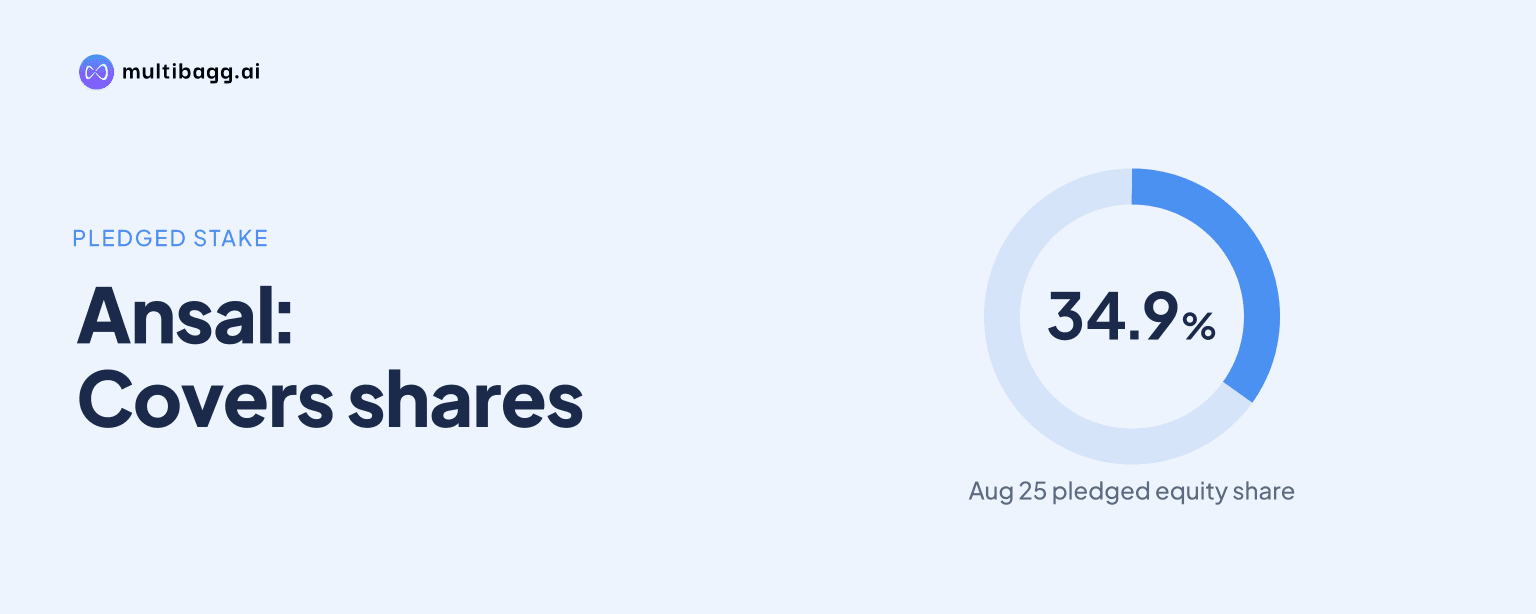
Ansal Properties and Infrastructure Limited’s 25 August 2023 pledge deed covered 5,49,33,816 equity shares, representing about 34.90% of its equity, to secure up to Rs 27 crore of debentures issued by Amarnath Properties Private Limited. The deed provides for voting rights over the pledged shares to move to the trustee after an Event of Default.
Know Ansal Properties & Infrastructure inside out
Results, valuation, peers and who's buying, in one view.
What financing did the APIL share pledge secure?
The APIL share pledge secured obligations linked to up to Rs 27 crore of non-convertible, redeemable debentures issued by Amarnath Properties Private Limited, referred to in the deed as APPL. The debentures had a face value of Rs 10 each, could be issued in one or more tranches, and carried a stated interest rate of 25% a year, payable on the final maturity date or final settlement date, whichever came earlier.
The shares were pledged to Vistra ITCL (India) Limited as share pledge trustee for DMI Alternative Investment Fund - Special Opportunities Scheme, described as the investor and debenture holder. The deed says the pledge was a pari passu charge, meaning it secured the debentures alongside the specified existing facilities, and remained a continuing security until the final settlement date despite any intermediate payment or partial satisfaction of obligations.
The collateral was not limited to the initial 5,49,33,816 APIL shares. It also included rights attached to them, dividends, distributions, buy-back proceeds and additional securities acquired through routes including subscription, conversion, rights, bonus issues or options. The pledgors agreed to add securities where required so that the pledge represented at least 34.90% of APIL equity on a fully diluted basis until the final settlement date.
How large was the APIL share pledge in 2023?
The deed states that the pledged 5,49,33,816 APIL shares represented approximately 34.90% of the company’s equity on the deed date. APIL’s issued and paid-up equity capital was stated as Rs 78.70 crore, divided into 15,74,04,876 equity shares with a face value of Rs 5 each.
The 34.90% threshold applied not only to the original pledged shares but also to any additional securities the pledgors acquired after the deed’s execution. The document defines a fully diluted basis as assuming conversion into equity of convertible securities, options, warrants or similar instruments under their terms and applicable law.
The deed does not say the trustee had invoked the pledge, sold any shares or exercised voting rights as of the document date. Its provisions instead establish the security, maintenance requirements and enforcement rights that would apply if an Event of Default, defined by reference to the 4 August 2023 debenture subscription agreement, occurred and continued.
When can the trustee vote APIL’s pledged shares?
Before an Event of Default, the pledgors retain voting and consequential rights over the pledged APIL shares under clause 2.3. Those rights are restricted because the pledgors cannot vote for resolutions that alter the trustee’s rights, prejudice the pledged securities or result in an APIL securities issuance contrary to the transaction documents.
After an Event of Default occurs, the pledgors’ voting rights cease forthwith under the deed. Vistra ITCL (India) Limited or its nominee is irrevocably authorised to attend meetings of APIL members, classes of members or creditors and exercise voting rights over the pledged securities in the manner it considers fit.
The pledgors were required to lodge the deed and powers of attorney with APIL so that the trustee or its nominee could act, including through a proxy or attorney. APIL was also required to issue meeting notices to the trustee when notices were sent to shareholders or creditors, giving the trustee access to meetings involving the 34.90% pledged stake.
Cash dividends, interest and other distributions could remain with the pledgors until an Event of Default, subject to the deed. However, non-cash dividends, liquidation or capital-reduction distributions, and cash arising from buy-backs or exchanges were to be delivered to the trustee as collateral whether or not an Event of Default had occurred.
Got a follow-up? Ask IRIS
What happens if the APIL pledge is invoked?
If an Event of Default occurs and continues, the investor may instruct the trustee to enforce the pledge, receive payments connected with the collateral, register securities in its or its nominee’s name, vote the shares and sell all or part of the collateral. Sale proceeds are to be applied against the obligations under the transaction documents.
Clause 6 sets out a two-business-day cure process. Following written investor instructions, the trustee must give the pledgors two business days’ notice to cure the Event of Default; if the default is not cured to the investor’s satisfaction, the trustee must invoke all or a specified number of pledged shares no later than one business day after receiving those instructions.
The investor may direct invocation in tranches rather than over the entire 34.90% pledged stake at once. Once shares are invoked, the trustee may sell or dispose of them under investor instructions through a private sale or another method, and may impose sale conditions or sell to a person connected with the investor.
The deed says any surplus remaining after payment in full of all obligations is to be paid to the pledgors on a proportionate basis or to another person lawfully entitled to receive it. The pledgors also waived pre-emption rights they might have under APIL’s memorandum and articles of association in relation to a sale under the deed’s power-of-sale provisions.
What obligations did the APIL pledgors accept?
The pledgors agreed to maintain the pledged securities at not less than 34.90% of APIL equity until the final settlement date. They also agreed not to create another charge over the collateral, transfer or dispose of it outside the deed’s terms, or permit actions that diluted or prejudiced the trustee’s security interest.
The deed required the pledgors to make filings, registrations and disclosures necessary to create and protect the security interest, including disclosures under the Securities and Exchange Board of India regulations where applicable. It also required them to provide information and reports about the pledged shares when reasonably requested by the trustee.
A failure to create the agreed security interest within 60 days of the allotment date, or within a written extension allowed by the investor, would constitute an Event of Default under the debenture subscription agreement. The deed therefore links the validity and perfection of the 34.90% share pledge to the underlying Rs 27 crore financing arrangement.
Conclusion
The 25 August 2023 deed placed 5,49,33,816 APIL shares, equal to about 34.90% of equity, behind up to Rs 27 crore of APPL debentures. It gave the trustee a security package extending to the shares, related proceeds and later-acquired securities, while reserving shareholder voting rights to the pledgors only before an Event of Default.
The next matter to watch is whether an Event of Default under the 4 August 2023 debenture subscription agreement is declared and whether it is cured within the deed’s two-business-day notice period. The deed also requires the 34.90% equity threshold to be maintained until the final settlement date, but it does not disclose that date or the subsequent status of the pledge.