










APIL's 2016-26 forensic audit flags Kundli valuation gap
Key highlights
- APIL's forensic audit covers 1 April 2016 to 31 March 2026 and was initiated with effect from 19 August 2026.
- APIL cited a 9 February 2023 Kundli sale recorded at about Rs 12.75 crore against a stated circle-rate valuation above Rs 100 crore.
- The proposed 23 November 2026 EGM sought removal of 6 directors and appointment of 8 directors.
- Public shareholders held approximately 51% of APIL's paid-up equity share capital in the quarter ended 30 September 2026.
powered by IRIS
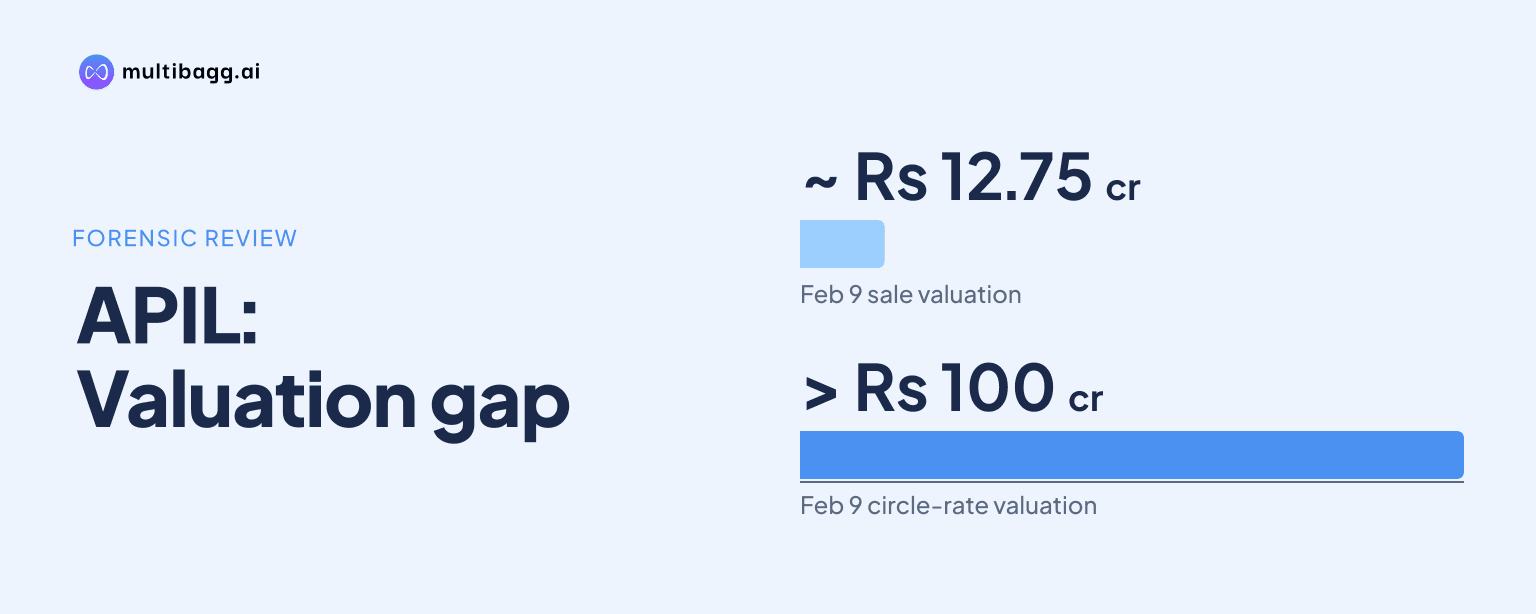
Ansal Properties & Infrastructure Ltd (APIL) has begun a forensic audit of transactions from 1 April 2016 to 31 March 2026, citing for scrutiny a 9 February 2023 Kundli property sale recorded at about Rs 12.75 crore against an applicable circle-rate valuation that it stated exceeded Rs 100 crore.
Know Ansal Properties & Infrastructure inside out
Results, valuation, peers and who's buying, in one view.
What does APIL's forensic audit cover?
APIL's forensic audit covers 10 financial years from 1 April 2016 to 31 March 2026 and was initiated with effect from 19 August 2026. The board resolution concerning the appointment of SLO Technologies Private Limited, referred to as AdvaRisk in the filing, is dated 20 August 2026. APIL said the review is intended to independently examine historical financial and commercial transactions and ascertain accountability where warranted.
The scope includes possible undervaluation of land, properties and other assets; related-party and connected-party dealings; and transactions without adequate supporting documents, corporate approvals or commercial justification. It also covers the utilisation of borrowed funds, including possible diversion or misapplication, as well as customer receipts, designated accounts and project-specific funds during the 2016-26 period.
APIL described these matters as areas requiring examination rather than established findings. The company said the review is designed to assess whether historical transactions caused financial prejudice to APIL and its shareholders, including through asset disposals, financial arrangements or related-party dealings. The filing does not disclose a completed forensic-audit report or any final conclusion on the transactions under review.
Why did APIL cite the Kundli property sale?
APIL cited the 9 February 2023 sale of a property at Ansal Highway Plaza, Kundli, as an illustrative transaction requiring independent scrutiny. The filing said the sale deed in favour of M/s Kamadgiri Properties recorded consideration of about Rs 12.75 crore, while the applicable circle-rate valuation at the relevant time exceeded Rs 100 crore.
APIL said the difference between the recorded price and the stated circle-rate valuation warrants review of the transaction's commercial rationale, valuation reports, approvals and execution circumstances. It did not state that the circle rate was the final market value, nor did it state that the transaction constituted proven undervaluation.
The Kundli sale is within the 1 April 2016 to 31 March 2026 audit window and is one example among historical asset disposals, related-party dealings and financing arrangements under examination. APIL said AdvaRisk's review will determine whether any actions caused prejudice to the company, meaning the Rs 12.75 crore sale remains subject to the audit rather than a concluded finding.
How is the forensic audit linked to the proposed EGM?
APIL said the requisition for an extraordinary general meeting, or EGM, came shortly after the 20 August 2026 board resolution on the forensic auditor's appointment. A requisition dated 8 September 2026, from shareholders described in the filing as the Requisitionists, sought to remove six directors and appoint eight directors under Section 100 of the Companies Act, 2013.
The EGM was scheduled for 23 November 2026 at 1:00 PM at The Roseate House, Aerocity, New Delhi. APIL alleged that the timing of the proposed board reconstitution could disrupt the examination of transactions conducted during the former promoter group's tenure. That concern is APIL's position in its representation and not a finding from the audit or a ruling by a regulator.
APIL also disputed the validity of the EGM process, citing the mode and timing of the requisition's delivery, the authenticity of certain signatures, candidate documentation and statutory deposits. The company further alleged that the EGM communication lacked complete electronic-voting particulars, an operational remote e-voting facility, disclosed scrutineer details and a voting cut-off date.
The filing says the requisition bore the date 8 September 2026, was initially transmitted by email on 13 September 2026 and had an alleged postal dispatch date of 13 October 2026. APIL said it raised its delivery objection with the Requisitionists on 1 October 2026. These are procedural objections put forward by APIL; the disclosure does not report a final determination on them.
Got a follow-up? Ask IRIS
What is APIL's insolvency and board context?
APIL entered the Corporate Insolvency Resolution Process, or CIRP, on 25 February 2025 after the National Company Law Tribunal admitted an application by IL&FS Financial Services Limited under Section 7 of the Insolvency and Bankruptcy Code, 2016. The National Company Law Appellate Tribunal upheld the admission on 7 January 2026 while confining CIRP to the concerned projects, according to the filing.
APIL said its current board was reconstituted on 3 February 2026 and 5 February 2026. Public shareholders held approximately 51% of APIL's paid-up equity share capital in the quarter ended 30 September 2026, while the company said three present directors had initially been appointed effective 3 February 2026 by Pranav Ansal.
The filing also refers to personal insolvency proceedings involving Pranav Ansal and Sushil Ansal, each admitted on 28 August 2024. APIL said that four cheques of Rs 1 lakh each, totalling Rs 4 lakh, were submitted through the HUF of which Pranav Ansal is Karta for statutory deposits connected with proposed director candidates in an October 2026 communication.
APIL said the source and permissibility of the Rs 4 lakh deposits required examination in light of the personal insolvency proceedings and any applicable moratorium. The company did not disclose an adjudicated outcome on those cheques, the proposed candidates or the question of whether the deposits were permissible.
What action did APIL seek from SEBI and the tribunal?
APIL sought an ad-interim order in a 19 November 2026 representation to the Securities and Exchange Board of India, or SEBI, and the stock exchanges. It asked that the Requisitionists and persons acting with them be restrained from taking steps pursuant to the EGM process pending completion of the forensic audit and SEBI's examination of the matters raised.
At its 20 November 2026 meeting, held from 5:00 PM to 5:45 PM, APIL's board noted and discussed the representation. APIL also said it had filed a petition before the National Company Law Tribunal, New Delhi Branch, and civil-contempt proceedings as remedial measures concerning the proposed 23 November 2026 EGM.
APIL further contended that the Requisitionists lacked voting rights at the proposed EGM under the binding and irrevocable terms of a deed of pledge dated 25 August 2023. This is APIL's stated legal position, not a SEBI order or tribunal ruling disclosed in the filing. The company said it was seeking to protect its forensic review, records and stakeholder interests while the dispute was examined.
Conclusion
APIL's disclosure combines a 10-year forensic review with a dispute over control of its board. Its most specific transaction is the 9 February 2023 Kundli sale, recorded at about Rs 12.75 crore against a stated applicable circle-rate valuation above Rs 100 crore. APIL has presented that comparison as a reason for independent scrutiny, not as a final finding of wrongdoing.
The next disclosed matters are the EGM scheduled for 23 November 2026, APIL's proceedings before the National Company Law Tribunal and the completion of AdvaRisk's review of 1 April 2016 to 31 March 2026 transactions. The filing leaves unresolved whether the EGM will proceed, whether APIL's voting-rights position will prevail and what the audit will conclude about the historical transactions.