










Ansal Properties asks SEBI to halt November 23 board EGM
Key highlights
- APIL has sought an interim halt to the EGM scheduled for November 23, 2026.
- The proposed EGM would remove 6 directors and appoint 8 new directors, according to APIL.
- APIL’s forensic audit covers transactions from April 1, 2016 to March 31, 2026.
- APIL cited a February 2023 asset sale at approximately Rs 12.75 crore against a stated circle-rate valuation exceeding Rs 100 crore.
powered by IRIS
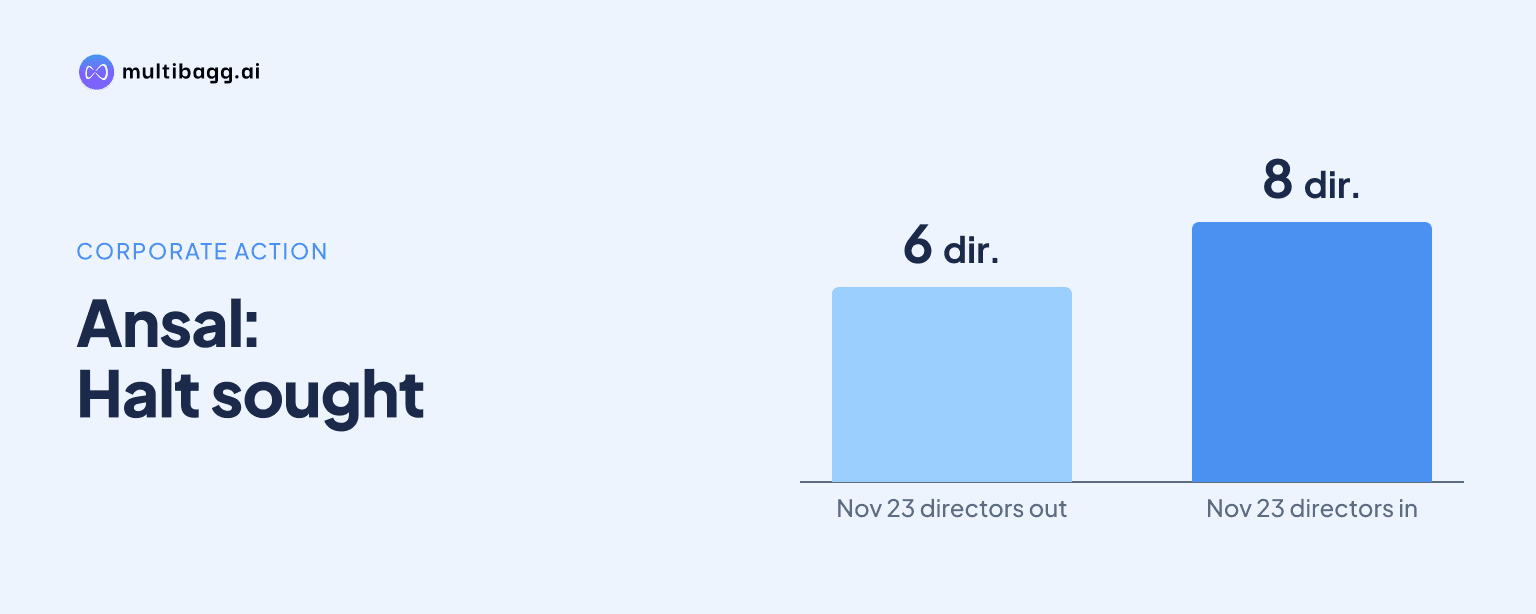
Ansal Properties and Infrastructure Ltd. has asked the Securities and Exchange Board of India to halt a November 23, 2026 extraordinary general meeting proposing the removal of six directors and appointment of eight new directors, saying it could disrupt a forensic audit of transactions from April 1, 2016 to March 31, 2026.
Know Ansal Properties & Infrastructure inside out
Results, valuation, peers and who's buying, in one view.
Why does APIL want the November 23 EGM stopped?
APIL wants the November 23, 2026 extraordinary general meeting, or EGM, stopped pending completion of its forensic audit and regulatory examination of the issues it has raised. The company identifies Mr. Sushil Ansal, Mr. Pranav Ansal, Mrs. Sheetal Ansal and M/s Pranav Ansal & Sons HUF as requisitionists under a requisition dated September 8, 2026.
The proposed resolutions would remove six existing directors and appoint eight directors, according to APIL’s representation to regulators. APIL says this would amount to a wholesale reconstitution of its board and could affect management and control while the auditor examines 10 financial years, from April 1, 2016 through March 31, 2026.
APIL says its board approved the forensic auditor’s appointment on August 20, 2026, with the audit initiated with effect from August 19, 2026. The company has asked the Securities and Exchange Board of India, or SEBI, to examine the timing because the September 8 requisition followed the appointment and the audit includes transactions during Mr. Pranav Ansal’s tenure as chairman. These are APIL’s allegations, not findings by SEBI.
What is APIL’s forensic audit examining?
APIL says the forensic audit covers historical financial and commercial dealings over the April 2016 to March 2026 period. Its stated scope includes possible undervaluation of land and other assets, related-party transactions, use of borrowed funds, customer receipts, designated accounts, project-specific funds and transactions lacking supporting documents or corporate approvals.
The company cited a sale deed dated February 9, 2023 involving Ansal Plaza, Kundli, as one transaction requiring scrutiny. APIL says the recorded consideration was approximately Rs 12.75 crore, while the applicable circle-rate valuation exceeded Rs 100 crore, and has called for examination of valuations, approvals, commercial rationale and the circumstances of that sale.
APIL has not reported a concluded finding of undervaluation in relation to the February 2023 transaction. It says a board change before the audit concludes could affect the preservation and availability of records, documents and electronic data needed for the review of transactions over the 10-year audit period.
What defects does APIL allege in the EGM process?
APIL alleges that the requisition was not validly delivered under Section 100(3) of the Companies Act, 2013. It says the document dated September 8, 2026 was first transmitted by email on September 13, 2026, rather than delivered at its registered office in the required manner, and that it communicated this objection to the requisitionists on October 1, 2026.
The company says the alleged postal dispatch occurred on October 13, 2026, creating a gap between the date on the requisition and its subsequent transmission. APIL also disputes the authenticity of signatures attributed to Mr. Sushil Ansal and Mrs. Sheetal Ansal, saying it observed material differences against specimen signatures held by the company.
APIL says the EGM notice was dated October 27, 2026 and a public notice was published in The Pioneer on November 5, 2026. It alleges that the EGM communication lacked an electronic-voting event number, complete voting particulars, an operational remote e-voting facility, disclosure of a scrutinizer and a cut-off date for determining shareholders eligible to vote.
The company also raises questions over four cheques of Rs 1 lakh each, aggregating Rs 4 lakh, furnished on October 13, 2026 as statutory deposits for proposed candidates under Section 160. APIL says the cheques were drawn on the account of M/s Pranav Ansal & Sons HUF and has sought examination in light of personal insolvency proceedings disclosed in its representation.
Got a follow-up? Ask IRIS
How do the NCDRC orders feature in APIL’s case?
APIL says the proposed board reconstitution may conflict with directions of the National Consumer Disputes Redressal Commission, or NCDRC. It cites an April 29, 2026 order in Execution Application No. 77 of 2021 that reiterated status quo regarding APIL’s assets and included directions concerning transfer of shareholding, management and control.
The NCDRC reiterated compliance with the April 29 direction in an order dated November 4, 2026, according to APIL. The company says paragraph 15(a) of the April 29 order could make an action involving management or control after April 8, 2026 non-binding and void ab initio, and has asked SEBI and the exchanges to assess the EGM’s implications.
APIL also refers to Sections 115, 149, 152, 160, 161, 164, 169 and 196 of the Companies Act, 2013 in relation to the proposed director changes. It says removal of independent directors must meet applicable safeguards under the SEBI Listing Obligations and Disclosure Requirements Regulations, including a special resolution in relevant circumstances.
The company’s request does not state that the NCDRC, SEBI, BSE Limited or National Stock Exchange of India Limited has ruled that the November 23, 2026 EGM breaches any order or law. APIL seeks examination before any board-composition filing or EGM outcome is acted upon.
What intervention has APIL requested from SEBI and exchanges?
APIL has requested ad-interim directions before November 23, 2026 restraining the requisitionists and parties acting with them from convening or proceeding with the EGM. It also seeks restrictions on voting over director appointments or removals and management or control matters until the forensic audit and SEBI’s examination are completed.
The company has asked that its registrar and share transfer agent not provide e-voting for the proposed EGM and that no outcome or consequential corporate filing be disseminated, recorded or acted upon without verification. APIL seeks review of the September 8 requisition, October 27 notice, voting arrangements, signature concerns and director eligibility.
APIL has additionally requested examination of trading in its shares from August 20, 2026 onwards, including trades by the requisitionists and connected persons. It seeks to rule out trading based on unpublished price-sensitive information under the SEBI Prohibition of Insider Trading Regulations, 2015; the filing does not say that SEBI has opened an inquiry or reached a conclusion.
Conclusion
APIL’s representation describes a corporate-governance dispute over a November 23, 2026 EGM that would remove six directors and appoint eight, while a forensic audit reviews dealings from April 1, 2016 to March 31, 2026. Its case relies on alleged requisition and voting deficiencies, the potential relevance of NCDRC directions, and concerns that a board overhaul could affect the audit. None of those allegations is presented as a regulatory finding.
The immediate development to watch is whether SEBI, BSE Limited or National Stock Exchange of India Limited issues an interim direction before November 23, 2026. APIL has also asked that the forensic audit be completed independently, records for the April 2016 to March 2026 period be preserved, and regulators examine the requisition, voting process, management-control issues and trading from August 20, 2026 onward.