










Anuh Pharma Limited Lifts API Capacity to 2,975 MTPA
Key highlights
- Anuh Pharma inaugurated Tarapur Unit F-10 on 20 October 2026.
- F-10 adds 575 MTPA, taking Anuh Pharma's stated total API capacity to 2,975 MTPA.
- The new facility has approximately 69 KL of reactor capacity across two API blocks and one intermediate block.
- F-10 occupies approximately 9,500 square metres in MIDC Tarapur, Boisar.
powered by IRIS
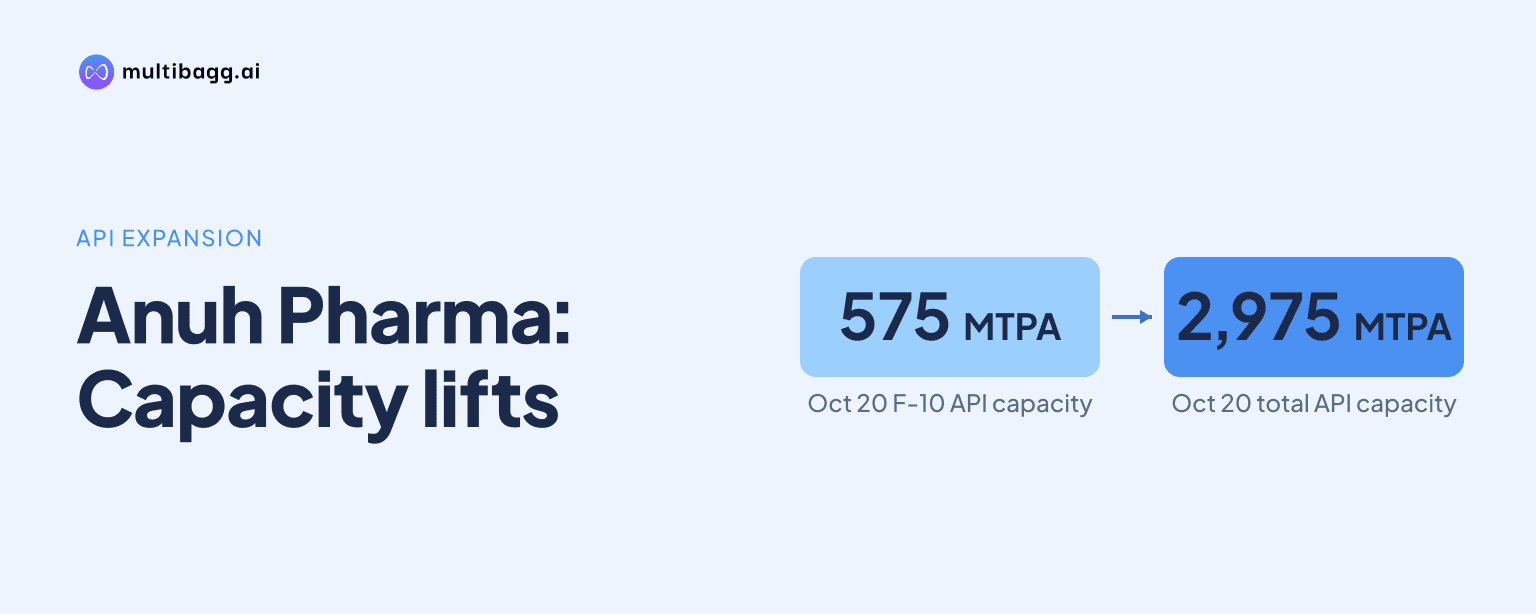
Anuh Pharma Limited inaugurated Tarapur Unit F-10 on 20 October 2026, adding 575 MTPA of API capacity and taking its stated total capacity to 2,975 MTPA. The new multi-purpose facility expands the company's manufacturing network at the MIDC Tarapur industrial area in Boisar, Maharashtra.
Know Anuh Pharma inside out
Results, valuation, peers and who's buying, in one view.
What did Anuh Pharma add through Tarapur Unit F-10?
Anuh Pharma added 575 metric tonnes per annum of installed active pharmaceutical ingredient, or API, capacity through Tarapur Unit F-10. The facility is located at Plot F-10/1 in the MIDC Tarapur industrial area at Boisar, District Palghar, where the company already operates its E-17 and E-18 units.
The company inaugurated F-10 on 20 October 2026. It describes the site as a multi-storey, current Good Manufacturing Practice, or cGMP, facility designed for multi-purpose API manufacturing. The plant brings production, quality-control and finished-goods warehousing functions together at one location.
F-10 has two API blocks and one intermediate block. It also has approximately 69 kilolitres of total reactor capacity, comprising stainless-steel and glass-lined reactors with capacities of up to 6.3 KL. The site covers approximately 9,500 square metres and includes a dedicated finished-goods warehouse.
How does F-10 change Anuh Pharma's manufacturing capacity?
F-10 takes Anuh Pharma's stated total API capacity to 2,975 MTPA, including the 575-MTPA addition. The company presents this as multi-purpose capacity across its Tarapur E-17 and E-18 units and the newly added F-10 facility.
The expansion follows an earlier capacity addition at the Tarapur network. In July 2025, the company inaugurated Manufacturing Block INT-1A at its E-17 and E-18 location. That block was expected to add 200 MTPA, taking the then stated capacity from about 2,200 MTPA to about 2,400 MTPA, along with 40 KL of reactor capacity.
The F-10 addition increases the physical manufacturing base available to the company. However, Anuh Pharma has not disclosed the API products planned for the new facility, the capacity utilisation level, or a timetable for commercial output from the 575-MTPA capacity.
What is the background to the F-10 facility acquisition?
The F-10 site entered Anuh Pharma's network through an asset transfer involving Vanquest Pharma Private Limited. Anuh Pharma announced that it received physical possession of Vanquest Pharma's manufacturing facility at Plot F-10, MIDC Tarapur, following an Asset Transfer Agreement executed on 16 October 2026.
The company said the possession handover was a continuation of its prior corporate disclosure and that there were no material changes to the transaction details previously announced. The subsequent inauguration took place on 20 October 2026, four days after the stated agreement date.
Anuh Pharma has said that site licences and certificates are being transferred to the company and will be published as issued. It has also stated that F-10 is being integrated into its group-wide quality management system. These disclosures are relevant because regulated pharmaceutical manufacturing requires site-specific approvals and operating systems alongside physical production infrastructure.
Got a follow-up? Ask IRIS
What quality and operating infrastructure does F-10 have?
F-10 has in-house quality-control facilities, a boiler house and a finished-goods warehouse alongside its manufacturing blocks. This layout gives the Tarapur site dedicated space for production operations, quality checks and storage of manufactured products.
The plant also has purified-water capability that meets Indian Pharmacopoeia, British Pharmacopoeia, European Pharmacopoeia and United States Pharmacopeia requirements, according to the company. These standards are used in pharmaceutical manufacturing quality systems and are part of the infrastructure described for the new unit.
The facility's reactor mix includes both stainless-steel and glass-lined reactors. Multi-purpose reactor capacity can support manufacturing flexibility, but the company has not identified individual API molecules or intermediate products that will be assigned to the F-10 blocks.
Why does the Tarapur expansion matter for investors and operations?
The commissioning expands Anuh Pharma's stated installed API capacity by 575 MTPA and consolidates additional manufacturing infrastructure within the Tarapur industrial cluster. F-10 is located alongside the E-17 and E-18 units, while the company also operates Turbhe Unit D-5 in Navi Mumbai as a dedicated corticosteroid facility.
For investors, the disclosed capacity increase is a measurable operating development rather than a disclosed revenue or earnings event. The company has not provided expected sales from F-10, capital expenditure for the acquisition or commissioning, utilisation assumptions, customer contracts, product mix, or a projected financial contribution from the facility.
Management has identified rebuilding exports, utilising surplus capacity, expanding regulated-market sales and pursuing annual growth of 15-20% as immediate priorities. The new unit provides additional manufacturing capacity in this context, although the article's disclosures do not quantify how much of that capacity will be used for exports, regulated markets or specific products.
Conclusion
Anuh Pharma's Tarapur Unit F-10 adds 575 MTPA of installed API capacity, lifting the company's stated total capacity to 2,975 MTPA. The facility combines two API blocks, an intermediate block, approximately 69 KL of reactor capacity, quality-control infrastructure and warehousing at a 9,500-square-metre site.
The next points to watch are the transfer of site licences and certificates, the facility's integration into the company-wide quality system, and any future disclosures on commercial production, product allocation, utilisation and regulated-market sales from F-10.