










APAR conductor backlog reaches Rs 12,025 crore as volumes fall
Key highlights
- APAR’s conductor order book stood at Rs 12,025 crore on September 30, 2026.
- APAR received Rs 4,725 crore of conductor orders in Q2 FY27, up 82% year on year.
- Conductor revenue rose 21.1% to Rs 3,753 crore in Q2 FY27 while volume declined 9.2%.
- APAR expects about 25% of its conductor backlog to be executed within two to three months.
powered by IRIS
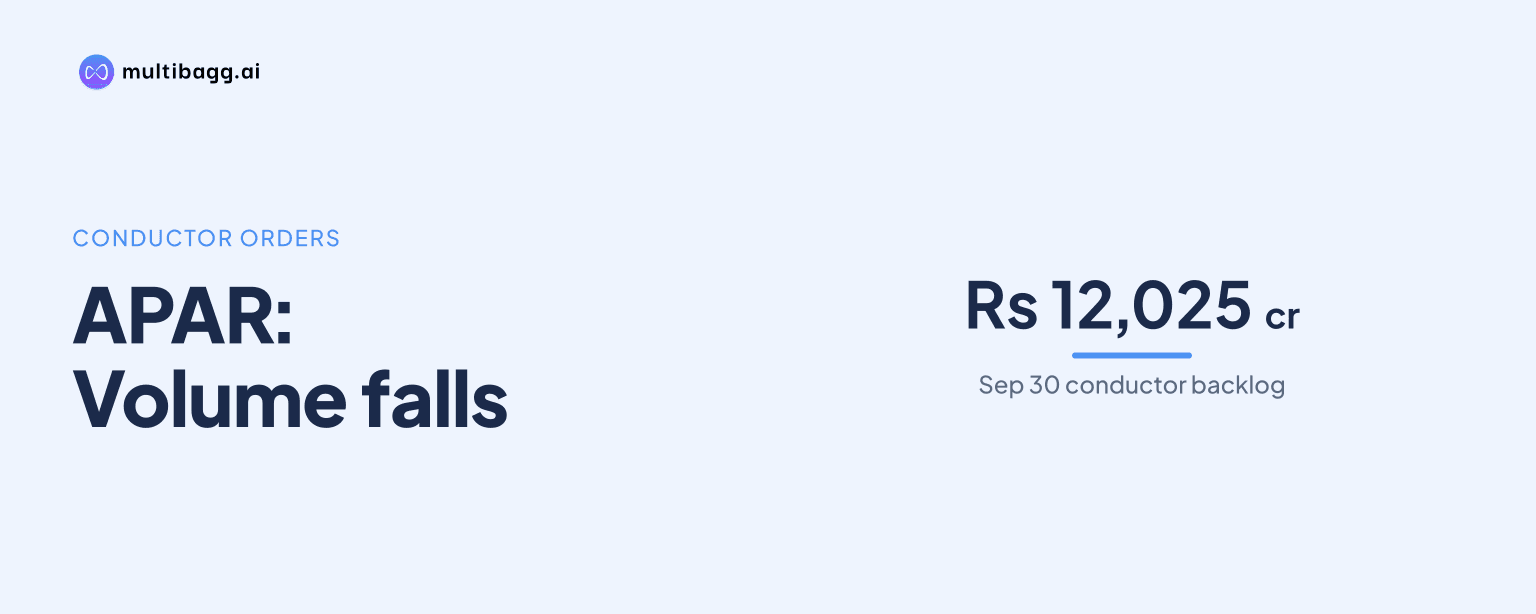
APAR Industries Limited reported a record conductor order book of Rs 12,025 crore on September 30, 2026, despite a 9.2% year-on-year decline in Q2 FY27 conductor volume, as quarterly orders rose 82% to Rs 4,725 crore and management cited delayed clearances and project awards rather than weaker demand.
Know Apar Industries inside out
Results, valuation, peers and who's buying, in one view.
What was APAR’s conductor order book at September 30?
APAR’s conductor order book was at an all-time high of Rs 12,025 crore on September 30, 2026. The balance included Rs 4,725 crore of new orders received in Q2 FY27, which management said was 82% above orders received in Q2 FY26.
The record backlog coincided with lower physical sales volumes but higher reported revenue. Conductor revenue rose 21.1% year on year to Rs 3,753 crore in Q2 FY27, led largely by higher commodity and underlying metal prices, while volume declined 9.2%. In H1 FY27, conductor revenue increased 20.5% to Rs 7,092 crore, while overall sales volume was 8% below the prior-year period.
Domestic conductor revenue rose 22% year on year and 8% sequentially in Q2 FY27. Export revenue increased 18.3% from Q2 FY26 and 29.5% from Q1 FY27, taking the export share to 23.6% from 20.5% in Q1 FY27. APAR’s U.S. conductor revenue increased 12.2% year on year during the quarter.
Why did APAR’s conductor volumes decline in Q2 FY27?
APAR said conductor volume declined because manufacturing clearances and awards of new conductor orders were delayed, particularly among tariff-based competitive bidding, or TBCB, awardees. Management described Q2 FY27 as the second consecutive quarter in which it had seen this pattern, while saying execution of existing contracts was high during the quarter.
Management said TBCB orders generally carry execution periods of no more than 36 months and stringent penalties for delivery delays. Its view was that there is therefore a finite period for postponement before project execution must catch up with final delivery schedules.
Logistics also affected export activity in Q2 FY27. APAR said international freight rates rose sharply and container demand from China was heavy on Europe and U.S. routes. Management said freight rates had begun to reverse as Q3 FY27 started and expected export conditions to improve during the quarter.
The company also reported higher input costs during the period. Management said aluminium and copper prices had increased, aluminium Midwest premium was at a four-year high, and steel prices for tower manufacturing had risen. These factors increased the billing value of conductor sales, contributing to revenue growth despite the 9.2% volume decline.
Which orders are included in APAR’s conductor backlog?
APAR’s Rs 12,025 crore backlog includes about Rs 3,000 crore of utility orders from the U.K. and the U.S., as well as high-temperature low-sag, or HTLS, conductor orders from Africa, South America and Europe. The company also received its first Z-shaped conductor order from Scandinavia for evacuation from an offshore wind farm.
Management said the Z-shaped conductor is designed for high-wind conditions and is manufactured by only two other conductor manufacturers globally. It characterised the order and other recent wins as part of a move towards more premium products, while noting that eventual margins depend on product, customer, geography and execution.
The backlog also includes optical ground wire, or OPGW, orders. APAR received what it described as its largest single OPGW order, worth about Rs 960 crore, from Karnataka Power Transmission Corporation Limited for 48-fibre OPGW and an Internet Protocol Multi-Protocol Label Switching, or IP MPLS, communication system.
APAR also received its first 144-fibre OPGW order from a Central American customer. Management said higher-fibre OPGW could become more relevant with increasing data transmission needs from data centres, while the Karnataka project covers work from design through delivery and includes a technology tie-up with Nokia.
Got a follow-up? Ask IRIS
How did APAR’s conductor profitability change despite lower volume?
APAR’s conductor earnings before interest, tax, depreciation and amortisation, or EBITDA, after open-period foreign-exchange adjustments rose 11.3% year on year to Rs 276 crore in Q2 FY27. EBITDA per metric tonne increased to Rs 48,241 from Rs 39,363 a year earlier, which management attributed to execution of higher-margin orders.
The H1 FY27 comparison showed a similar outcome. EBITDA per metric tonne reached Rs 50,739, compared with Rs 41,421 in H1 FY26, while conductor EBITDA after foreign-exchange adjustments increased about 12.6%. However, the premium-product mix was 39.4% in Q2 FY27, below 45.3% in Q2 FY26.
Management did not provide quarterly or annual profitability guidance because many conductor orders are made to order and the business has multiple variables. It reiterated a medium- to long-term EBITDA-per-tonne range of Rs 35,000 to Rs 36,000-plus, while saying outcomes can vary with product mix, customer, geography, freight, commodity costs and execution.
How quickly can APAR convert its conductor backlog into revenue?
APAR expects about 25% of its Rs 12,025 crore conductor backlog to be executed over two to three months, with the remaining balance likely to be executed in less than 18 months. Management said it was preparing for higher volumes in H2 FY27 and expected transmission-line execution to become more aggressive in the second half.
Management linked that expectation to transmission development in India. India added about 8,775 circuit kilometres of transmission lines in H1 FY27, up 153% year on year. In September 2026, the central government approved intrastate transmission systems designed to evacuate up to 135 gigawatts of renewable energy by FY33.
APAR also pointed to Central Electricity Authority measures setting a 10% to 15% thermal margin limit for transmission lines and requiring N-1 network reliability. Management expects those changes to support reconductoring and secondary transmission-line activity, although the timing of individual clearances and TBCB-related awards remains unresolved.
Conclusion
APAR’s Rs 12,025 crore conductor order book shows that the Q2 FY27 volume decline occurred alongside higher order intake and a wider set of utility and specialised-product wins. Revenue increased 21.1% to Rs 3,753 crore despite the 9.2% reduction in volume, while EBITDA per metric tonne rose to Rs 48,241 as higher-margin orders were executed.
The next measure is H2 FY27 execution against the backlog. Management expects about 25% of the order book to convert over two to three months and the balance in less than 18 months, while looking for faster transmission activity, easing freight rates and progress on delayed manufacturing clearances and TBCB awards.