










APAR says data-centre cables are largest backlog segment
Key highlights
- APAR said about Rs 1,000 crore of data-centre orders sit within its Rs 3,000 crore cable backlog.
- APAR reported 11% cable EBITDA margin and reiterated an 11% to 12% margin aspiration.
- More than Rs 440 crore of cables in transit were expected to enter APAR's books in Q3.
- APAR said cable-capacity utilisation exceeded 90%, with some data-centre copper-product lines at 100% to 105%.
powered by IRIS
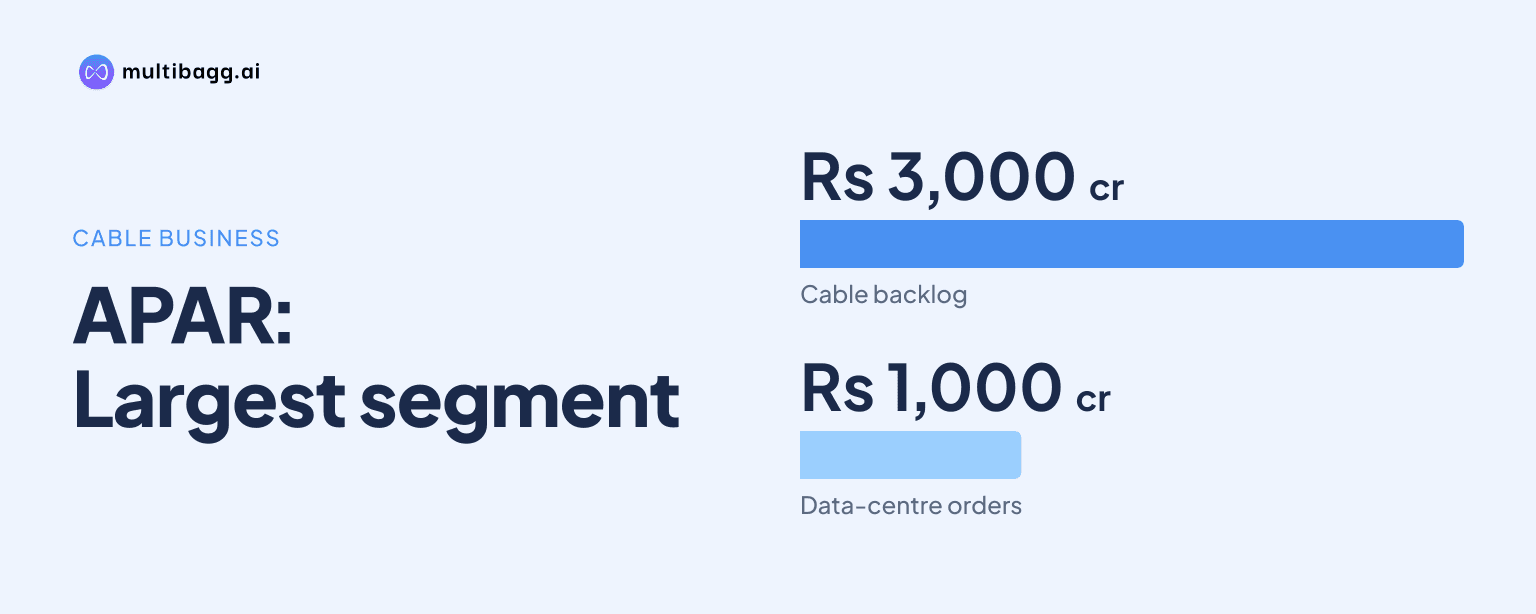
APAR says data-centre cable products are the largest component of its Rs 3,000 crore cable order backlog, with about Rs 1,000 crore of orders linked to AWS and Google data centres. Management said the orders support its 25% year-on-year cable-business growth objective, while higher-specification US data-centre cables have a better margin profile than comparable Indian products.
Know Apar Industries inside out
Results, valuation, peers and who's buying, in one view.
How large are APAR's data-centre cable orders?
APAR said orders related to AWS and Google data centres total about Rs 1,000 crore, or roughly one-third of its Rs 3,000 crore cable order backlog. Management described cables going into data centres as the largest chunk of the backlog, ahead of additional orders from renewable-energy and railway customers.
APAR also said it had received orders for Amazon's new data centres at two Indian locations, which management expects to be Amazon's largest in India. Execution is scheduled between the time of the call and the end of the financial year, and management expects additional orders from the same site.
The comparison identifies data-centre cables as APAR's largest named cable-demand source, but management also cited increases in solar, wind and railway orders. The Rs 1,000 crore figure is an order value, while the timing of delivery, including the Amazon projects through the financial year-end, will determine when it converts into business activity.
Why do US data-centre cables have higher margins for APAR?
APAR said US data-centre cables offer a better margin profile than similar products sold in India because US projects require much higher specifications. Management attributed the difference to cable construction and manufacturing complexity, rather than to the data-centre end-market alone.
In India, APAR said data centres offer a large addressable market but face greater competitive intensity and have a lower margin profile than exports. This creates a distinction between domestic data-centre orders, which add to backlog, and US products, where more demanding specifications can change the cable mix.
APAR reported an 11% cable-business EBITDA margin in the quarter discussed on the call. EBITDA means earnings before interest, tax, depreciation and amortisation. Management reiterated its publicly stated aspiration to reach an 11% to 12% cable EBITDA margin, while citing freight, metal premiums and steel-price movements as factors that can affect near-term results.
Management said graphics-processing-unit-based data centres used for artificial-intelligence training need higher specifications because of their electricity use and utilisation relative to enterprise data centres that are largely central-processing-unit based. APAR said no Indian artificial-intelligence data centres of meaningful size are operating yet, and management said the eventual premium or margin from higher-specification Indian projects remains to be seen.
Got a follow-up? Ask IRIS
What is APAR's cable growth and delivery outlook?
APAR said it remains on track to grow its cable business by 25% year on year. Management cautioned that factory dispatches can look different because more than Rs 440 crore of cables in transit were expected to physically enter its books in Q3.
The Rs 440 crore in-transit amount reflects products moving toward recognition or delivery rather than a separately disclosed order pool. APAR said US cable order books had started filling and described the pipeline as good, including orders already booked within the Rs 3,000 crore cable order book.
APAR said overall cable-capacity utilisation exceeded 90% in the quarter, while some copper-product sections serving data-centre orders were operating at 100% to 105%. Management said it was expanding capacity in certain cable sections and expects capacity not to be its biggest issue by the end of the year and into the following year.
This differs from APAR's conductor business, where management put utilisation at about 80% and said customer manufacturing clearances could constrain activity. In cables, the higher utilisation of copper product lines indicates that data-centre demand is concentrated in particular products, even as capacity additions are under way.
What capital spending and exports support APAR's plans?
APAR said it planned domestic capital expenditure of about Rs 1,500 crore over 12 to 15 months and had spent about Rs 500 crore at the time of the call. Management said the programme is intended to step up capacity, including in cable sections where expansion is being undertaken.
The Rs 1,500 crore domestic plan does not include a major overseas expansion. APAR said it was at an advanced stage of assessing overseas options but had not closed the process or disclosed a final investment amount; management described an enabling resolution for its wholly owned Singapore subsidiary as funding flexibility for potential overseas expansion.
APAR also cited about Rs 3,000 crore of utility contracts in the US and Europe, structured as rate contracts over two to three years. Those contracts relate to conductors rather than the cable backlog, but they show the company's stated focus on export customers and longer-duration arrangements.
Management said Chinese competition remained aggressive in standard cable and conductor products with shorter delivery cycles. APAR said it was concentrating on products and transaction structures where specifications or customer requirements are less suited to that competition, with higher-specification US data-centre cables being one stated example.
Conclusion
APAR's disclosed Rs 1,000 crore of AWS and Google data-centre orders makes data-centre products the largest named component of its Rs 3,000 crore cable backlog. The mix matters because APAR reported an 11% cable EBITDA margin and management said US data-centre products carry a better margin profile than comparable Indian cables, while domestic projects offer a larger but more competitive market.
The next indicators are execution of Amazon-related Indian orders by the financial year-end, recognition of more than Rs 440 crore of cables in transit in Q3, and progress toward the 11% to 12% cable-margin aspiration. Management's domestic Rs 1,500 crore capital-spending plan, including Rs 500 crore already spent, and any decision on overseas expansion will also indicate how APAR addresses capacity and export demand.