










APAR says Rs 800 crore transit depressed reported Q2 U.S. sales
Key highlights
- APAR reported Rs 800 crore of U.S.-bound conductor and cable shipments in transit under DDP terms at Q2 FY27-end.
- Consolidated Q2 FY27 revenue rose 21.3% year-on-year to Rs 6,931 crore despite reported U.S. revenue falling 29.7%.
- More than Rs 440 crore of cable shipments were in transit, and APAR said the incremental amount equalled almost 20% of cable sales value.
- APAR's conductor order book was Rs 12,025 crore as of September 30, including Rs 4,725 crore of Q2 FY27 order intake.
powered by IRIS
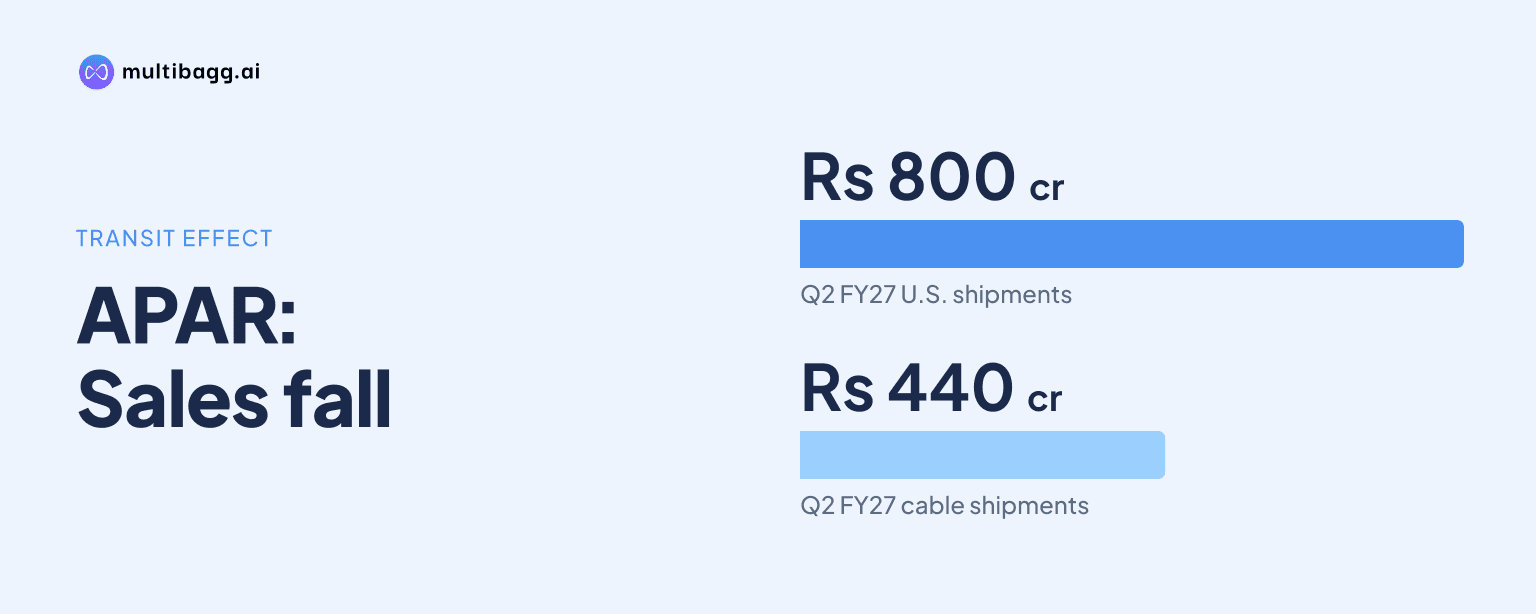
In Q2 FY27, APAR Industries Limited said Rs 800 crore of U.S.-bound conductor and cable shipments remained in transit under delivery duty paid terms, depressing reported U.S. sales, even as consolidated revenue rose 21.3% year-on-year to Rs 6,931 crore. Management said the timing effect should make the Q3 FY27 picture look different.
Know Apar Industries inside out
Results, valuation, peers and who's buying, in one view.
Why did APAR's reported Q2 U.S. sales fall?
APAR said the decline in reported U.S. revenue reflected shipment timing under delivery duty paid, or DDP, terms rather than an absence of underlying dispatches. Under the DDP arrangements cited by management, APAR had sold conductors and cables to customers, but revenue could not be recognised while the goods remained in transit. Shipping timelines lengthened after container availability moved later in Q2 FY27.
The combined value of conductors and cables in transit was about Rs 800 crore, and all of those goods were scheduled for sale in the U.S. market. On the reported basis, U.S. revenue in Q2 FY27 was 29.7% lower than in Q2 FY26. Export revenue overall declined 3.3%, while domestic revenue increased 34.3%, producing consolidated revenue growth of 21.3%.
How much of the transit issue came from cables?
APAR identified more than Rs 440 crore of cable shipments in transit during Q2 FY27, for which revenue was not recognised because the Incoterms were DDP. Incoterms are contractual international commercial terms that determine delivery obligations. Management said the incremental transit value, calculated as the Rs 440 crore quarter-end balance less the opening transit balance, represented almost 20% of cable sales value.
Cable division revenue was Rs 1,875 crore in Q2 FY27, up 22.1% year-on-year, but U.S. cable sales declined 50% year-on-year. Domestic cable revenue rose 71.4%, while exports fell 45.2%; the export mix consequently dropped to 19.0% from 42.3% a year earlier. Management attributed the lower recognised U.S. and overall cable revenue to the unusual transit balance.
What does the conductor segment show about the delay?
APAR's conductor business reported a different revenue pattern from cables, although management included conductors in the Rs 800 crore transit total. Conductor revenue rose 21.1% year-on-year to Rs 3,753 crore in Q2 FY27, aided largely by higher commodity and underlying metal prices. Sales volume, however, declined 9.2% from the prior-year quarter.
Reported conductor exports increased 18.3% year-on-year and 29.5% sequentially, with exports accounting for 23.6% of Q2 revenue, up from 20.5% in Q1 FY27. U.S. conductor revenue rose 12.2% during Q2 FY27. This contrasts with the cable division's 50% U.S. sales decline and indicates that the transit-related recognition effect was more visible in cables on the reported segment data.
For H1 FY27, conductor revenue was Rs 7,092 crore, up 20.5%, while total sales volume was 8.0% lower than the year-earlier period. U.S. conductor revenue was down 8.4% for the half year. APAR also said delays in manufacturing clearances and the award of new conductor orders, particularly among tariff-based competitive bidding, or TBCB, awardees, contributed to the volume decline.
Got a follow-up? Ask IRIS
When does APAR expect the U.S. revenue timing effect to reverse?
APAR expects the transit issue to improve in Q3 FY27 as freight rates have already begun to reverse, according to management. It said international freight rates rose sharply in Q2 FY27 and container demand was diverted toward China, Europe and U.S. routes. Management did not provide a precise Q3 FY27 revenue amount for goods expected to be recognised.
The company said that, with realisation of the DDP amount, the Q3 FY27 picture would look different. That statement is management's outlook based on cargo already in transit, not reported Q3 FY27 revenue guidance. At the end of Q2 FY27, APAR said its order book remained at a high level, supporting its view that the underlying commercial position was different from the reported U.S. revenue trend.
The conductor order book stood at Rs 12,025 crore as of September 30, with Rs 4,725 crore of new orders received in Q2 FY27. About 25% of that order book was expected to be staggered over two to three months, while the remainder was expected to be executed in less than 18 months. Management also said it was preparing for higher transmission-line volumes in H2 FY27.
What do APAR's wider results say about reported growth?
APAR's consolidated Q2 FY27 revenue of Rs 6,931 crore was 5.2% higher than Q1 FY27 as well as 21.3% higher year-on-year. Earnings before interest, tax, depreciation and amortisation, or EBITDA, after open-period foreign-exchange adjustments, rose 57.8% to Rs 787 crore. The EBITDA margin increased 270 basis points to 11.4% from 8.7% a year earlier.
Profit after tax rose 77.8% year-on-year to Rs 447 crore, and the profit-after-tax margin rose 200 basis points to 6.5%. For H1 FY27, revenue increased 25.0% to Rs 13,522 crore, while EBITDA grew 60.2% to Rs 1,602 crore and profit after tax rose 77.7% to Rs 915 crore. Management said exports grew 3.7% in H1 FY27 excluding the Rs 800 crore transit amount, while domestic revenue grew 35.5%.
Conclusion
The Rs 800 crore transit balance means APAR's reported Q2 FY27 U.S. and export revenue did not fully reflect the conductors and cables it said had already been sold under DDP arrangements. The effect was especially apparent in cables, where more than Rs 440 crore was in transit and U.S. sales fell 50%, while conductor revenue and exports still increased year-on-year.
The next evidence point is Q3 FY27 recognition of the U.S.-bound cargo, which management expects to improve as freight rates reverse. Readers can also watch execution against the Rs 12,025 crore conductor order book, including the roughly 25% scheduled over two to three months, and cable orders worth Rs 3,000 crore that management expects largely to execute before year-end.