










Apeejay Surrendra Park Hotels targets 7,500 keys by FY31
Key highlights
- ASPH targets 7,500 hotel keys across 100 hotels by FY31, versus 2,729 keys across 43 operational hotels.
- Managed keys are planned to rise by 3,627 to 4,905, representing about 65% of the FY31 target.
- The 4,771-key development pipeline includes 3,627 managed, 997 owned and 147 leased keys.
- ASPH’s FY28 schedule indicates total keys could reach 3,608 after 879 additions from Q3 FY27 through FY28.
powered by IRIS
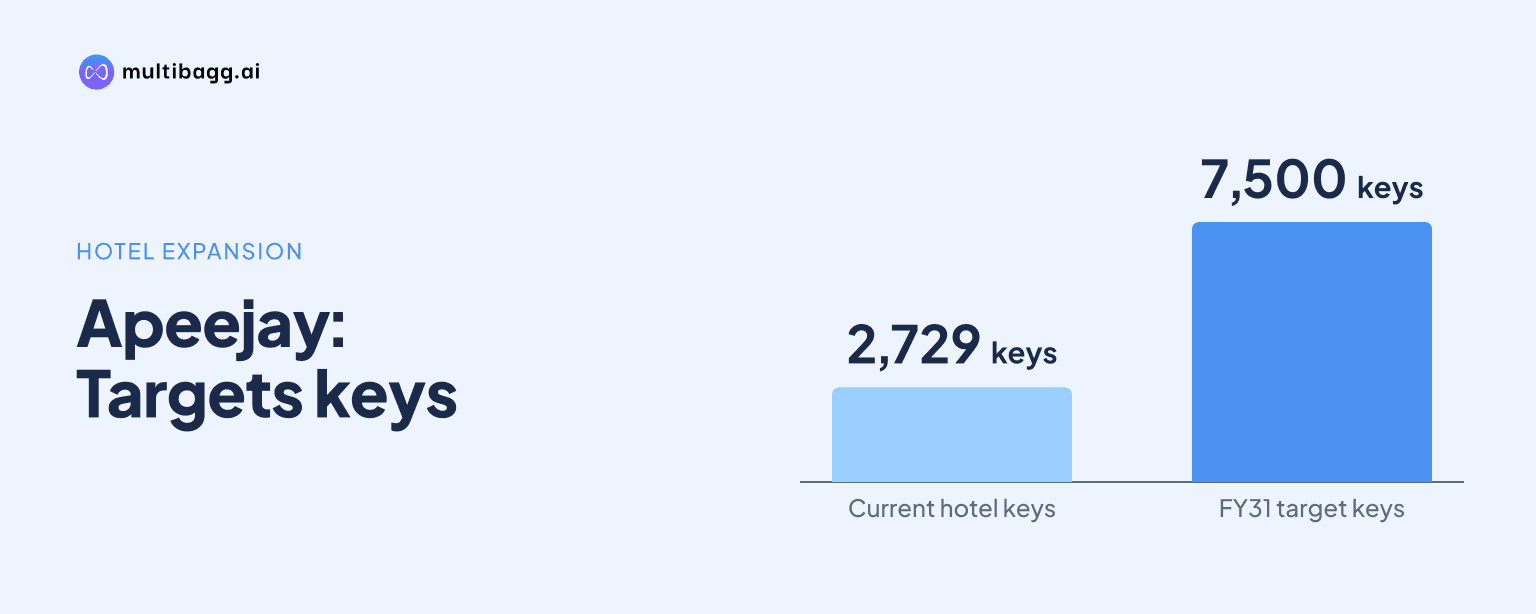
Apeejay Surrendra Park Hotels is targeting 7,500 hotel keys by FY31, compared with 2,729 operational keys, with 4,905 of the planned total designated as managed inventory. ASPH would add 4,771 keys across 57 hotels under development, making management contracts the principal route to its stated expansion.
Know Apeejay Surrendra Park Hotels inside out
Results, valuation, peers and who's buying, in one view.
What is ASPH targeting by FY31?
ASPH is targeting a hospitality portfolio of 100 hotels and 7,500 keys by FY31, up from 43 operational hotels and 2,729 keys. The target represents an increase of 57 hotels and 4,771 keys, taking the planned key base to about 2.75 times the current operational portfolio rather than a full threefold increase.
The target mix increases every category of inventory, but managed keys account for most of the planned additions. Managed inventory is set to rise by 3,627 keys, compared with 997 additional owned keys and 147 additional leased keys. The following comparison uses key counts throughout.
How will managed keys shape ASPH's FY31 portfolio?
Managed keys are planned to make up 4,905 of ASPH’s 7,500 FY31 keys, or about 65% of the target portfolio. This is a larger share than the 1,278 managed keys in the current 2,729-key operational base, where managed inventory represents about 47% of keys.
The change is also evident in the development pipeline. Of 4,771 keys under development, 3,627 are managed, while 997 are owned and 147 are leased. Managed properties therefore account for about 76% of keys under development, consistent with ASPH’s description of a predominantly managed and asset-light portfolio.
Owned keys remain a material part of the roadmap at 2,112 keys by FY31, versus 1,115 operational keys. Their share falls from about 41% of the current base to about 28% of the target, while leased keys increase from 336 to 483 but decline from about 12% to about 6% of total planned keys.
What does ASPH’s near-term development schedule show?
ASPH’s FY28 development update shows 106 new keys scheduled for Q3 FY27, 215 for Q4 FY27 and 558 for FY28, taking total keys from 2,729 to 3,608. The Q3 FY27 additions are 64 keys in Ujjain and 42 in Mathura, while the Q4 FY27 plan lists five projects totalling 215 keys.
The Q4 FY27 additions comprise The Malabar House with 17 keys, Raipur with 58, Muzzafarpur with 50, Pondicherry with 42 and Dharamshala with 48. The FY28 additions span Manali, Mashobra, Ayodhya, Aurangabad, Dehradun, Bharatpur, Havelock, Indore, Gangtok and Bhopal, although the presentation does not assign individual key counts to those 10 locations.
The FY28 schedule would add 879 keys from the current 2,729-key base, or roughly 18% of the 4,771 total keys identified as under development for FY31. ASPH does not specify in this update how each scheduled opening is allocated among owned, managed and leased categories in the FY31 portfolio mix.
Got a follow-up? Ask IRIS
Which owned projects are on ASPH’s disclosed development list?
ASPH lists four upcoming owned projects with 628 rooms in Mumbai, Navi Mumbai, Pune and Vizag, with stated completion dates ranging from October 2027 to 2032. The 250-room Navi Mumbai expansion is the largest listed project, followed by Pune with 200 rooms, Vizag with 100 and Mumbai’s Juhu project with 78.
The Mumbai project at Juhu covers 60,000 square feet and is scheduled for completion in October 2027 after receiving a fire no-objection certificate. Vizag, where ASPH has signed a memorandum of understanding with the government and states that permissions are in place, is scheduled to launch in December 2026 and complete in early 2030.
Navi Mumbai is an expansion of an existing hotel on a 3.80 lakh-square-foot site, with launch stated for 2028 and completion for 2032. Pune’s Shivaji Nagar development is scheduled for early 2031 and includes a 2.72 lakh-square-foot hotel area plus 4 lakh square feet of serviced apartments, following an increase in floor space index area from 2.5 lakh to 6.72 lakh square feet.
What operating and technology catalysts does ASPH identify?
ASPH identifies faster-growing upper-midscale expansion, asset-light growth, occupancy ratios and NOR1’s artificial intelligence-driven upselling platform as catalysts for the FY31 roadmap. The company also cites potential value from prime hospitality assets and land parcels it owns, alongside guest personalization through the NOR1 platform.
The Q2-FY27 city data provides context for ASPH’s occupancy focus. ASPH reported 100% occupancy in Kolkata against an industry figure of 84%, 97% in Chennai against 84%, and 96% in Bengaluru against 81%; in Indore, both ASPH and the industry were at 68%.
Room economics also varied by city in Q2-FY27. ASPH’s revenue per available room, or RevPAR, was Rs 8,251 in Kolkata versus the industry’s Rs 4,998, and Rs 5,302 in Goa versus Rs 2,794. These city operating comparisons cover existing performance and do not forecast returns from the FY31 development pipeline.
Conclusion
ASPH’s FY31 plan is principally a scale and mix change: the portfolio target rises by 4,771 keys to 7,500, while managed inventory contributes 3,627 of those additions. The planned managed share rises from about 47% of operational keys to about 65% of the target, while owned capacity still increases by 997 keys.
The next disclosed milestones are the 106-key Q3 FY27 and 215-key Q4 FY27 additions, followed by 558 keys in FY28. Execution can also be measured against project dates, including Mumbai in October 2027, Vizag in early 2030, Pune in early 2031 and Navi Mumbai in 2032, as well as the still-undisclosed ownership mix of individual scheduled openings.