










Flurys operates 112 stores as tea rooms drive additions
Key highlights
- Flurys operated 112 stores in H1-FY27, including 53 kiosks, 42 cafés and 17 tea rooms.
- Flurys grew from 19 stores in FY17 to 112 in H1-FY27, with a stated 21% compound annual growth rate.
- Tea rooms increased from 13 in FY26 to 17 in H1-FY27, accounting for four of six net additions.
- Flurys reported total income of Rs 20.9 crore in Q2-FY27, versus Rs 19 crore in Q2-FY26.
powered by IRIS
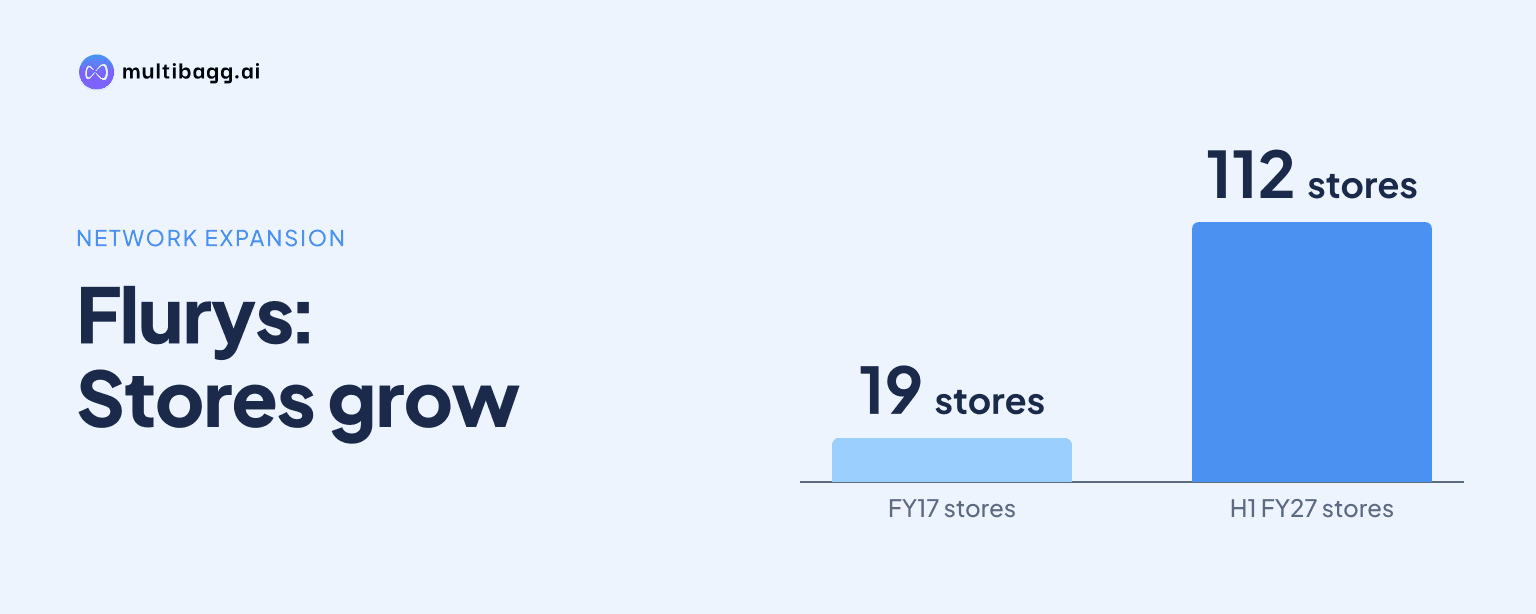
Flurys operated 112 stores in H1-FY27, six more than in FY26, with tea rooms contributing four of the six additions as the brand pursued a national premium café network. The presentation reports a 21% compound annual growth rate from FY17, but does not disclose a FY30 target of about 300 stores or an omnichannel plan.
Know Apeejay Surrendra Park Hotels inside out
Results, valuation, peers and who's buying, in one view.
How large is Flurys' retail network?
Flurys had 112 stores in H1-FY27, comprising 42 cafés, 17 tea rooms and 53 kiosks. The network was part of a wider group footprint of 43 hotels, 2,729 keys and more than 100 restaurants, nightclubs and bars across 32 cities and Union Territories.
The H1-FY27 count was six stores above the 106 reported in FY26 and 12 above the 100 reported in FY25. Cafés rose by three stores from FY25 to FY26 but were unchanged at 42 in H1-FY27, while tea rooms increased by four to 17 and kiosks by two to 53 in the latest partial period.
Tea rooms accounted for four of the six net additions from FY26 to H1-FY27, while kiosks accounted for two. This represented a shift from FY25 to FY26, when the network added six stores through three new cafés and three new tea rooms, with kiosks remaining at 51.
How fast has Flurys expanded since FY17?
Flurys expanded from 19 stores in FY17 to 112 in H1-FY27, an increase of 93 outlets, and the presentation states a 21% compound annual growth rate for the network. The store base passed 50 outlets in FY21, reached 69 in FY23, 77 in FY24 and 100 in FY25.
The pace of additions changed across the disclosed periods. Flurys added 23 outlets between FY24 and FY25, but six between FY25 and FY26; it then added a further six by H1-FY27, although this was a partial-year count rather than a full-year comparison.
Kiosks dominated the starting estate, accounting for 14 of 19 stores in FY17. By H1-FY27, kiosks remained the largest format at 53 stores, but cafés and tea rooms together had reached 59 outlets, compared with five combined locations in FY17.
What formats is Flurys using for expansion?
Flurys is using cafés, tea rooms and kiosks to serve distinct dining and retail occasions across its 112-store network. The presentation describes tea rooms and restaurants as heritage-style sit-down formats for bakes, patisserie, all-day dining and breakfast, while kiosks address grab-and-go demand.
Flurys had 53 kiosks in H1-FY27, located in airports, malls and transit hubs, compared with 42 cafés and 17 tea rooms. Cafés offer all-day breakfast, pastries, savoury products, teas and coffees, while tea rooms retain a sit-down proposition linked to the brand's Kolkata heritage.
The presentation characterises café, kiosk and restaurant formats as asset-light and scalable because they require limited capital deployment. It does not disclose store-level capital expenditure, franchise arrangements, store payback periods, unit economics or the proportion of the 112 stores operated under each ownership structure.
Flurys traces its legacy to 1927 and describes European-style baking, patisserie and fine confectionery as central to its heritage. The presentation positions the 112-store platform as a dedicated retail food-and-beverage business extending that proposition beyond the heritage flagship.
Got a follow-up? Ask IRIS
How is Flurys contributing to food-and-beverage income?
Flurys reported total income of Rs 20.9 crore in Q2-FY27, compared with Rs 20 crore in Q1-FY27 and Rs 19 crore in Q2-FY26. The reported increase was Rs 0.9 crore quarter on quarter and Rs 1.9 crore year on year, without a format-level split between cafés, tea rooms and kiosks.
Food-and-beverage revenue including Flurys income was Rs 303.8 crore in FY26, up from Rs 266.3 crore in FY25 and Rs 250.9 crore in FY24. The presentation reported Rs 153 crore for H1-FY27, but this covers the wider food-and-beverage platform rather than Flurys alone.
In Q2-FY27, food and beverage represented 44% of the total revenue mix shown, compared with 43% in Q1-FY27 and 43% in Q2-FY26. Room revenue represented 49% in Q2-FY27, compared with 48% in Q1-FY27 and 50% a year earlier; the source notes that occupancy, average room rate and revenue per available room data apply only to owned hotels.
Has Flurys disclosed a FY30 target of 300 stores?
No, Flurys has not disclosed a FY30 target of about 300 stores in the supplied presentation. It reports annual store data from FY17 through FY26 and a H1-FY27 count of 112, while describing its stated direction as scaling into a national premium café network.
Flurys also has not disclosed an omnichannel plan in the supplied material. The presentation contains no figures for online ordering, delivery sales, digital revenue, loyalty members or e-commerce, and instead identifies physical cafés, tea rooms and kiosks as its expansion formats.
The disclosed 21% compound annual growth rate is a historical measure of the increase from 19 stores in FY17 to 112 in H1-FY27. Management does not present that historical growth rate as FY30 guidance, nor does the presentation provide a future store-opening schedule or city-by-city rollout target.
Conclusion
Flurys has built a 112-store retail network from 19 stores in FY17, combining 53 kiosks with 42 cafés and 17 tea rooms. Recent expansion was concentrated in tea rooms and kiosks, while Flurys' Q2-FY27 income reached Rs 20.9 crore and the broader food-and-beverage platform, including Flurys, recorded Rs 303.8 crore in FY26 revenue.
What to watch next is whether Flurys resumes café additions after the count remained at 42 from FY26 to H1-FY27, and whether tea rooms continue their four-store H1-FY27 increase. The disclosed plan is to scale a national premium café network through asset-light formats, but the presentation leaves future store targets, omnichannel activity and store-level financial measures unresolved.