










Apollo Tyres targets stable Europe operations next financial year
Key highlights
- Apollo Tyres stopped Enschede plant operations at the end of the first quarter.
- Apollo Tyres expects replacement manufacturing supply to be ready within the next two quarters.
- Enschede dismantling and equipment-sale work is expected to take two to three quarters.
- Apollo Tyres said agri and off-highway tyre supply should stabilise next year.
powered by IRIS
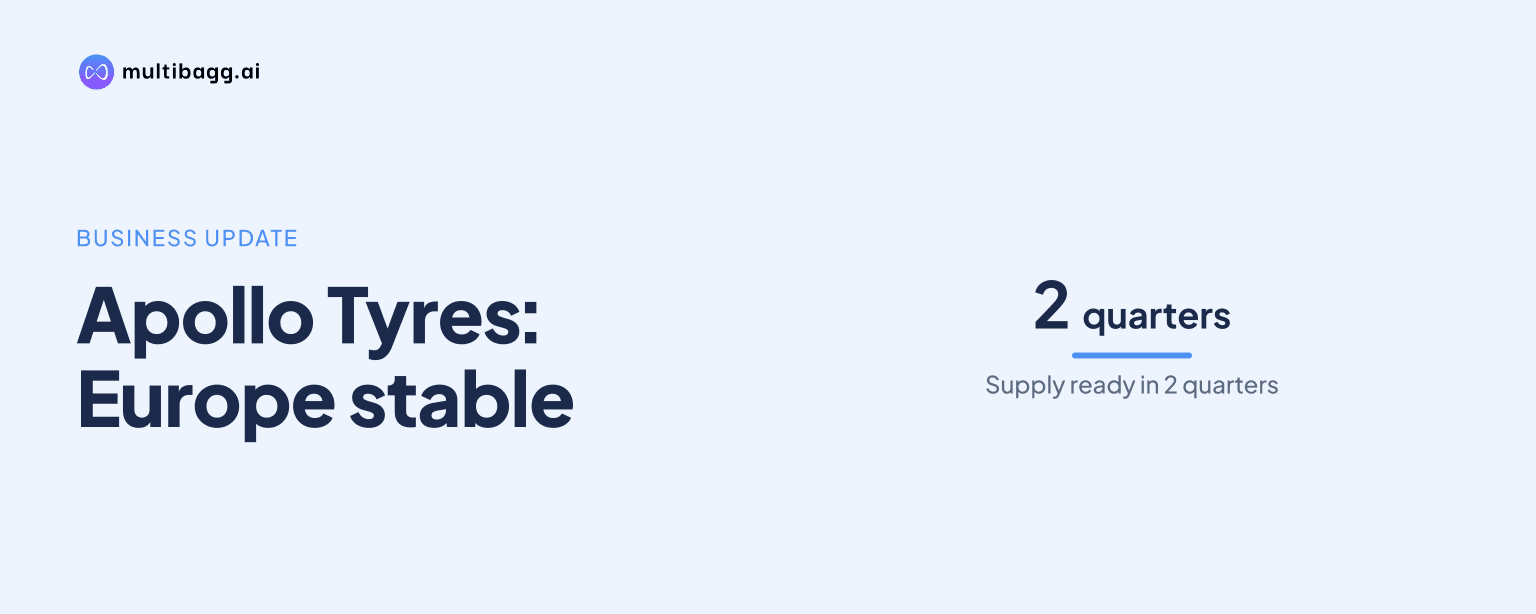
Apollo Tyres expects European supply to be ready within the next two quarters and largely stable operations from next financial year after closing Enschede at the end of the first quarter. Passenger-car tyre supply is already being split between India and Hungary, but agri and off-highway tyre volumes are expected to stabilise only next year.
Know Apollo Tyres inside out
Results, valuation, peers and who's buying, in one view.
What has Apollo Tyres changed in its European manufacturing footprint?
Apollo Tyres has stopped production at its Enschede plant and is replacing its output through Hungary and India to move away from what management described as a high-cost manufacturing location. Plant operations at Enschede stopped at the end of the first quarter, although physical closure work will continue for another two to three quarters.
The transition includes moving truck and bus radial tyre manufacturing from Hungary to Apollo Tyres' India plant. Hungary will therefore be the only operating European plant, while India will supply part of the European product range. Management said the revised footprint is intended to restore supply without retaining Enschede's operating-cost base.
The remaining Enschede work is not production activity. A team is dismantling equipment and arranging asset sales, a process management said would take two to three quarters to complete. That timetable means the legal and physical closure may extend beyond the period in which Apollo Tyres expects replacement supply to become ready.
Can Apollo Tyres meet European winter-tyre demand during the transition?
Apollo Tyres said its passenger-car winter-tyre supply plan is already in motion, with smaller sizes supplied from India and high-end tyres made in Hungary. Management described the third quarter as seasonally important for winter tyres and said the passenger-car production plan had already been established across the two locations.
The company gave particular priority to this range because management called passenger-car tyres one of its most profitable European segments. In the second quarter, Apollo Tyres reported a volume increase in Vredestein, contrasting with volume losses in agri and off-highway tyres. That split indicates that the transfer has protected passenger-car supply more effectively than the specialty lines.
Management expects its manufacturing facilities to be ready with supply over the next two quarters. During those two quarters, Apollo Tyres is focusing on putting its European supply chain in place, including warehouse reorganisation across different parts of Europe and changes to its business model.
The operational programme also includes an S4/HANA enterprise-system implementation in Europe. Management expects the warehouse, business-model and system work to finish in the current financial year or, potentially, by the first quarter of the next financial year. The stated target is largely stable European operations next financial year rather than fully normal operations in the third quarter.
Got a follow-up? Ask IRIS
Why are agri and off-highway tyre volumes lagging?
Apollo Tyres said agri and off-highway tyres were the main sources of volume loss in the second quarter, even as Vredestein volumes increased. Management linked the weaker performance to the manufacturing transition and said supply for those categories will be served from India and Hungary after the footprint changes.
The expected timing is later than for winter tyres. Management said agri and off-highway supply should start stabilising next year, rather than confirming a recovery during the current financial year. This means the passenger-car and winter-tyre plan is intended to support the third quarter while specialty categories remain exposed to transfer-related supply constraints.
The difference reflects the sequencing of Apollo Tyres' production plan. Smaller tyre sizes are assigned to India, while high-end tyres are assigned to Hungary, but management did not provide a quarter-by-quarter production timetable for agri or off-highway tyres. It instead identified next year as the period when disrupted volumes should stabilise.
This distinction means Apollo Tyres is not describing a uniform recovery across Europe. The second-quarter comparison showed growth in Vredestein alongside losses in agri and off-highway tyres, and management's next-year stabilisation comment applies specifically to the latter categories. No numerical volume change was disclosed for either segment.
What costs and operational work remain at Enschede?
Apollo Tyres said Enschede no longer carries plant operating costs, but limited cleanup costs may continue for the next few quarters. These costs relate to dismantling equipment and moving it out of the facility, rather than running tyre production, and management said it did not expect the remaining costs to be significant.
Management said the larger part of Enschede-related costs had already been recorded by the second quarter. It also disclosed an exceptional item of EUR 23 lakh in European operations during that quarter, largely related to employees remaining in a different legal entity, and said that matter had been taken into the accounts.
The company therefore distinguishes between production costs and closure costs. Hungary will be the only operating plant in Europe from the third quarter, while Enschede may still generate residual dismantling and asset-removal expenses for two to three quarters. That separation underpins management's expectation that European operations can become stable next financial year.
Apollo Tyres also linked the new footprint to its margin objective. Management said it hopes stable operations will allow Europe to return to the normalised margin the business had previously achieved, but did not provide a margin target or a specific quarter for that outcome. The timing remains conditional on completing supply-chain, warehouse and system changes.
Conclusion
Apollo Tyres has completed the operational shutdown of Enschede at the end of the first quarter and is using Hungary and India to support European demand. The transition is more advanced for winter and high-end passenger-car tyres, as Vredestein volumes increased in the second quarter, while agri and off-highway categories remain the principal areas of volume loss.
The next milestones are supply readiness over the next two quarters, completion of warehouse and S4/HANA work by the current financial year or the first quarter of the next financial year, and stabilisation of agri and off-highway supply next year. Investors will also be watching whether residual Enschede cleanup costs remain limited as management expects.