










Apollo Tyres says input costs rose 25% since April
Key highlights
- Apollo Tyres said India raw-material costs rose approximately 25% from April 2026.
- Apollo Tyres implemented Replacement-segment pricing actions of up to 15%.
- India revenue rose nearly 26% year on year to Rs 5,920 crore in Q2 FY27.
- India EBITDA margin declined to 11.1% from 15.3% in the corresponding prior-year period.
powered by IRIS
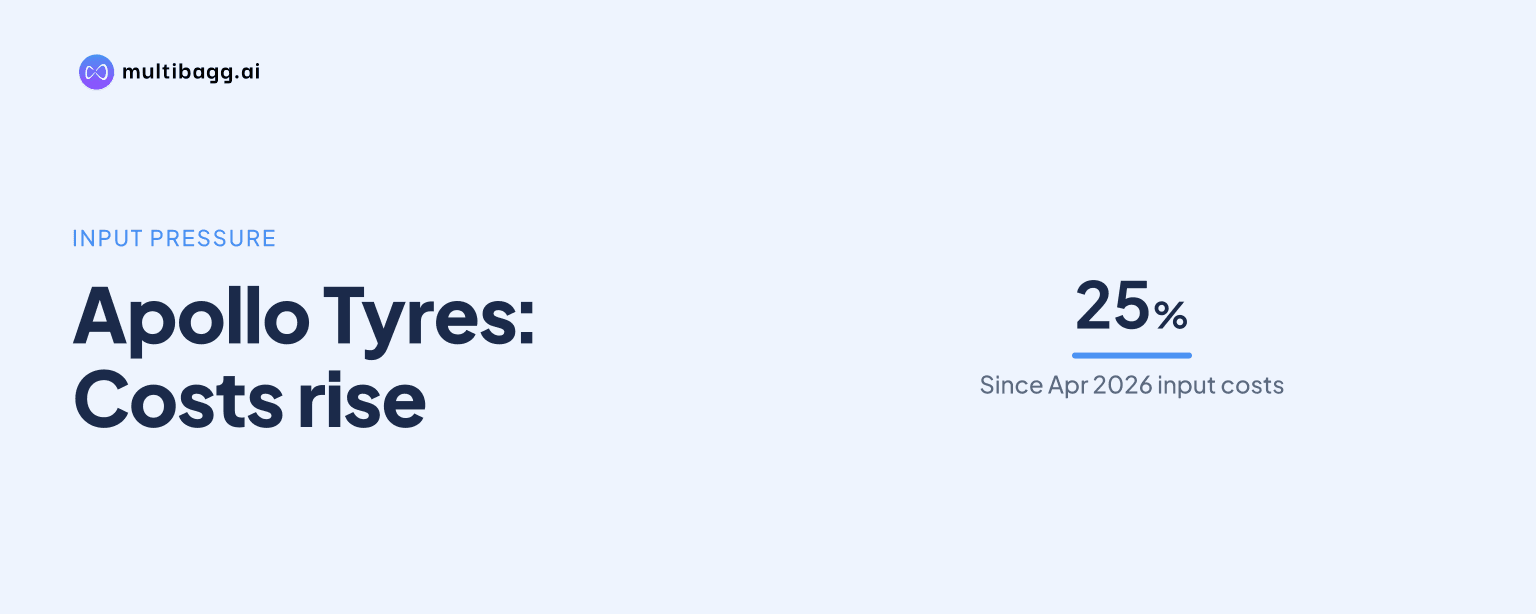
Apollo Tyres Limited said its India raw-material costs increased approximately 25% from April 2026, while Replacement-segment price actions reached up to 15%, contributing to an India EBITDA margin of 11.1% in Q2 FY27 versus 15.3% a year earlier. Management said volume growth and pricing contributed almost equally to India revenue growth of nearly 26%.
Know Apollo Tyres inside out
Results, valuation, peers and who's buying, in one view.
How much have Apollo Tyres’ raw-material costs increased?
Apollo Tyres said raw-material costs in its India operations had risen approximately 25% since April 2026, which management described as one of the steepest and fastest inflation episodes it has experienced in many years. The increase affected profitability even as India revenue rose nearly 26% year on year to Rs 5,920 crore in Q2 FY27.
India EBITDA was Rs 660 crore in Q2 FY27 and the margin was 11.1%, compared with 15.3% in the corresponding period a year earlier. The 4.2-percentage-point year-on-year margin reduction shows that higher revenue did not fully offset the raw-material inflation during the quarter.
At the consolidated level, Apollo Tyres reported Q2 FY27 revenue of Rs 7,970 crore, up more than 16% year on year, and EBITDA of Rs 860 crore, equal to a 10.7% margin. Management said disciplined cost management and operating efficiencies partly offset elevated raw-material costs, without saying that they fully recovered the increase.
Has Apollo Tyres raised prices enough to cover higher costs?
Apollo Tyres said it has implemented price actions of up to 15% in the Replacement segment since the April 2026 cost escalation began, alongside meaningful price increases in original equipment manufacturer, or OEM, business. The company did not disclose an OEM pricing percentage, so the up-to-15% figure applies only to Replacement.
The disclosed maximum Replacement price action is below the approximately 25% increase in raw-material costs, although the transcript does not quantify net cost recovery. It does not provide product-level input usage, the timing of individual increases, realised pricing by channel, or the proportion of sales covered by each action.
Management said volume growth and pricing contributed almost equally to India’s nearly 26% revenue growth in Q2 FY27. OEM volume grew more than 25% year on year, Replacement volume increased in the low double digits and exports were broadly flat, indicating that the reported sales increase was not solely price-led.
Within India Replacement, Apollo Tyres said passenger car radial, or PCR, volumes grew in the mid-teens and truck volumes rose by high single digits. Two-wheeler volume growth was about 25% to 26%, though management said that business had a relatively small base, while V-Strom led the Replacement performance.
Got a follow-up? Ask IRIS
What is Apollo Tyres trying to change through pricing?
Apollo Tyres said its objective is to make the enhanced pricing discipline used in the current inflation cycle a permanent feature of the business rather than a temporary response. Management said raw-material prices could stabilise and may soften over time, but it wants pricing discipline to support a more resilient and profitable long-term business model.
That objective is management’s stated intent rather than a forecast of a specific margin or price level. Apollo Tyres did not say whether the up-to-15% Replacement actions were implemented in every tyre category, how much had appeared in customer invoices by Q2 FY27, or whether another price increase is planned.
Apollo Tyres expects demand conditions in India to remain supportive, although management said reported volume growth could moderate in coming quarters because of a higher base. It nevertheless expects revenue momentum to benefit from pricing actions taken since April 2026, separating the outlook for sales from the outlook for percentage volume growth.
The India result contrasts with Europe, where Q2 FY27 revenue fell 12% year on year to EUR 157 million because of weakness in truck and agriculture segments and temporary supply disruption after the Enschede plant closure. Apollo Tyres said Europe’s PCR business gained market share despite subdued demand, while the European EBITDA margin was 10.3%, below India’s 11.1%.
What will determine Apollo Tyres’ margin recovery?
Apollo Tyres said the direction of margin recovery is clear, but the timing depends on commodity-market movements and geopolitical developments. The company did not provide an India raw-material cost outlook, a targeted India margin or a date by which price actions should offset the April 2026 inflation.
The Q2 FY27 outcome frames that uncertainty: India revenue increased nearly 26% to Rs 5,920 crore, while the EBITDA margin declined to 11.1% from 15.3%. Management said it would balance growth with profitability through disciplined execution as commodity prices and geopolitical conditions develop.
Apollo Tyres spent about Rs 1,500 crore of consolidated net capital expenditure in the first half of FY27, broadly in line with its full-year plan. Consolidated net debt to EBITDA was 0.9 times as of September 30, 2026, and management said leverage should remain within its targeted range while it funds capacity, digital, technology and product-development investments.
In Europe, Apollo Tyres identified completing the manufacturing transition, stabilising the supply chain and improving cost competitiveness as immediate priorities after the Enschede closure. Management reiterated a medium-term ambition for the European business to deliver high-teen operating margins, but did not give a date for reaching that range.
Conclusion
Apollo Tyres is managing a sharp India input-cost increase with Replacement price actions of up to 15%, OEM price increases and operating efficiencies, but Q2 FY27 margins show that the response had not fully neutralised inflation. India revenue growth was broad-based across OEM and Replacement, with pricing and volume each contributing nearly half of the nearly 26% increase.
The next issue is whether commodity markets and geopolitical developments allow pricing actions introduced since April 2026 to support margin recovery. Investors can also watch execution of the full-year capital-spending plan, the 0.9-times net-debt-to-EBITDA position reported on September 30, 2026, and progress in Europe’s manufacturing transition toward management’s high-teen operating-margin ambition.