










Ardee Export Revenue Rose From FY24 to Rs 465.1 Crore in FY26
Key highlights
- Ardee's export revenue rose from Rs 81.6 crore in FY24 to Rs 465.1 crore in FY26.
- Ardee reported Rs 244.1 crore of export revenue in H1 FY27.
- Ardee says it sources raw materials from 85 countries through more than 150 suppliers.
- Ardee's integrated recycling facility has capacity of 1,56,950 MTPA.
powered by IRIS
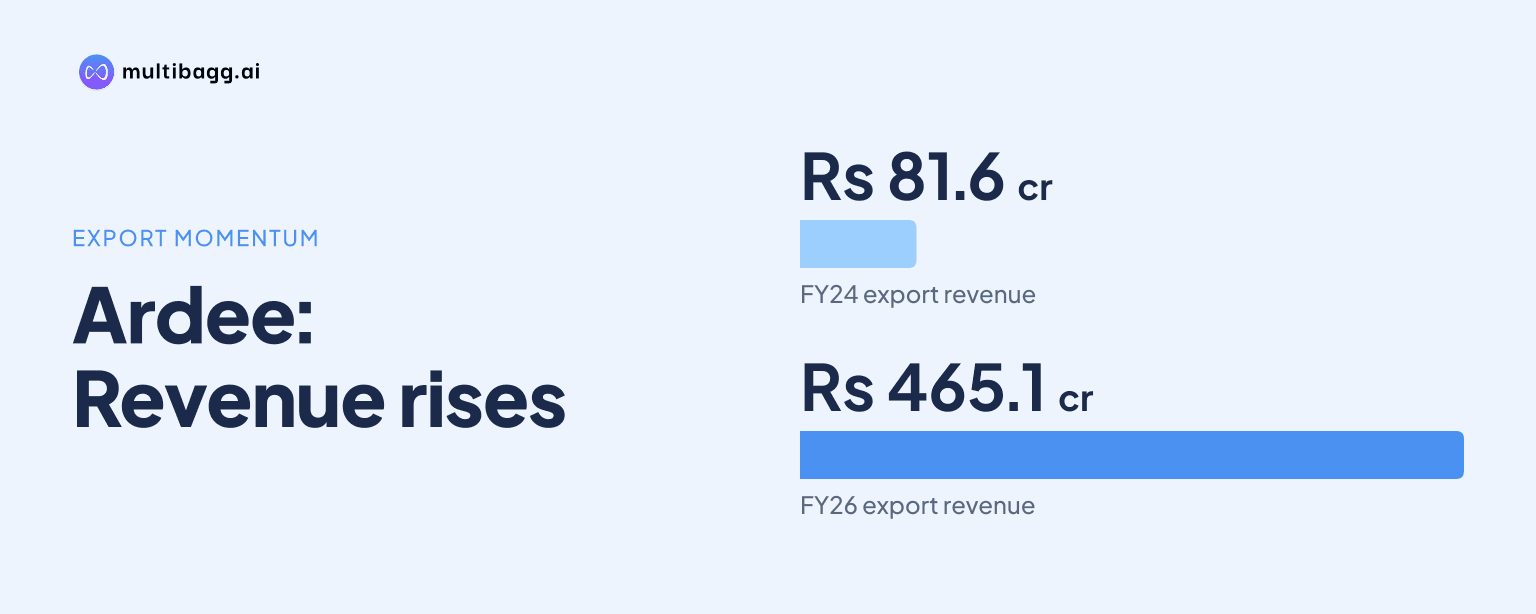
Ardee reported export revenue of Rs 465.1 crore in FY26, up from Rs 81.6 crore in FY24, while its procurement network covered 85 sourcing countries and more than 150 suppliers. The presentation also records Rs 244.1 crore of export revenue in H1 FY27, a partial-year figure that should not be treated as a full-year result.
Know Ardee Industries inside out
Results, valuation, peers and who's buying, in one view.
How quickly did Ardee's export revenue grow?
Ardee's export revenue increased by Rs 383.5 crore between FY24 and FY26, rising from Rs 81.6 crore to Rs 465.1 crore over two financial years. Revenue first reached Rs 275.1 crore in FY25, an increase of Rs 193.5 crore from FY24, before increasing by a further Rs 190 crore in FY26. The presentation presents these figures as an export-revenue trend and does not provide a split by product, destination or customer.
H1 FY27 export revenue was Rs 244.1 crore, lower than the Rs 465.1 crore recorded for the full FY26 but relating to only the first half of FY27. The disclosed series therefore shows expansion from FY24 to FY26, while the H1 FY27 number is an interim measure rather than a like-for-like annual comparison. Ardee does not disclose an FY27 export target or forecast in the presentation.
What supports Ardee's global raw-material procurement?
Ardee says it procures raw materials across 85 sourcing countries and maintains a supplier base of more than 150 partners across multiple continents. Its stated raw-material streams include used lead-acid batteries, remelted lead blocks or ingots, and lead scrap. The company describes this spread of suppliers and trade hubs as a way to maintain supply flow without reliance on a single supplier.
Ardee's sourcing process begins with used lead-acid batteries and lead or non-ferrous scrap obtained domestically and from more than 50 countries, followed by dismantling, smelting, refining and alloying, and casting and testing. The presentation uses 85 sourcing countries for global procurement and “50+ countries” in its operating-process overview. Neither disclosure provides purchase volumes by country or supplier.
The integrated recycling facility has capacity of 1,56,950 metric tonnes per annum, or MTPA, across 7.61 acres. Ardee says its location near Chennai and key ports supports logistics and faster deliveries, a mechanism relevant to handling imported scrap and export shipments. Its stated operating certifications are ISO 9001:2015, ISO 14001:2015 and ISO 45001:2018.
Got a follow-up? Ask IRIS
Which products and end markets does Ardee serve?
Ardee produces pure lead with disclosed purity of 99.97% to 99.985%, with standard ingot weights of 23 to 30 kilograms, alongside customised lead alloys. Its alloy portfolio includes lead calcium, lead antimony, lead cadmium, lead silver and lead tin products, as well as refined lead ingots. The presentation does not specify how much of the Rs 465.1 crore FY26 export revenue came from pure lead versus alloys.
Ardee lists battery manufacturers among its key customer base and names Amara Raja, Chloride Metals, Glencore International AG, Sebang, thyssenkrupp, Trafigura and IXM. The presentation identifies these companies as customers but does not state their respective purchase volumes, locations, contract terms or whether their purchases were domestic or export sales. The disclosed customer list therefore cannot be used to allocate export revenue.
The company performs spectrometric quality checks at the casting and testing stage after refining and alloying in refining kettles. This process follows lead recovery in rotary furnaces after dismantling and segregation of used lead-acid batteries. Ardee frames the integrated sequence as a route to quality-assured ingots and customised compositions rather than as a separate export-only production line.
How does Ardee manage lead pricing and market access?
Ardee says it hedges 100% of its lead-price exposure through London Metal Exchange, or LME, futures contracts. The presentation says this mechanism is intended to protect margins from lead-price volatility and aligns pricing with LME benchmarks recognised by export customers. It does not disclose hedge tenors, contract volumes, hedge-accounting treatment or gains and losses from these contracts.
Ardee's brand is listed on the Multi Commodity Exchange of India, or MCX, and its ARDEE LEAD 9997 brand is listed on the LME. The presentation says MCX listing allows customers and commodity traders to purchase or trade pure lead, while the LME listing provides global price benchmarking and hedging access for international customers and traders. These listings are described as mechanisms that can support global customer relationships, rather than evidence of a stated FY27 export-revenue target.
The company also uses oxygen-enriched combustion and recycled pyrolysis oil at its 1,56,950 MTPA facility. Separately, the presentation cites recycled lead's carbon footprint at 0.98 tonnes of carbon dioxide equivalent per tonne, compared with 1.82 tonnes for primary lead, or about 46% lower according to the source. This comparison concerns the stated production footprint and does not quantify Ardee's own emissions or export-related emissions.
Conclusion
Ardee's disclosed export trend shows that exports moved from Rs 81.6 crore in FY24 to Rs 465.1 crore in FY26 alongside a procurement base spanning 85 countries and more than 150 suppliers. The company combines this supply network with an integrated 1,56,950 MTPA recycling process, pure-lead and alloy products, and LME-based hedging of 100% of disclosed lead-price exposure.
The next disclosed marker is export revenue in H1 FY27 of Rs 244.1 crore, which will need a full-year outcome for comparison with FY26. Investors can also watch the regulatory timetable cited in the presentation: mandatory recycled content in new lead-acid batteries is stated to rise from 35% in FY28 to 40% by FY30, while the 2026-27 collection target is shown as 80% or more.