










Ardee Industries Limited identifies 35% recycled lead mandate
Key highlights
- Ardee says new lead-acid batteries must contain 35% recycled lead from FY28 and 40% from FY30.
- Ardee shows an EPR collection target of more than 80% for 2026-27, while producers must recycle 100% of collected batteries.
- Ardee reports installed capacity of 1,56,950 MTPA as of 30 September 2026.
- Ardee cites recycled lead emissions of 0.98 tCO2e per tonne versus 1.82 tCO2e per tonne for primary lead.
powered by IRIS
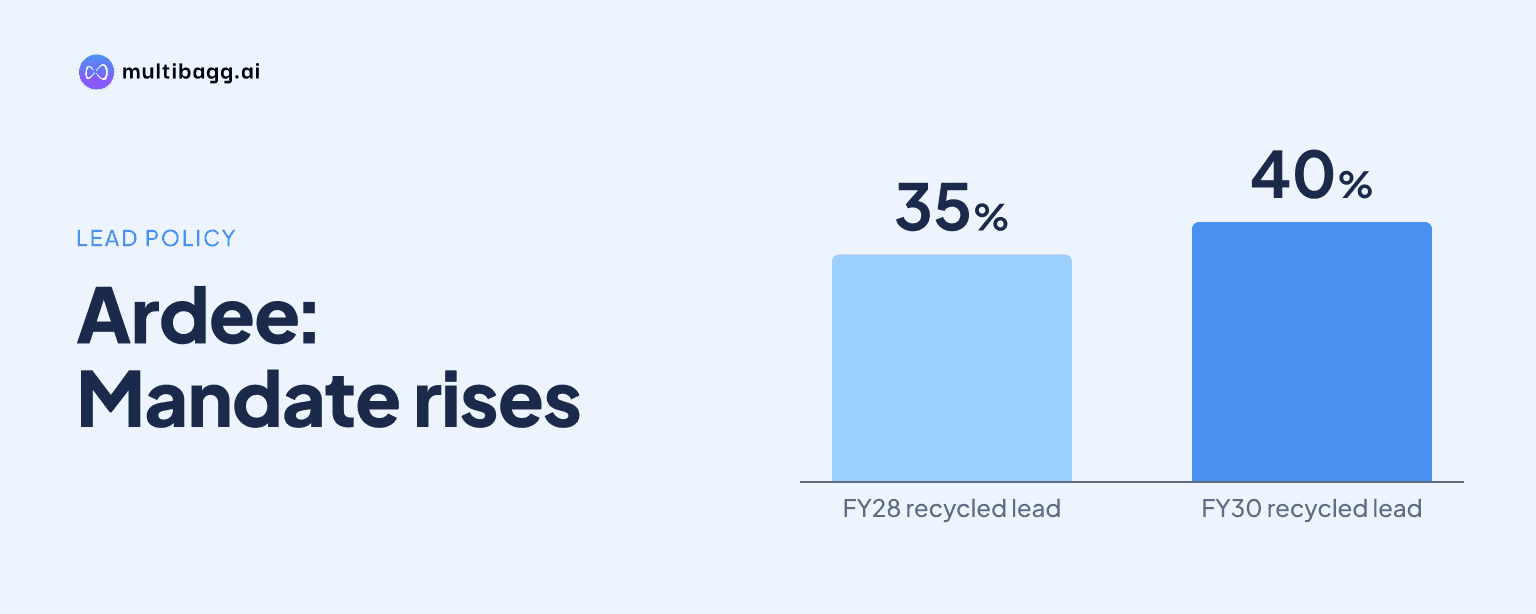
Ardee Industries Limited says new lead-acid batteries must contain 35% recycled lead from FY28, rising to 40% by FY30. Ardee identifies the requirement, together with an 80% material-recovery obligation for recyclers and an EPR collection target of more than 80% for 2026-27, as a regulatory shift towards formal recycling.
Know Ardee Industries inside out
Results, valuation, peers and who's buying, in one view.
What do the battery-waste rules require from FY28?
The rules require new lead-acid batteries to contain 35% recycled lead from FY28, with the required share rising to 40% by FY30. Ardee presents this requirement under the Battery Waste Management Rules, 2022, or BWMR 2022, and describes it as mandatory recycled content rather than voluntary procurement by battery makers.
The same BWMR 2022 framework requires recyclers to recover 80% of material, according to Ardee. The measures therefore cover both the recycled input used in new batteries and the output recovered from waste batteries, including used lead-acid batteries, or ULABs, processed by recyclers.
The increase from 35% in FY28 to 40% in FY30 is a 5-percentage-point change over the disclosed regulatory milestones. Ardee says the framework is formalising the industry, but its presentation does not forecast the volume of recycled lead that the rules will require or allocate to any individual recycler.
How could EPR change battery-scrap collection?
Extended Producer Responsibility, or EPR, requires producers to recycle 100% of the batteries they collect, while Ardee shows a collection target of more than 80% for 2026-27. The presentation also says EPR certificates are available only from registered recyclers, linking compliance documentation to registered processing facilities.
Ardee says this arrangement can create recurring ULAB feedstock for registered recyclers because collection, recycling and certificate issuance are connected. That is a stated mechanism rather than a commitment of any particular scrap volume to Ardee, whose operations include ULAB and non-ferrous scrap recycling.
EPR and the 80% recycler material-recovery requirement apply at different points in the battery-waste chain. Producers must meet collection and recycling responsibilities, while recyclers must recover material from the waste they process, creating separate obligations for scrap movement and recycling output.
What does the reverse charge mechanism change for scrap buyers?
The Reverse Charge Mechanism, or RCM, shifts goods and services tax liability on battery scrap to registered buyers, according to Ardee. The company says this mechanism promotes documented scrap purchases and greater transparency in transactions involving battery waste.
RCM addresses tax treatment, whereas EPR addresses collection and recycling obligations, including the more-than-80% target for 2026-27. Ardee presents the two mechanisms together as factors that can make scrap flows more visible to organised and registered recyclers.
Ardee also cites established import authorisations, original equipment manufacturer approvals, pollution-control consents and EPR registrations as market-entry barriers. These approvals are part of its stated operating position, but the presentation does not disclose the number of EPR certificates issued or the company’s share of battery-scrap purchases.
Got a follow-up? Ask IRIS
Why is recycled lead relevant to battery makers?
Battery makers account for 80% to 85% of recycled-lead offtake, according to Ardee. The company links this demand to replacement batteries for vehicles, backup power, telecommunications and solar storage, and says internal-combustion-engine and hybrid vehicles keep lead-acid batteries relevant.
The FY28 35% and FY30 40% requirements apply specifically to new lead-acid batteries. Ardee produces pure lead with stated purity of 99.97% to 99.985%, as well as lead calcium, antimony, cadmium, silver and tin alloys for customer-specific compositions.
Ardee cites a carbon-footprint comparison of 0.98 tonnes of carbon-dioxide equivalent per tonne of recycled lead against 1.82 tonnes per tonne of primary lead. The presentation describes recycled lead as having an approximately 46% lower carbon footprint and using approximately 57% less energy than primary lead.
The company also identifies solar capacity, data centres and telecom sites as users of battery storage and backup systems. Ardee says growing battery exports need compliant and traceable lead, although it provides no forecast for battery demand, exports or lead sales arising from those applications.
What capacity has Ardee built before FY28?
Ardee reports installed capacity of 1,56,950 metric tonnes per annum, or MTPA, as of 30 September 2026. Its integrated Naidupet, Andhra Pradesh facility spans 7.61 acres and processes ULABs, lead scrap and non-ferrous scrap through dismantling, smelting, refining, alloying, casting and testing.
The company expanded capacity from 54,750 MTPA in 2022 and 2023 to 1,04,025 MTPA in 2025 and 1,56,950 MTPA in 2026. The 2026 level is 52,925 MTPA above the 2025 figure and 1,02,200 MTPA above the 2022 and 2023 level.
Ardee says it sources material domestically and from more than 50 countries through its recycling process, while separately describing a supplier network spanning more than 85 countries. Rotary furnaces recover lead, refining kettles purify and alloy it, and spectrometric testing is used during the casting and testing stage.
For FY26, Ardee reported revenue of Rs 1,167.70 crore, earnings before interest, taxes, depreciation and amortisation of Rs 147.10 crore, and profit after tax of Rs 84.70 crore. The presentation provides no FY25 financial comparison, so it does not establish a year-on-year trend in revenue, earnings or profit.
Conclusion
The disclosed regulatory change requires 35% recycled lead in new lead-acid batteries from FY28 and 40% from FY30, while BWMR 2022 also requires 80% material recovery by recyclers. EPR, with a collection target of more than 80% for 2026-27, and RCM on battery scrap describe a more documented system for collecting, purchasing and recycling battery waste.
The next stated milestones are the more-than-80% EPR collection target in 2026-27, the 35% recycled-content threshold from FY28 and the 40% level from FY30. Investors can also watch how Ardee uses its 1,56,950-MTPA capacity and whether the formal collection and certificate framework changes scrap availability for registered recyclers.