










Ardee expands recycling capacity to 156,950 MTPA by 2026
Key highlights
- Ardee’s installed capacity rose from 54,750 MTPA in 2022 and 2023 to 156,950 MTPA as of September 30, 2026.
- Ardee added 49,275 MTPA in 2025 and a further 52,925 MTPA in 2026.
- Ardee reported FY26 revenue of Rs 1,167.7 crore and profit after tax of Rs 84.7 crore.
- Ardee reported H1 FY27 sales volume of 33,300 metric tonnes and revenue of Rs 663.6 crore.
powered by IRIS
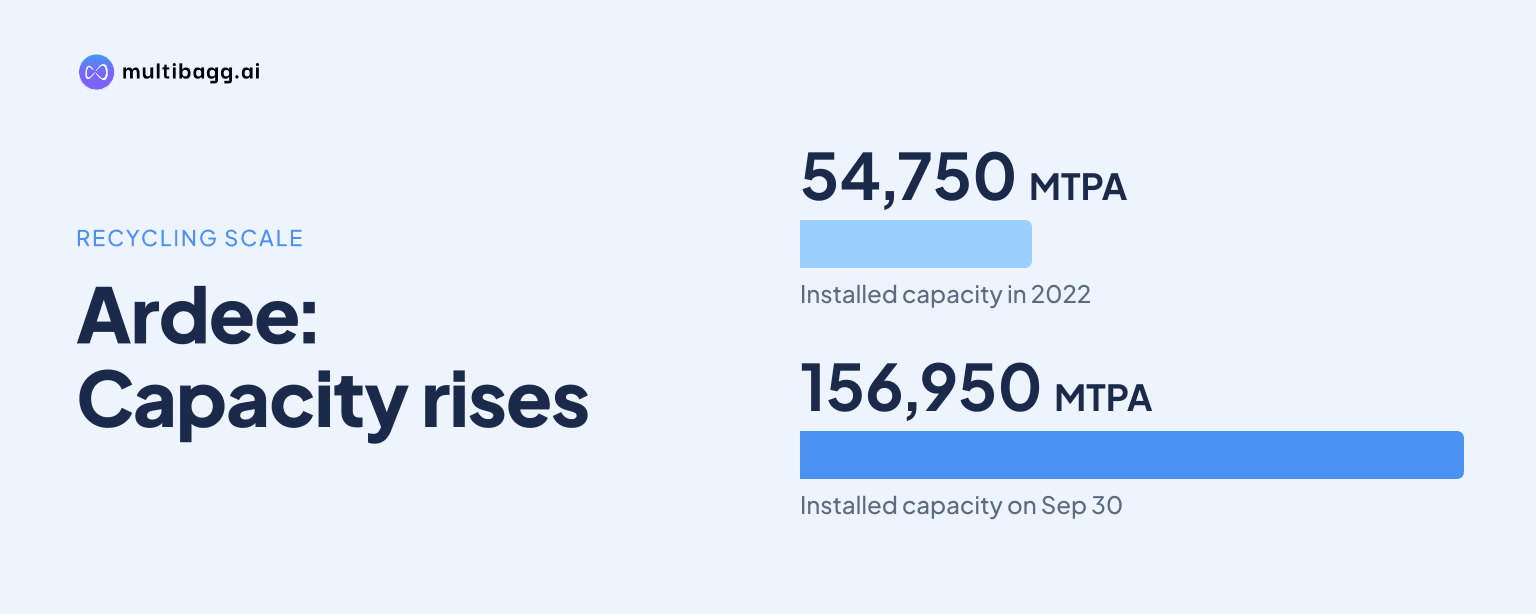
Ardee Industries Limited expanded installed recycling capacity by 102,200 metric tonnes per annum (MTPA), from 54,750 MTPA in 2022 and 2023 to 156,950 MTPA as of September 30, 2026. The company reported intermediate capacity of 104,025 MTPA in 2025 and added London Metal Exchange recognition for ARDEE LEAD 9997 in 2026.
Know Ardee Industries inside out
Results, valuation, peers and who's buying, in one view.
How much did Ardee expand recycling capacity?
Ardee increased its disclosed installed capacity by 102,200 MTPA, or about 187%, between the 54,750 MTPA level reported for 2022 and 2023 and the 156,950 MTPA reported as of September 30, 2026. Its manufacturing facility is located at Naidupet, Andhra Pradesh.
The company disclosed two reported expansion steps after the 2022 and 2023 capacity level. Capacity rose by 49,275 MTPA to 104,025 MTPA in 2025, then increased by a further 52,925 MTPA to 156,950 MTPA in 2026. The 2026 increment was therefore 3,650 MTPA larger than the 2025 increment.
Ardee’s presentation identifies the 156,950 MTPA figure as installed capacity, rather than output or sales volume. In H1 FY27, the company reported sales volume of 33,300 metric tonnes, while Q2 FY27 sales volume was 15,656 metric tonnes; the presentation does not disclose capacity utilisation for either period.
What products does Ardee make from recycled materials?
Ardee recovers and recycles end-of-life energy-storage products and non-ferrous scrap into pure lead, lead alloys and lead ingots. Its pure lead is stated to have 99.97% to 99.985% purity, with standard ingot weights of 23 kilograms to 30 kilograms.
The company’s alloy range includes lead calcium, lead antimony, lead cadmium, lead silver and lead tin alloys. Ardee says it tailors compositions to customer requirements based on the purity and composition of metal and non-metal elements, linking the expanded capacity to refined and customised lead products.
Ardee describes its operating model as integrated recycling of used lead-acid batteries, or ULAB, and non-ferrous scrap. The presentation says 80% to 85% of recycled lead goes to battery makers, while replacement demand is associated with vehicles, backup power, telecom and solar-storage applications.
Which qualifications accompanied Ardee’s capacity build-out?
Ardee added certification, export and exchange-listing milestones between 2021 and 2026 as its disclosed capacity rose from 54,750 MTPA to 156,950 MTPA. In 2021, it received ISO 9001:2015 and ISO 14001:2015 certifications, commercialised its plant, started pure-lead and lead-alloy manufacturing, and commenced exports.
In 2022 and 2023, Ardee received One Star Export House recognition from the Directorate General of Foreign Trade and listed its Ardee brand on the Multi Commodity Exchange, or MCX, for non-ferrous metals. These milestones were reported alongside the 54,750 MTPA capacity level.
Ardee received ISO 45001:2018 certification and became an Authorized Economic Operator recognised by the Central Board of Indirect Taxes and Customs in 2024. In 2025, it converted into a public limited company and adopted the name Ardee Industries Limited while reporting 104,025 MTPA of capacity.
In 2026, ARDEE LEAD 9997 was empanelled with the London Metal Exchange, or LME, and Ardee received Three-Star Export House status. The company also listed on NSE and BSE during 2026, the year in which it reported 156,950 MTPA of manufacturing capacity.
Got a follow-up? Ask IRIS
What sourcing and compliance features does Ardee identify?
Ardee says its supplier network spans more than 85 countries and is supported by direct yard sourcing and diversified procurement channels. The company identifies scrap access as part of its value proposition for supplying its pure lead and alloy portfolio to more than 50 customers across more than six industries.
The presentation identifies import authorisations, original equipment manufacturer approvals, pollution-control consents and extended producer responsibility, or EPR, registrations as entry barriers. It does not disclose the number of each approval or authorisation held, but says its operations are fully approved and ISO-certified.
Ardee also cites in-house quality testing, direct customer relationships and LME and MCX brand listings. Its named customer list includes Amara Raja, Chloride Metals, Glencore International AG, Sebang, thyssenkrupp, Trafigura and IXM, while the company reports exports to eight countries.
How do regulations relate to Ardee’s recycling platform?
Ardee says the Battery Waste Management Rules, or BWMR, 2022 establish recycled-content requirements for new lead-acid batteries of 35% from FY28, rising to 40% by FY30. The presentation also states that recyclers must recover 80% of material under the framework.
For 2026-27, the presentation cites an EPR collection target of more than 80% and says producers must recycle 100% of what they collect. It says EPR certificates are issued only by registered recyclers, which management identifies as a mechanism supporting recurring ULAB feedstock.
Ardee also points to the reverse charge mechanism, or RCM, for battery-scrap transactions. The presentation says RCM shifts goods and services tax liability to registered buyers and promotes documented transactions and greater transparency in domestic scrap procurement.
The company compares recycled lead’s carbon footprint of 0.98 tonnes of carbon-dioxide equivalent per tonne with 1.82 tonnes for primary lead. It describes recycled lead as having an approximately 46% lower carbon footprint and using about 57% less energy than primary lead.
What financial scale did Ardee report during the expansion?
Ardee reported FY26 revenue of Rs 1,167.7 crore, earnings before interest, tax, depreciation and amortisation of Rs 147.1 crore, and profit after tax of Rs 84.7 crore. These FY26 results provide the presentation’s full-year financial reference before the September 30, 2026 installed-capacity snapshot.
In H1 FY27, Ardee reported revenue of Rs 663.6 crore, earnings before interest, tax, depreciation and amortisation of Rs 62.8 crore, profit after tax of Rs 38 crore and sales volume of 33,300 metric tonnes. Q2 FY27 revenue was Rs 324.8 crore, with Rs 29 crore of earnings before interest, tax, depreciation and amortisation, Rs 18.1 crore of profit after tax and 15,656 metric tonnes of sales volume.
Management says its priorities after the 156,950 MTPA expansion are to optimise capacity utilisation, diversify sourcing, expand the customer base and increase value-added product share. Ardee does not disclose a future capacity-utilisation target, revenue forecast or timetable for another capacity expansion.
Conclusion
Ardee’s reported capacity increased from 54,750 MTPA in 2022 and 2023 to 156,950 MTPA as of September 30, 2026, through additions of 49,275 MTPA in 2025 and 52,925 MTPA in 2026. The company paired that growth with ULAB and non-ferrous scrap recycling, 99.97% to 99.985% pure lead products, international sourcing across more than 85 countries, and LME and MCX brand qualifications.
The next items to watch are management’s stated plans to optimise use of the 156,950 MTPA base, diversify scrap sourcing, broaden its customer base and raise value-added product share. Regulatory milestones also remain relevant, with the presentation citing 35% mandatory recycled content in new lead-acid batteries from FY28 and 40% by FY30.