










Arrow Greentech Limited Q1 FY27 Revenue Doubles to ₹87.84 Crore
Key highlights
- Arrow Greentech Limited reported Q1 FY27 revenue of ₹87.84 crore, up 111.15% year on year.
- Q1 FY27 net profit rose 151.19% year on year to ₹27.43 crore.
- Operating profit increased 246.48% sequentially to ₹35.93 crore.
- Arrow Greentech reported an operating or EBITDA margin of 40.9% to 41.4% in Q1 FY27.
powered by IRIS
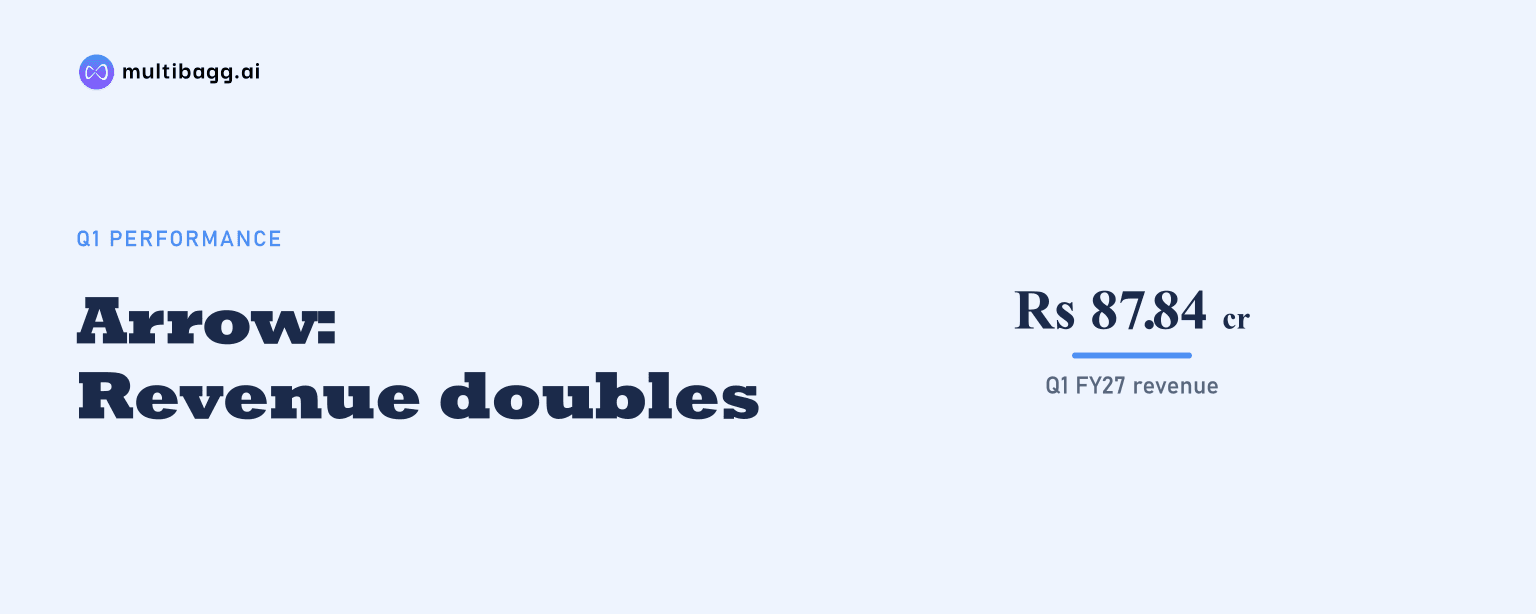
Arrow Greentech Limited reported revenue from operations of ₹87.84 crore in Q1 FY27, up 111.15% year on year and 110.24% sequentially, while net profit rose 151.19% year on year to ₹27.43 crore. The results point to a sharp improvement in operating scale and profitability during the quarter ended June 30, 2026.
Know Arrow Greentech inside out
Results, valuation, peers and who's buying, in one view.
What did Arrow Greentech report for Q1 FY27?
Arrow Greentech reported consolidated revenue from operations of ₹87.84 crore for Q1 FY27, compared with ₹41.78 crore in the preceding quarter and ₹41.6 crore in Q1 FY26. Total income for the quarter stood at ₹89.89 crore. The company said revenue growth reflected the commercial conversion of investments in manufacturing capacity, research and development, and its patent portfolio.
Profitability increased at a faster pace than revenue. Operating profit was ₹35.93 crore, up 246.48% quarter on quarter from ₹10.37 crore. Profit before tax was ₹36.27 crore, compared with ₹10.63 crore in Q4 FY26, while profit after tax reached ₹27.43 crore against ₹7.44 crore in the prior quarter.
The company also reported PBDT of ₹37.90 crore, a sequential increase of 199.13% from ₹12.67 crore. Earnings per share stood at ₹18.15 in Q1 FY27, compared with ₹4.90 in Q4 FY26. The quarterly performance was supported by improved operating leverage, according to the company’s investor presentation.
Why did Arrow Greentech’s profitability improve?
Arrow Greentech attributed the quarter’s performance to the commercialisation of investments made over several years in production capacity, research and development, and intellectual property. The company indicated that these investments helped it convert higher revenue into substantially higher operating and net profit.
The reported operating or EBITDA margin was 40.9% to 41.4%, depending on the presentation reference, compared with 25.6% in Q4 FY26. On a year-on-year basis, the company reported an EBITDA margin of 40.9%, up from 34.3% in Q1 FY26, representing an improvement of 660 basis points.
Finance cost remained at ₹1 crore between Q1 FY26 and Q1 FY27, according to the research material provided. A stable finance cost alongside higher revenue and operating profit limited the pressure of interest expenses on earnings during the quarter.
Got a follow-up? Ask IRIS
Which business segment supported the quarterly growth?
Arrow Greentech’s High-Tech Product segment was identified as the principal contributor to the quarterly performance. The research material stated that high-tech product revenue rose from ₹34.4 crore in Q1 FY26 to ₹81.6 crore in Q1 FY27, supporting the company’s overall revenue growth.
The company’s commentary linked the growth to higher-value security applications and the commercialisation of its product and intellectual-property investments. It also expressed confidence in continued revenue and profit growth through product development and environmentally sustainable innovations, although no quantitative earnings guidance was reported.
The Green Products segment showed softer demand in the material provided. Arrow Greentech said it was tracking demand cycles for these products, while noting exposure to underlying demand patterns and global economic conditions. No earnings-call transcript was published for the quarter, so the available figures and observations are based on the investor presentation rather than management guidance from a call.
How do the Q1 FY27 results matter for investors and operations?
For investors, the key feature of the quarter was the pace of margin expansion alongside revenue growth. Revenue more than doubled year on year, but net profit rose by 151.19%, taking the reported PAT margin to 30.5%, compared with 25.1% a year earlier. This indicates that the increase in sales was accompanied by a larger share of profit retained after expenses and taxes.
The results also show the significance of product mix for Arrow Greentech. High-Tech Product revenue was a major driver of growth, while the Green Products business faced softer demand conditions. The company’s performance therefore reflects both the benefits of higher-value product sales and the sensitivity of some operations to demand cycles.
No share-price movement, order-book figure, dividend decision, or revised annual target was included in the supplied material. Investors assessing the quarter will therefore have to rely on reported financial performance, margin trends, segment developments, and future disclosures from the company.
What should investors watch after Arrow Greentech’s Q1 FY27 results?
The Q1 FY27 results establish a high base for subsequent comparisons, with revenue at ₹87.84 crore and net profit at ₹27.43 crore. Sustaining the performance will depend on the continued commercialisation of capacity, research and development, and patent-related investments cited by the company.
Arrow Greentech’s next scheduled corporate result date in the provided calendar is November 5, 2026, for Q2 FY26-27 results. That update may provide clearer evidence on whether high-tech product demand remains strong, how Green Products demand develops, and whether operating margins remain near the Q1 FY27 level.
Conclusion
Arrow Greentech delivered a substantial increase in Q1 FY27 revenue, operating profit, and net profit, with revenue rising 111.15% year on year to ₹87.84 crore and net profit increasing 151.19% to ₹27.43 crore. The company linked the outcome to commercialisation of prior investments, while margin expansion strengthened the earnings result.
The next point to watch is the Q2 FY26-27 result scheduled for November 5, 2026. Investors will look for updates on High-Tech Product demand, Green Products conditions, margin sustainability, and the company’s product-development and sustainable-innovation plans.