










Arrow Greentech Limited holds 23 patents across seven territories
Key highlights
- Arrow reports 23 in-force granted patents across 7 territories.
- India accounts for 12 of Arrow's 23 in-force patents, while the USA has 4.
- More than 10 Indian and 3 foreign patent applications are under process.
- Arrow reports 41 registered Indian trademarks and 26 trademark applications under processing.
powered by IRIS
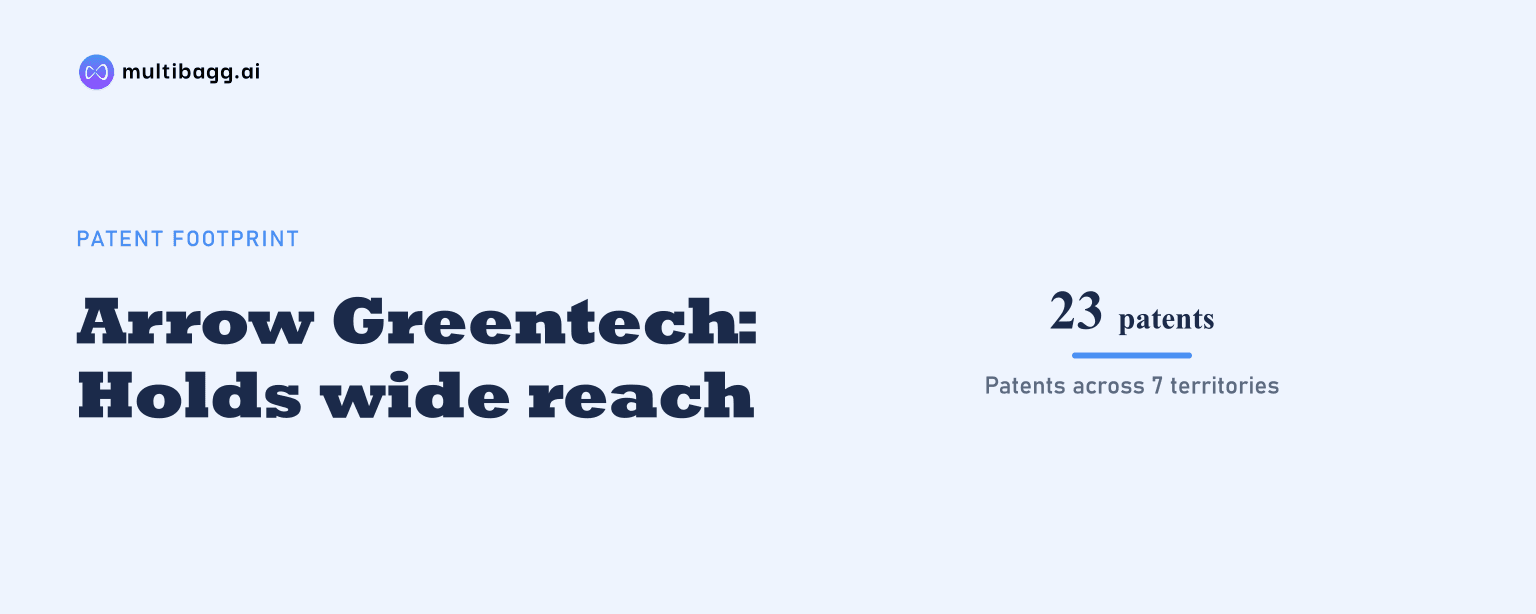
Arrow Greentech Limited reports 23 in-force patents across seven territories in its investor presentation, including 12 granted patents in India and more than 13 patent applications under process in India and foreign markets. The portfolio covers water-soluble films, security products, packaging, healthcare, hygiene, printing and self-adhesive materials.
Know Arrow Greentech inside out
Results, valuation, peers and who's buying, in one view.
How is Arrow's patent portfolio distributed globally?
Arrow has 23 granted patents presently in force across India, the United Kingdom, the United States, Europe, Singapore, Sri Lanka and Malaysia. The company separately says it has obtained more than 50 patents globally over time, meaning the larger figure is cumulative while 23 is the current in-force portfolio.
India accounts for 12 of the 23 in-force granted patents, the largest disclosed territorial count. The USA has four patents, while the UK and Europe together have four; Sri Lanka, Singapore and Malaysia have one patent each. These country and regional figures add to the reported total of 23.
Arrow also reports 41 registered trademarks in India and 26 trademark applications under processing. The trademarks are separate from the 23 patents: the presentation identifies patents as covering technologies and processes, while trademarks protect registered marks.
Which industries do Arrow's patents cover?
Arrow groups its disclosed technologies into five areas: paper and packing, packaging, security products, health, hygiene and food, and printing and self-adhesive materials. The paper and packing group includes cold-water-soluble film, high-strength paper and its manufacturing process, self-destructive irreversible security packaging film, high-security film, and a bio-compostable multi-layered composite.
The packaging group includes improved water-soluble film, cold-water-soluble film, high-strength paper, security packaging film and bio-compostable composite materials. Cold-water-soluble film and self-destructive irreversible security packaging film appear in both the paper and packing and packaging groups, so the presentation classifies technologies by application rather than presenting each occurrence as an additional patent.
In the health, hygiene and food group, Arrow lists improved water-soluble film, medicated bands, a water-soluble-film matrix for samples extracted from living species, and a cleaning device with sustained release of active ingredients. The table lists India dates of 12.12.23 for improved water-soluble film, 20.02.24 for cold-water-soluble film and 13.05.24 for medicated bands, alongside Europe and USA entries for the sample-matrix technology dated 24.07.13 and 18.03.14.
What security technologies does Arrow list in its patents?
Arrow lists colour-shift base film, graphene-based security thread, security laminates, security yarn, multicolour security fibres or planchettes, dual-colour-shift security film, and security packaging technologies in its security-products group. It says these technologies can be used in security labels, secure packaging and security documents including cheques, banknotes and passport papers.
The security table spans India, Sri Lanka, the UK, Malaysia, Singapore, the USA and Europe. It lists an Indian colour-shift base-film entry dated 18.05.2026, an Indian graphene-based security-thread entry dated 20.06.2026, a Sri Lankan security-laminates entry dated 05.06.25, and a US self-destructive irreversible security packaging-film entry dated 23.08.16.
Arrow describes its security-products business as manufacturing anti-counterfeit products for high-security papers and brand protection. The company says this segment has an in-house research and development centre, proprietary technology, fully integrated indigenous technologies and supplies to leading paper mills.
Got a follow-up? Ask IRIS
How does Arrow's healthcare and hygiene portfolio use films?
Arrow identifies water-soluble-film technologies as a common mechanism across health, hygiene, food and packaging applications. Its health list includes mouth-melting strips, gel strips and enzyme strips, while its hygiene list covers detergents, softeners, laundry, dish, flooring, wall and furniture cleaning applications using active ingredients retained for longer periods.
For clinical uses, Arrow says its patented technologies can support blood, serum and urine testing. The presentation also lists a water-soluble-film matrix to contain samples extracted from living species, with entries shown for Europe on 24.07.13 and the USA on 18.03.14.
Arrow also lists printing applications for fabrics, net or perforated cloth, paper, vinyl, hoardings and one-way vision films. In the self-adhesive group, it identifies new improved self-adhesive materials using water-soluble films and self-adhesive wallpaper with reduced adhesive material and water-soluble film, both listed in India with dates of 30.10.23 and 16.03.23.
What patent pipeline and monetisation plan does Arrow disclose?
Arrow reports more than 10 Indian patent applications and three foreign patent applications under process, or more than 13 applications in total. The company says the pending filings mainly cover water-soluble films and the security segment, while its wider filing areas include brand protection, security papers, security films, healthcare, self-adhesive materials and bio-compostable materials.
The company says its in-house research and development and intellectual-property team is continuously working on innovations and patents from its Mumbai research and development laboratory and intellectual-property cell. The presentation does not provide an application-by-application timetable, expected grant dates or a forecast of how many of the more than 13 pending applications will be granted.
Arrow identifies out-licensing key patents and producing patented products as its two disclosed monetisation routes. Management also says innovation is focused on green and high-technology products, illustrated by the bio-compostable multi-layered composite, water-soluble films and security-film technologies, but it does not disclose patent licensing revenue or product sales linked to individual patents.
Conclusion
Arrow's intellectual-property disclosure shows a current portfolio of 23 in-force granted patents across seven territories, with India contributing 12 and the USA plus the UK and Europe contributing eight combined. The technologies span films, packaging, security documents, anti-counterfeit materials, healthcare, hygiene, printing and self-adhesive uses, while 41 registered Indian trademarks add a separate layer of registered brand protection.
The next point to watch is progress on more than 10 Indian and three foreign applications, particularly those involving water-soluble films and security products. Arrow's stated plan to monetise key patents through out-licensing and patented-product production is also relevant, although the presentation gives no timing, partner list, application-level status or revenue target.