










Avery Pharmaceuticals reports over 54 nutraceutical approvals
Key highlights
- Avery Pharmaceuticals says more than 54 nutraceutical products are approved under FSSAI.
- The presentation displays 40 nutraceutical rows and 21 prescription-product rows.
- Avery Pharmaceuticals says more than 10 products are under prescription approval.
- Avery Pharmaceuticals is pursuing registrations in Russia, Yemen and Vietnam.
powered by IRIS
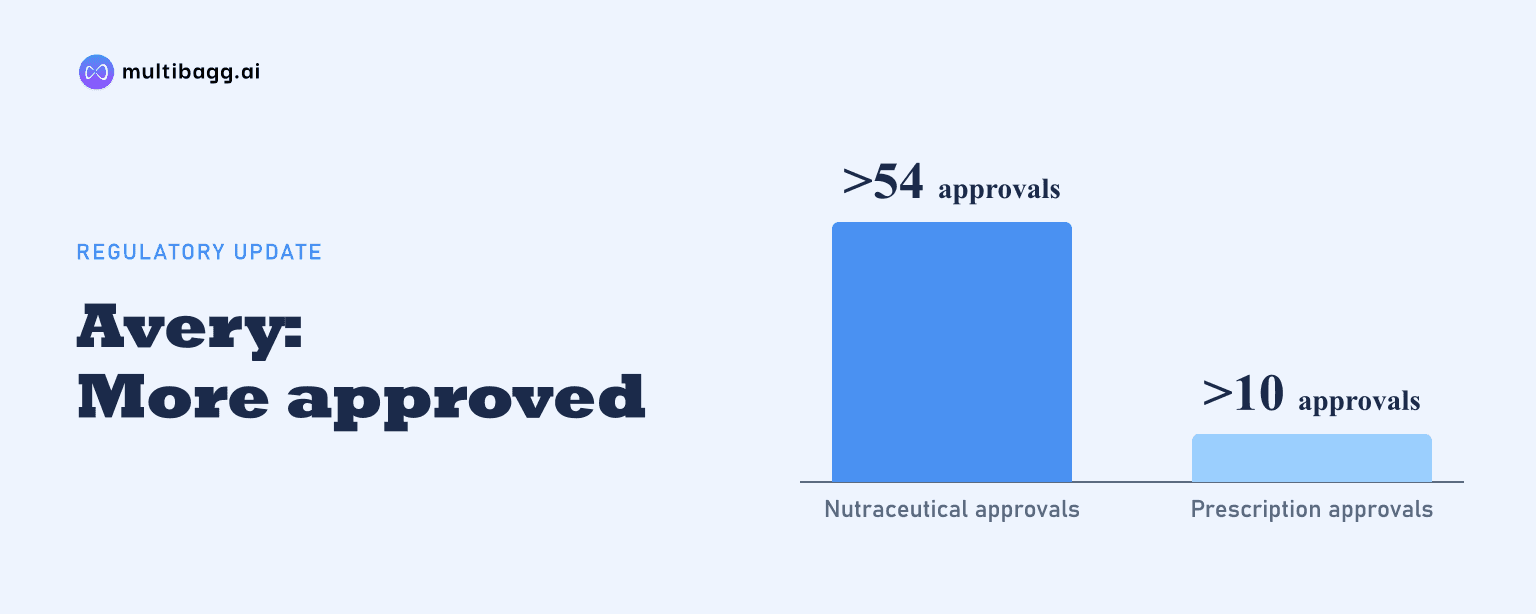
Avery Pharmaceuticals Pvt Ltd reports more than 54 nutraceutical products approved under FSSAI and more than 10 products under prescription approval, using mouth-dissolving strips made at its Sanand, Gujarat facility as it pursues CDMO projects and product registrations in Russia, Yemen and Vietnam.
Know Arrow Greentech inside out
Results, valuation, peers and who's buying, in one view.
How many nutraceutical products has Avery Pharmaceuticals approved?
Avery Pharmaceuticals says it has more than 54 products approved under FSSAI, while its presentation displays 40 nutraceutical product rows. The presentation states that all 40 listed rows belong to the nutraceutical category, but it does not say that the table is a complete list of the more than 54 approved products.
The disclosed nutraceutical range covers vitamins, minerals, botanical ingredients, stimulants and probiotic products in mouth-dissolving-strip, or MDS, formats. Examples include Vitamin B12 MDS at 500, 1,000 and 1,500 micrograms, Vitamin D3 MDS at 400 to 2,000 international units, iron MDS at 17 milligrams, zinc picolinate MDS at 10 milligrams, and melatonin MDS at 0.5 to 10 milligrams.
The 40 displayed nutraceutical rows include combinations as well as single active ingredients. Curcumin MDS is listed at 50 and 100 milligrams, curcumin plus piperine at 45 plus 5 milligrams, and a probiotic product at 5 billion colony-forming units plus 10 milligrams of fructo-oligosaccharides. The range also includes mouth-freshener films and food-grade edible film.
How does Avery Pharmaceuticals' MDS platform work?
Avery Pharmaceuticals describes its patented Embedded Water-Soluble Film technology as the basis for MDS, which embed or entrap one or more active ingredients at controlled concentrations. The presentation says the films dissolve rapidly and can deliver active pharmaceutical ingredients more rapidly than tablets, capsules and liquids.
Avery Pharmaceuticals identifies three delivery routes for its films: lingual, sublingual and buccal. It says MDS melt in the mouth and bypass the gastrointestinal tract, while water-soluble or dispersible films can also contain embedded or coated actives for controlled, time-based release. These are company descriptions of the delivery mechanism; the presentation provides no comparative clinical data.
The company says the platform can be applied to pediatric, geriatric, psychiatric and veterinary therapies, and that multiple molecules have been identified for a first phase of embedding. It does not name those molecules, identify a product in each therapy area, or give a development timetable. The presentation also identifies a biodegradable-polymer delivery device and an RX Matrix system for biological-sample collection, storage and disposal.
Got a follow-up? Ask IRIS
What prescription products and manufacturing credentials does Avery Pharmaceuticals disclose?
Avery Pharmaceuticals says it has a World Health Organization Good Manufacturing Practices, or WHO-GMP, approved facility and an in-house product-development centre in Sanand, Gujarat. It also lists FSSAI, Good Laboratory Practice, ISO 9001 and ISO 22000 certifications for the facility.
The prescription product table has 21 rows, compared with 40 rows in the displayed nutraceutical list. Of the 21 prescription entries, 3 are labelled WHO-GMP products, 5 are licensed for domestic and export markets, and 13 are labelled test-licence products. This differs from the broader statement that more than 10 products are under prescription approval, because the table uses several regulatory and licence classifications.
The three WHO-GMP-labelled products are nicotine polacrilex MDS at 1, 2 and 4 milligrams, ondansetron MDS at 4 and 8 milligrams, and sildenafil MDS at 25 and 50 milligrams. The five licensed products include amlodipine MDS, tadalafil ODS, Vitamin D3 MDS, Vitamin B12 MDS and NOS Primes Spiced Rose. The test-licence list includes clonazepam, dextromethorphan, ketorolac, paracetamol, rizatriptan and zolmitriptan products.
How is Avery Pharmaceuticals building its CDMO and overseas pipeline?
Avery Pharmaceuticals says it is undertaking Contract Development and Manufacturing Organization, or CDMO, projects spanning formulation development through commercial-scale manufacturing. Its stated offering includes controlled active loading, precision dosing, taste masking and customised lingual, sublingual and buccal MDS formats for pharmaceutical and nutraceutical applications.
The company links this CDMO plan to Arrow Greentech Ltd.'s film-casting expertise and its ability to embed active pharmaceutical ingredients in water-soluble films. Avery Pharmaceuticals says it has entered contracts with domestic and international multinational companies and is discussing long-term supply contracts with other companies. The presentation does not disclose the number of customers, contract values, volumes, dates or CDMO revenue.
Avery Pharmaceuticals is pursuing product registrations in Russia, Yemen and Vietnam. The presentation does not identify which of its more than 54 nutraceutical products or 21 displayed prescription entries are being registered in those countries, nor does it give filing dates, approval schedules, launch plans or sales targets. The overseas disclosure therefore describes registration activity rather than approved international launches.
Conclusion
Avery Pharmaceuticals has disclosed a product base of more than 54 FSSAI-approved nutraceutical products and more than 10 products under prescription approval, supported by a 40-row nutraceutical table and a 21-row prescription table. Its MDS platform is being used across vitamins, minerals, botanicals, probiotics and prescription-oriented molecules, with Sanand manufacturing and product-development capabilities cited as the operating base.
The next points to watch are registrations in Russia, Yemen and Vietnam, the unnamed first-phase embedded molecules, and whether discussions for long-term supply contracts result in disclosed agreements. Avery Pharmaceuticals has outlined CDMO activity and listed 21 prescription entries, but the presentation gives no capacity target, contract value, revenue contribution or regulatory decision date for these plans.