










Alufluoride recovers as distant FSA freight costs rise
Key highlights
- Alufluoride's Q2 FY27 revenue was Rs 63.9 crore, or 2.4 times Q1 FY27.
- Alufluoride's supplier reported the FSA supply constraint resolved on 15 July 2026.
- Alufluoride's Q2 FY27 profit after tax rose 91% year on year to Rs 15.2 crore.
- Alufluoride's EBITDA margin before other income rose to 36.1% from 25.4%.
powered by IRIS
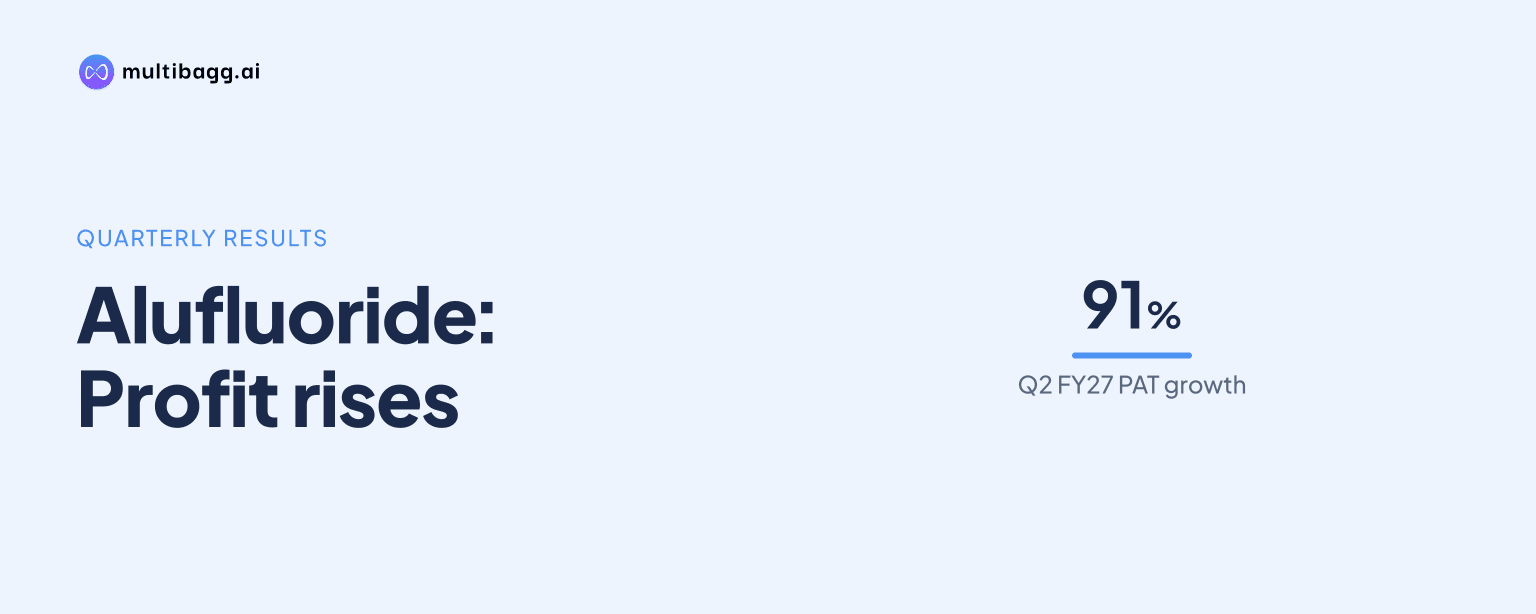
Alufluoride Limited returned its Visakhapatnam operations towards normal in Q2 FY27 after its supplier reported on 15 July 2026 that an FSA supply constraint had been resolved, lifting revenue to Rs 63.9 crore, or 2.4 times Q1 FY27. The recovery coincided with the final expansion phase being available throughout the quarter, while freight from distant FSA sources rose with fuel prices.
Know Alufluoride inside out
Results, valuation, peers and who's buying, in one view.
How did Alufluoride resolve its FSA supply constraint?
Alufluoride said its FSA supply constraint ended when the supplier reported resolution on 15 July 2026. The constraint, which concerned material sourced from fertiliser producers, had been disclosed on 23 May 2026 and contributed to the Q1 FY27 supply shortfall. With supply conditions improved, operations at Visakhapatnam returned towards normal during Q2 FY27.
The timing allowed Alufluoride to use its final expansion phase for the full Q2 FY27 period. That phase was commissioned in June 2026, before the supplier's July resolution notice. The company reported that Q2 FY27 revenue was 2.4 times Q1 FY27, linking the sequential recovery to restored FSA availability and capacity available for the whole quarter.
What did the FSA recovery do to Alufluoride's Q2 FY27 results?
Alufluoride reported Q2 FY27 revenue of Rs 63.9 crore, up 17% year on year, and profit after tax of Rs 15.2 crore, up 91%. Revenue increased more slowly than earnings, while earnings before interest, tax, depreciation and amortisation, or EBITDA, margin before other income rose to 36.1% from 25.4% in Q2 FY26.
Alufluoride attributed the Rs 9.2 crore year-on-year increase in Q2 FY27 profit before tax to several factors. Lower material cost added about Rs 7.9 crore, revenue added Rs 2.3 crore and other income added Rs 0.9 crore, while other costs reduced the improvement by about Rs 2.0 crore. Materials cost, net of inventory change, fell to 36.4% of revenue from 48.8%, and the effective tax rate declined to 26.1% from 29.9%.
The Q2 recovery did not remove the first-quarter disruption from the half-year comparison. H1 FY27 operating revenue was Rs 90.5 crore, down 8% from Rs 98.6 crore in H1 FY26 because of the Q1 FY27 supply shortfall. However, H1 FY27 EBITDA rose 43% to Rs 31.3 crore and profit after tax increased 62% to Rs 17.9 crore despite the lower half-year revenue.
Got a follow-up? Ask IRIS
Why does FSA sourcing remain a risk for Alufluoride?
Alufluoride says FSA cost and availability remain the supply variables it manages most closely because supply comes from the adjacent fertiliser complex as well as more distant sources. The presentation identifies IFFCO Paradeep and Coromandel Kakinada as principal distant sources, and says freight on FSA from these sources is rising with fuel prices. This leaves a transport-cost exposure after the July 2026 resolution.
The sourcing issue also includes quality control because Alufluoride requires all incoming material to meet its specification. This can narrow the available pool of supply when availability changes. The company said Q2 FY27 materials cost benefited from inventory, but that benefit will taper as stocks are consumed, making replenishment cost another item to monitor.
All Rs 63.9 crore of Alufluoride's Q2 FY27 operating revenue came from aluminium fluoride, or AlF₃, according to the income-mix disclosure. Captive solar generated no operating revenue in that disclosure. FSA availability, material quality and freight therefore affect the company's reported operating product rather than a minor activity.
How is Alufluoride managing FSA availability and cost?
Alufluoride is managing FSA through long-term contracts with leading phosphatic fertiliser producers, a wider supplier base and forward purchases of key raw materials. A new FSA source was added from April 2026, before the supplier reported the constraint resolved in July 2026. The company also said suppliers indicated additional quantities as they upgrade their fluorine-recovery facilities, without quantifying those volumes.
The presentation says annual pricing agreements with smelters and forward buying of key raw materials supported Q2 FY27 margins. These mechanisms operated alongside lower materials cost as EBITDA margin before other income rose by 1,070 basis points to 36.1%. Alufluoride also disclosed that the inventory advantage will taper as stocks are consumed, alongside the freight and replenishment-cost exposure.
The expansion has moved from construction into operating assets. At 30 September 2026, net block, meaning property, plant and equipment after depreciation, was Rs 92.9 crore, up from Rs 65.0 crore at 31 March 2026. Capital work in progress fell to Rs 1.8 crore from Rs 22.5 crore as the expansion was capitalised, consistent with the final phase being available in Q2 FY27.
Conclusion
Alufluoride's Q2 FY27 performance shows a supply-chain recovery with measurable financial effects: revenue reached Rs 63.9 crore after the July FSA resolution, profit after tax reached Rs 15.2 crore and EBITDA margin before other income rose to 36.1%. H1 FY27 revenue nevertheless remained 8% below the prior-year period, showing the effect of the Q1 supply shortfall on first-half volume.
The next items to watch are the disclosed tapering of inventory benefits, freight inflation linked to fuel prices and availability of qualified FSA from distant and newly added suppliers. Alufluoride reported Rs 29.1 crore of inventories at September 2026, up from Rs 21.0 crore in March 2026, while suppliers' indicated additional volumes depend on fluorine-recovery upgrades rather than a quantified delivery schedule.