










Alufluoride’s top two buyers account for 72% of AlF₃ revenue
Key highlights
- Alufluoride’s largest customer accounted for 54% of FY26 AlF₃ revenue, down from 69% in FY25.
- Alufluoride’s top two customers accounted for 72% of FY26 AlF₃ revenue, and Odisha accounted for 70%.
- Alufluoride generated all Rs 63.9 crore of Q2FY27 operating revenue from AlF₃, up 17% year on year.
- Alufluoride reported Q2FY27 profit after tax of Rs 15.2 crore, up 91% year on year.
powered by IRIS
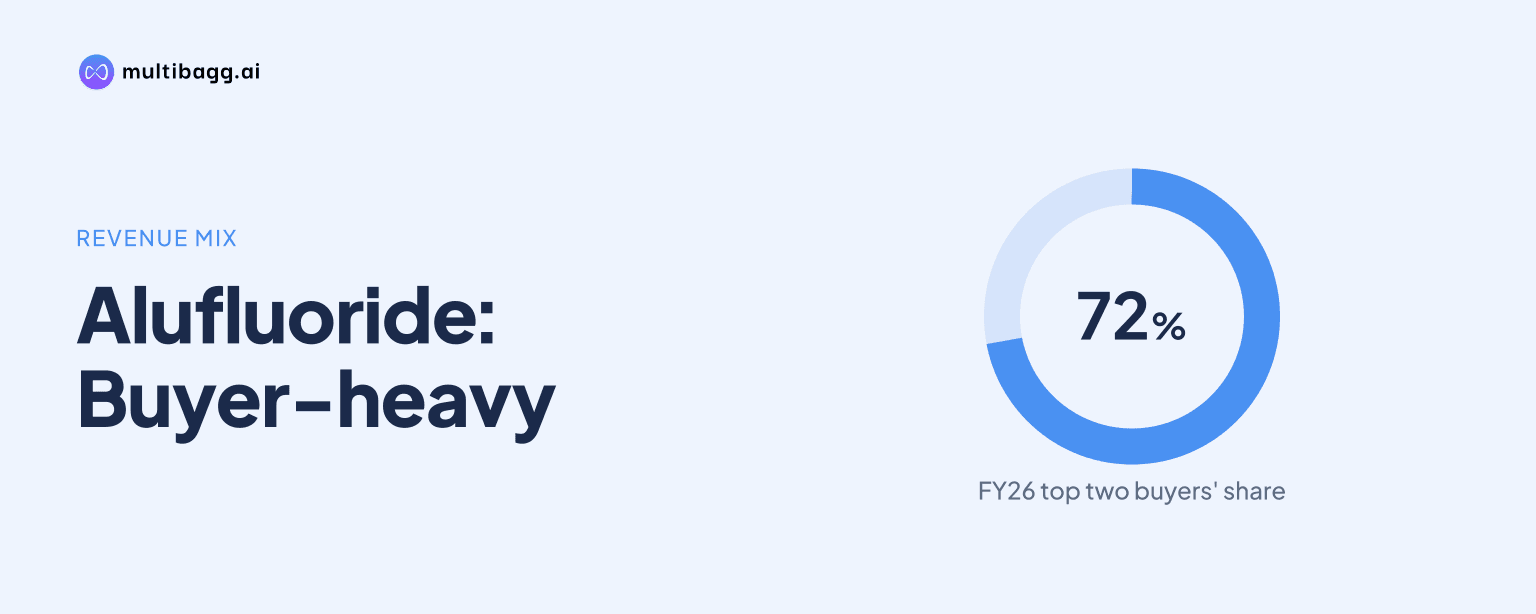
Alufluoride’s top two customers accounted for 72% of its aluminium fluoride, or AlF₃, revenue in FY26, even after the largest customer’s share declined to 54% from 69% in FY25. The disclosure shows lower dependence on one buyer, while revenue remains concentrated among two buyers and in one state.
Know Alufluoride inside out
Results, valuation, peers and who's buying, in one view.
How concentrated is Alufluoride’s customer base?
Alufluoride remained concentrated in FY26: its largest customer generated 54% of AlF₃ revenue, while the top two customers generated 72%. The largest-customer share was 15 percentage points lower than the 69% reported for FY25, showing that the company reduced its reliance on its single biggest buyer over the year.
Alufluoride also reported that Odisha accounted for 70% of AlF₃ revenue in FY26. This geographic concentration broadly tracks the 72% contribution from the top two customers, although the presentation does not identify the customers behind the percentages or provide FY25 comparative figures for the top-two and Odisha measures.
The FY26 movement changed the composition of concentration rather than removing it. Alufluoride’s largest buyer became less dominant, but 72% of AlF₃ revenue still depended on two buyers, leaving sales linked to purchasing decisions at a limited number of aluminium-smelting customers.
Why are Alufluoride’s customer relationships difficult to replace?
Alufluoride supplies high-purity AlF₃ to primary aluminium smelters, where the product acts as a flux in the electrolytic reduction of alumina. The company says it is qualified at Hindalco, Vedanta and NALCO, and states that smelter qualification is slow and exacting because an off-spec consignment can damage potlines.
This qualification process is the mechanism behind Alufluoride’s description of its customer book as sticky. It has received Hindalco’s Resilient Supply Chain recognition and NALCO’s Best Customer award, while its FY26 disclosure still shows 54% of revenue from one buyer and 72% from two, rather than a broadly distributed customer base.
The presentation also says fewer than five AlF₃ manufacturers operate in India and only a few are qualified for high-purity, low-bulk-density supply. That limited qualified supplier field may support established relationships, but it does not change the reported fact that Alufluoride’s FY26 revenue remained concentrated in a small buyer group.
What product and revenue streams underpin Alufluoride’s sales?
Alufluoride generated all Rs 63.9 crore of Q2FY27 operating revenue from AlF₃, up 17% from Rs 54.8 crore in Q2FY26. The company says no Ind AS 108 segment split applies because operating revenue came from a single product line rather than separately reportable operating segments.
Captive solar did not diversify reported sales in either Q2FY27 or Q2FY26, recording zero revenue in both periods. Alufluoride’s 4.1 megawatt solar capacity is largely for internal use, according to the presentation, lowering conversion cost instead of contributing a separate revenue stream.
Other income rose to Rs 1.3 crore in Q2FY27 from Rs 0.4 crore a year earlier, but represented about 6% of profit before tax of Rs 20.5 crore. This was lower than the 71% share of profit before tax attributed to other income in Q1FY27, as operating profit recovered during Q2.
Got a follow-up? Ask IRIS
What do Alufluoride’s latest results show about its operating recovery?
Alufluoride reported Q2FY27 revenue of Rs 63.9 crore, earnings before interest, tax, depreciation and amortisation, or EBITDA, of Rs 24.4 crore, and profit after tax of Rs 15.2 crore. Compared with Q2FY26, revenue rose 17%, EBITDA rose 70% from Rs 14.3 crore, and profit after tax rose 91% from Rs 7.9 crore.
The EBITDA margin before other income increased to 36.1% in Q2FY27 from 25.4% in Q2FY26, a gain of 1,070 basis points. Materials cost fell 13% to Rs 23.3 crore despite higher revenue, while total expenses increased 2% to Rs 44.7 crore, according to the company’s consolidated comparison.
For H1FY27, revenue was 8% lower at Rs 90.5 crore because of the Q1FY27 supply shortfall, but EBITDA rose 43% to Rs 31.3 crore and profit after tax rose 62% to Rs 17.9 crore. Q2FY27 revenue was also 2.4 times Q1FY27 revenue on recovery in hydrofluosilicic acid, or FSA, supply.
How is Alufluoride seeking to broaden its customer base?
Alufluoride is pursuing qualification with additional buyers and overseas markets through Alufluoride International Pte. Ltd., Singapore. The presentation does not quantify potential sales from this effort or give a timetable for customer approvals, but it identifies new qualifications and overseas markets as its route to widening the buyer base.
Alufluoride links that plan to prospective domestic smelter additions by NALCO, Hindalco and Vedanta of about 1.55 million tonnes per annum, equal to 36% of India’s base. At consumption of 14 to 20 kilograms of AlF₃ per tonne of aluminium, these additions would require an estimated 21,600 to 30,900 tonnes of AlF₃ annually.
Vedanta’s additions are expected by FY28, while NALCO’s Angul smelter is listed for 2030-31. Those projects could expand the addressable market, but Alufluoride’s disclosed concentration figures remain the relevant measure until additional buyers complete qualification and begin contributing revenue.
Conclusion
Alufluoride reduced the share of AlF₃ revenue supplied to its largest customer to 54% in FY26 from 69% in FY25, while Q2FY27 operating revenue rose 17% to Rs 63.9 crore. Yet the top two buyers still represented 72% of FY26 AlF₃ revenue and Odisha represented 70%, so sales remained concentrated despite the improvement in the largest-customer measure.
The next points to watch are Alufluoride’s stated pursuit of additional domestic and overseas qualifications through its Singapore entity, and the timing of customer smelter projects. The presentation identifies Vedanta additions by FY28 and NALCO’s Angul smelter in 2030-31, alongside estimated additional AlF₃ demand of 21,600 to 30,900 tonnes a year.