










Alufluoride exits Jordan JV, shifts overseas push to Singapore
Key highlights
- Alufluoride completed its Jordan JV exit and said related write-downs were absorbed in its Q2 FY27 roadmap.
- Alufluoride International Pte. Ltd., Singapore, will pursue overseas markets at much reduced cost, with no sales target disclosed.
- Alufluoride's Visakhapatnam aluminium fluoride capacity is 24,000 TPA, up from 18,000 TPA.
- An additional FSA supplier plant was added from April 2026 to widen Alufluoride's feedstock base.
powered by IRIS
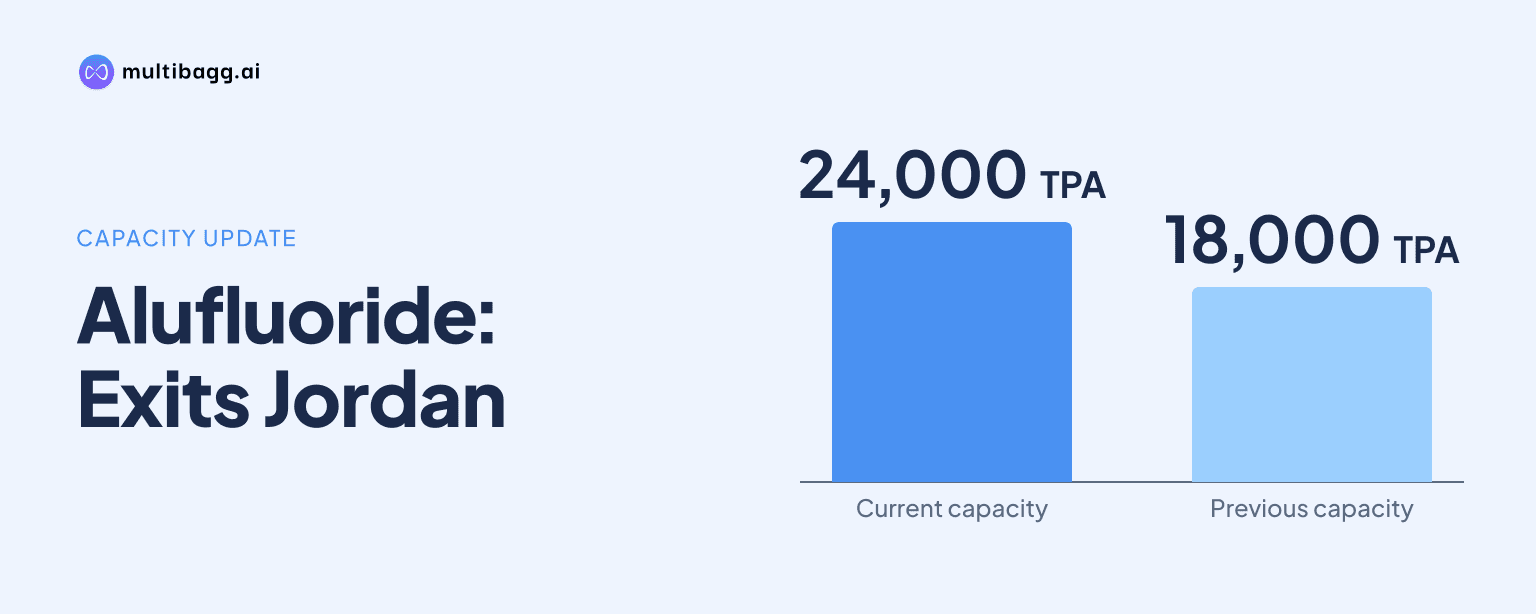
Alufluoride Limited said in its Q2 FY27 strategic roadmap that it completed its Jordan joint-venture exit, absorbed related write-downs and shifted overseas market pursuit to Singapore-based Alufluoride International Pte. Ltd. at much reduced cost. The reset sits alongside its 24,000-tonne-per-annum aluminium fluoride plant in Visakhapatnam.
Know Alufluoride inside out
Results, valuation, peers and who's buying, in one view.
Why did Alufluoride exit the Jordan JV?
The presentation does not state why Alufluoride exited the Jordan JV; it says only that the exit was completed and write-downs were absorbed by the Q2 FY27 presentation. The company did not disclose the investment amount, the write-down amount, the identity of the joint-venture partner or the date on which the exit closed. Its roadmap instead presents the exit as part of a “disciplined overseas reset”, rather than as a continuing overseas operating model.
The change is between the two routes to overseas markets identified in the Q2 FY27 material. The prior Jordan JV route has ended, while Alufluoride International Pte. Ltd., Singapore, is now assigned to pursue overseas markets. Alufluoride explicitly says the Singapore vehicle will do so at “much reduced cost”, but gives no cost comparison in rupees, sales target or timetable for overseas revenue from the Singapore entity.
The exit also appears in a roadmap containing several projects still at an assessment stage. A greenfield alumina hydrate facility is under exploration, potential second-site aluminium fluoride capacity is under evaluation, and fluorine-derivative chemistries are being assessed. In that context, the completed Jordan exit is one of the few roadmap actions described as finished, while the remaining initiatives require further project definition.
How will Alufluoride pursue overseas markets from Singapore?
Alufluoride will pursue overseas markets through Alufluoride International Pte. Ltd., Singapore, according to the Q2 FY27 roadmap. The presentation identifies Singapore as the replacement vehicle after the Jordan JV exit, but does not state whether the entity will sell directly, appoint distributors, hold inventory, arrange exports, or carry out marketing and customer qualification. It also does not identify any overseas country, customer, contract volume or pricing arrangement.
The stated mechanism is lower cost, not a disclosed expansion target. Alufluoride describes the Singapore entity as pursuing overseas markets “at much reduced cost”, whereas the former Jordan JV is described only through its completed exit and absorbed write-downs. This comparison establishes a change in international market structure, but the presentation does not quantify the cost saving or say when the new model should contribute to revenue.
Alufluoride’s existing product is high-purity aluminium fluoride, or AlF₃, made from hydrofluosilicic acid, or FSA, at Visakhapatnam. The Q2 FY27 presentation says AlF₃ is used as a flux in the electrolytic reduction of alumina by primary aluminium smelters, naming Hindalco, Vedanta and NALCO. That industrial use explains the relevance of overseas market development, although the roadmap gives no evidence that the Singapore entity has secured export orders.
Got a follow-up? Ask IRIS
Which domestic assets support Alufluoride's overseas reset?
Alufluoride’s manufacturing base is a 24,000-tonne-per-annum, or TPA, AlF₃ facility in Visakhapatnam, up from 18,000 TPA. The 6,000-TPA increase is the source’s clearest comparison of operating scale, showing that capacity increased from the earlier 18,000-TPA level. The site also has 4.1 megawatts of captive solar power, providing part of the electricity used at the coastal plant, though the presentation does not state the solar share of total consumption.
The company describes its Visakhapatnam location as being within manageable freight range of every major Indian smelter and on the same coast as both principal FSA suppliers. Its supply arrangements include long-term contracts with IFFCO Paradeep and Coromandel International, which together cover the bulk of feedstock needs. An additional supplier plant was added from April 2026, and further quantities were indicated after a supplier’s fluorine-recovery upgrade.
Alufluoride had 102 employees as of 31 March 2026 and held three ISO certifications: ISO 9001, ISO 14001 and ISO 45001. The company says it maintains strict incoming-quality specifications across its FSA sources. That quality process matters because the presentation says relatively few Indian AlF₃ manufacturers qualify for high-purity, low-bulk-density supply, and that an off-spec consignment can damage smelter potlines.
What projects could follow Alufluoride's overseas reset?
Alufluoride is exploring a greenfield alumina hydrate facility as a separate vertical and for raw-material security. Its objects clause was altered through a postal ballot in April 2025, enabling this direction, but the Q2 FY27 presentation does not state a plant location, capacity, capital cost or commissioning date. The company has therefore disclosed an exploratory project, not a formal construction commitment.
A second AlF₃ site is also under evaluation for domestic and overseas markets. This differs from the existing 24,000-TPA Visakhapatnam facility because the proposed capacity has no stated location or size. Alufluoride’s roadmap similarly lists adjacent fluorine-derivative chemistries and value-added silica products, with silica described as a byproduct of AlF₃ production, but no product specifications or revenue forecasts are disclosed.
The roadmap additionally says transport of raw materials through electric vehicles is under examination. Across the alumina hydrate, second-site AlF₃, fluorine derivatives, silica value-add and green-logistics items, Alufluoride states that formal commitments will follow only after specifications, capital cost, financing and revenue economics are determined to the board’s satisfaction. That condition leaves the scale, financing method and timing of every new-project option unresolved in Q2 FY27.
Conclusion
Alufluoride has replaced a concluded Jordan JV structure with a Singapore entity intended to pursue overseas markets at lower cost, while retaining its 24,000-TPA Visakhapatnam AlF₃ base and domestic feedstock arrangements. The presentation confirms the exit and the absorption of write-downs, but does not quantify either item or disclose export revenue, customers or operating targets for Alufluoride International Pte. Ltd.
The next disclosures to watch are management’s formal commitments on the second AlF₃ site, alumina hydrate, fluorine derivatives and silica value-add. Under Alufluoride’s stated plan, those decisions depend on specifications, capital cost, financing and revenue economics being satisfactory to the board; meanwhile, the additional FSA supplier plant added from April 2026 is the identified near-term supply-network development.