










Arvaya targets 791 operational beds by December 2026, from 517
Key highlights
- Arvaya ended September 2026 with 517 operational beds, up from 262 a year earlier.
- Arvaya targets about 791 operational beds by December 2026, adding 274 beds from the September base.
- Q2 FY27 revenue was Rs 40 crore, up 35% quarter on quarter, while EBITDA was Rs 5.24 crore.
- Arvaya has filed for a rights issue of about Rs 206 crore for equipment, fit-outs and planned acquisitions.
powered by IRIS
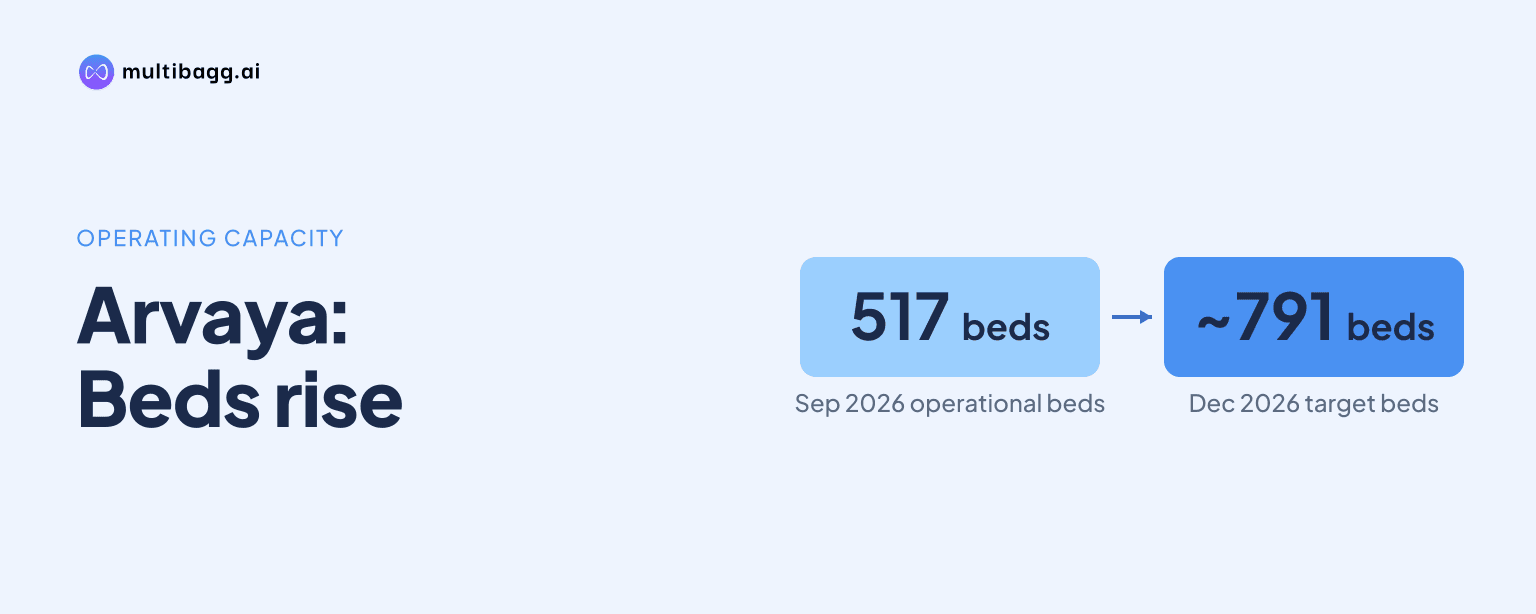
Arvaya Healthcare Limited plans to raise its operational bed count from 517 at September-end to about 791 by December 2026, a 274-bed expansion centred on acquired and leased hospitals. Management said the rollout requires medical-equipment investment and fit-outs, while newer facilities are expected to lift utilisation as they mature.
Know Arvaya Healthcare inside out
Results, valuation, peers and who's buying, in one view.
How will Arvaya reach 791 operational beds by December 2026?
Arvaya expects to reach about 791 beds by December 2026 by bringing acquired capacity into operation and integrating Sushodha Institute of Gastroenterology. The company ended September with 517 operational beds, compared with 262 a year earlier, after completing the acquisition of SeCURE Hospitals and associated units in March 2026. Management said SeCURE comprises nine multi-specialty hospitals across seven cities in Karnataka and Maharashtra, offering more than 22 specialties.
The 791-bed target includes Sushodha, a specialised gastroenterology hospital whose integration began on November 1 after permissions were received. Management described Sushodha as a profitable unit acquired through a 100% share-swap transaction without cash payment, with a monthly revenue run rate of about Rs 1 crore. The facility provides gastrointestinal surgery, including pancreatic and liver support, extending Arvaya's gastroenterology offering.
Arvaya's model relies principally on leased premises rather than owned real estate. All operating units except Gadag are leased, according to management, so capital is directed towards doctors, equipment and technology. A new 100-bed hospital in a leased building costs about Rs 23.6 crore to establish, and management expects a newly built unit to break even in roughly 18 to 24 months.
Why has Arvaya's occupancy fallen despite higher patient activity?
Arvaya's reported occupancy fell to 38% in H1 FY27 from 48% a year earlier because its operating bed base nearly doubled, rather than because management reported declining patient volumes. Patient discharges in Q2 FY27 increased 38% year on year to 5,526, while outpatient visits rose to 35,429 from 33,500. Management said the lower consolidated ratio reflects newly acquired hospitals and beds still being fitted out.
The utilisation difference between mature and newer sites shows the reason for the blended decline. Established hospitals operated at 46% occupancy, while newer hospitals reached 27%, up from roughly 10% to 11% earlier. Management said more than 200 acquired beds were under fit-out and that occupancy should normalise as the new hospitals become operational and patient volumes build.
Hubballi illustrates the effect of adding capacity during the period. Its two units had 135 beds and recorded 56.5% occupancy in H1, but the second unit only started in June. Mysuru-II was added in August and had the network's highest average revenue per occupied bed, or ARPOB, at Rs 31,000, while management said the acquired Kolhapur hospital broke even in its first month.
Got a follow-up? Ask IRIS
What funds Arvaya's bed rollout and fit-outs?
Arvaya said borrowings and operating cash flow are funding fit-outs, equipment and lease deposits needed to make acquired beds operational. As of September 30, equity stood at Rs 63.96 crore, borrowings at Rs 31.34 crore and cash at Rs 2.8 crore, resulting in net debt of about Rs 28.5 crore. Management put net debt at about 0.45 times equity.
The company generated operating cash flow of about Rs 8.6 crore in H1 FY27, equal to 89% of earnings before interest, tax, depreciation and amortisation, or EBITDA, of about Rs 9.21 crore. Management said borrowings were supporting capital expenditure, with asset growth and lease-related deposits accompanying the capacity additions.
Arvaya has also filed for a rights issue of about Rs 206 crore to fund medical equipment, fit-outs and planned acquisitions. Management separately said it had signed memorandums of understanding, or MoUs, for 220 beds in Jalna, Sangli and Shivamogga, due by the end of the next financial year. Its longer-range target is about 1,200 beds by the end of FY28 and roughly 2,400 beds by FY30 through operating partnerships and acquisitions.
Can higher-acuity care support Arvaya's expansion economics?
Arvaya said its ARPOB increased about 17% year on year to Rs 23,651 in Q2 FY27, primarily because of a richer specialty and surgical case mix rather than material price increases. Management identified cardiology, neurosciences, kidney care and robotic surgery as contributors, and said price adjustments were only nominal and related to inflation.
Q2 FY27 revenue was Rs 40 crore, up 35% quarter on quarter, while EBITDA rose 32% to Rs 5.24 crore. The EBITDA margin was 13.0%, compared with 13.1% in Q1, which management attributed to start-up costs at newer hospitals. Profit after tax was Rs 1.37 crore in Q2, compared with Rs 0.53 crore in Q1.
Management expects EBITDA margins to remain in the 13% to 14% range as the network expands, while acknowledging that hospitals can affect margins until they reach at least 50% occupancy. Government-sponsored schemes, including Ayushman Bharat, account for about 15% to 20% of the mix, management said. It added that private insurance and self-paying patients have higher profitability, while government schemes help utilisation and fixed-cost coverage.
Conclusion
Arvaya's stated December 2026 goal would add 274 beds to its September operating base of 517, extending an asset-light network that had already risen from 262 beds a year earlier. The immediate trade-off is visible in occupancy: consolidated utilisation was 38%, below the prior year's 48%, while newer hospitals operated at 27% and mature hospitals at 46%.
The next measures to watch are the operationalisation of fitted-out beds, the integration and revenue development of Sushodha, and progress on the proposed Rs 206 crore rights issue. Management also plans to launch the Arvaya app during the financial year; it said about 30,000 earlier patient records had already been ingested into systems built on the Fast Healthcare Interoperability Resources, or FHIR, standard.