










ArvayaSecure reaches 30,000 members before clinical pilot
Key highlights
- ArvayaSecure reported 30,000 enabled members against a past-patient base of about 2 lakh.
- More than 30,000 patients had full-history longitudinal records in the FHIR R4 standard.
- SecurANT.ai processes approximately 10,000 clinical documents each day.
- The Alpha+ engine is ready for a clinical pilot at one SeCURE hospital.
powered by IRIS
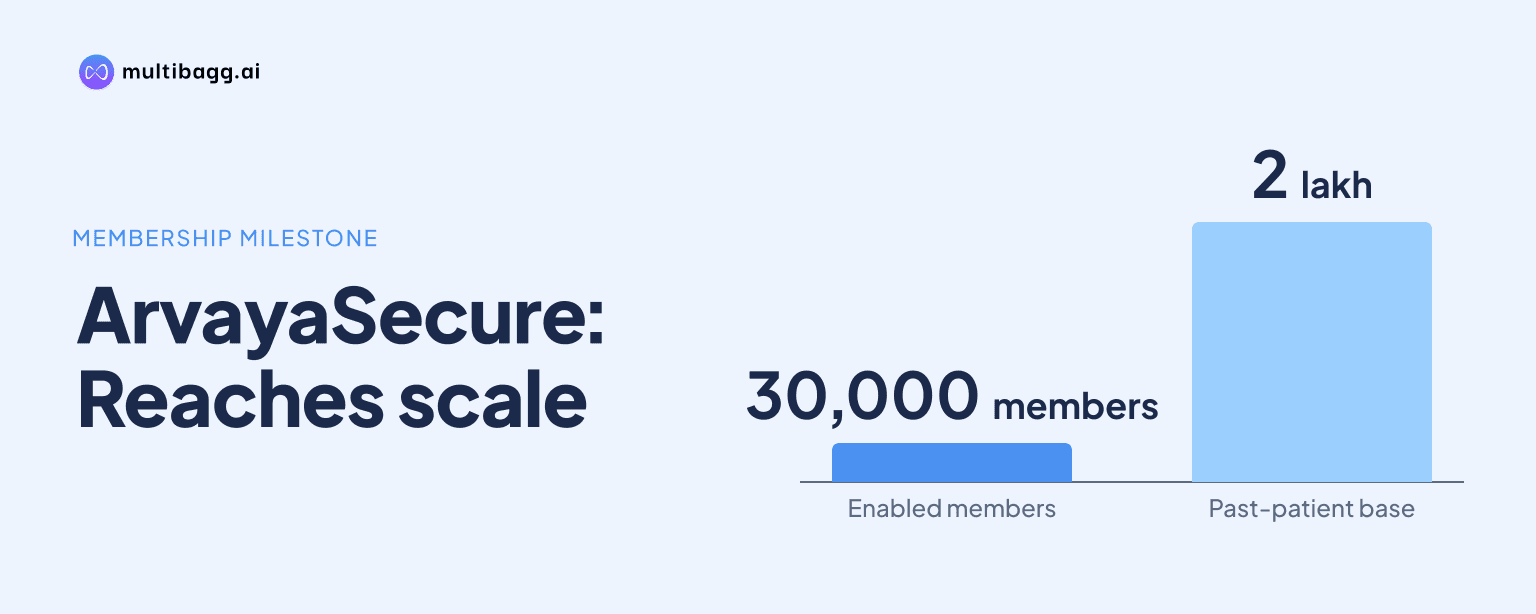
ArvayaSecure app reported 30,000 enabled members and more than 30,000 patients with full-history digital records, while SecurANT.ai processed approximately 10,000 clinical documents daily and had its Alpha+ engine ready for a clinical pilot at one SeCURE hospital. The figures sit against a past-patient base of about 2 lakh.
Know Arvaya Healthcare inside out
Results, valuation, peers and who's buying, in one view.
How large is ArvayaSecure's current digital patient base?
ArvayaSecure reported 30,000 enabled members, compared with a past-patient base of about 2 lakh across SeCURE. The presentation identifies enabled members as the current scale of the patient-facing platform, which includes consolidated health records, appointment booking, tele-consultation, home diagnostics, pharmacy services and preventive engagement.
ArvayaSecure separately reported more than 30,000 patients with a longitudinal, full-history record in the Fast Healthcare Interoperability Resources, or FHIR, R4 standard. The presentation does not state that enabled members and patients with longitudinal records are identical groups, nor does it say that all 2 lakh past patients have an enabled account or full-history digital record.
The comparison shows that ArvayaSecure's reported member and longitudinal-record populations are each far smaller than the 2 lakh past-patient base. The stated operating model begins with hospital visits creating records, then moves through patient engagement and wellness or care access to support appropriate care delivery and increased network utilisation.
How does ArvayaSecure connect hospital care with digital access?
ArvayaSecure is designed to connect hospital activity with automatic patient onboarding, richer clinical data and patient engagement. Its presentation describes a sequence in which hospital visits create records, those records become longitudinal data, and the app provides access to wellness and care services across the network.
The access layer is planned for iOS, Android, web and WhatsApp in four languages as part of an FY27 launch. Listed functions include appointment booking, tele-consultation, diagnostics at home and pharmacy services, alongside preventive engagement and a health-score display in the app interface.
ArvayaSecure's current position is described as records created through hospital visits plus access and wellness plans. The presentation does not disclose the number of the 30,000 enabled members using each feature, digital-membership revenue, or the methodology behind the displayed health score.
FHIR-based standardisation is the mechanism linking the app's longitudinal-record objective with SecurANT.ai's clinical-data workflow. The source says this framework supports longitudinal patient data and AI-powered clinical insights, but does not quantify the proportion of the 10,000 daily documents that are linked to app users.
Got a follow-up? Ask IRIS
What does SecurANT.ai process and produce today?
SecurANT.ai processes approximately 10,000 clinical documents daily and has created more than 30,000 FHIR R4 longitudinal patient records. The platform is described as an integrated clinical-data system that consolidates information across Arvaya's network, transforms it into structured records and provides insights intended to support clinical decisions and coordinated care.
Its five-stage workflow is collect, organise, standardise, analyse and enable. SecurANT.ai ingests information from multiple sources, extracts data from unstructured and structured documents, converts the data into clinical and coding standards, applies analytics, and uses the resulting information to support care enablement.
The daily document-processing volume and the 30,000-plus longitudinal-record figure measure different parts of the platform. Documents represent clinical-information flow, while longitudinal records represent patients whose full-history information has been assembled in the FHIR R4 standard; the presentation does not disclose documents per patient, processing accuracy or turnaround times.
SecurANT.ai is also described as system independent, meaning it is intended to work across different hospital systems. Its stated priority clinical application is diagnostic support through insights and trend analyses on various parameters, although the source provides no clinician-adoption or clinical-outcome metrics for the current processing scale.
What is the next stage for ArvayaSecure and SecurANT.ai?
ArvayaSecure is planned to launch its access layer in FY27, while SecurANT.ai's Alpha+ engine is ready for a clinical pilot at one SeCURE hospital. Readiness for a pilot indicates a preparation stage, not a completed deployment, and the presentation does not name the hospital, provide a pilot start date or specify evaluation criteria.
Management identifies diagnostic support, including parameter insights and trend analyses, as the Alpha+ engine's priority application. The proposed one-hospital pilot follows the disclosed base of more than 30,000 FHIR R4 records and approximately 10,000 documents processed daily, but no clinical-effectiveness target, commercial target or expansion timetable is provided.
ArvayaSecure also identifies a potential capitation pilot as a future opportunity, subject to the regulatory framework. The source does not disclose a covered population, payment amount, partner, launch date or whether the potential capitation pilot would use the same patient cohort as the FY27 app rollout.
Conclusion
ArvayaSecure has reported a tangible digital operating base of 30,000 enabled members, more than 30,000 longitudinal patient records and approximately 10,000 clinical documents processed daily by SecurANT.ai. The comparison with the 2 lakh past-patient base indicates scope for wider digital coverage, while the source does not establish a one-to-one relationship between enabled members and full-history records.
The next disclosed milestones are the FY27 availability of ArvayaSecure across iOS, Android, web and WhatsApp in four languages, and the Alpha+ clinical pilot at one SeCURE hospital. Readers should watch for management disclosures on the pilot's timing, evaluation measures and results, as well as any progress on the potential capitation pilot that remains subject to the regulatory framework.