










Arvaya hospital beds reach 517 as occupancy recovers to 38%
Key highlights
- Arvaya operated 517 beds in Q2 FY27, compared with 262 beds in Q2 FY26.
- All-hospital occupancy was 38% in Q2 FY27, versus 35% in Q1 FY27 and 48% in Q2 FY26.
- Inpatient discharges increased 38% year on year to 5,526 in Q2 FY27.
- Hubballi reported H1 FY27 occupancy of 56.5%, while Shivamogga reported 12.3%.
powered by IRIS
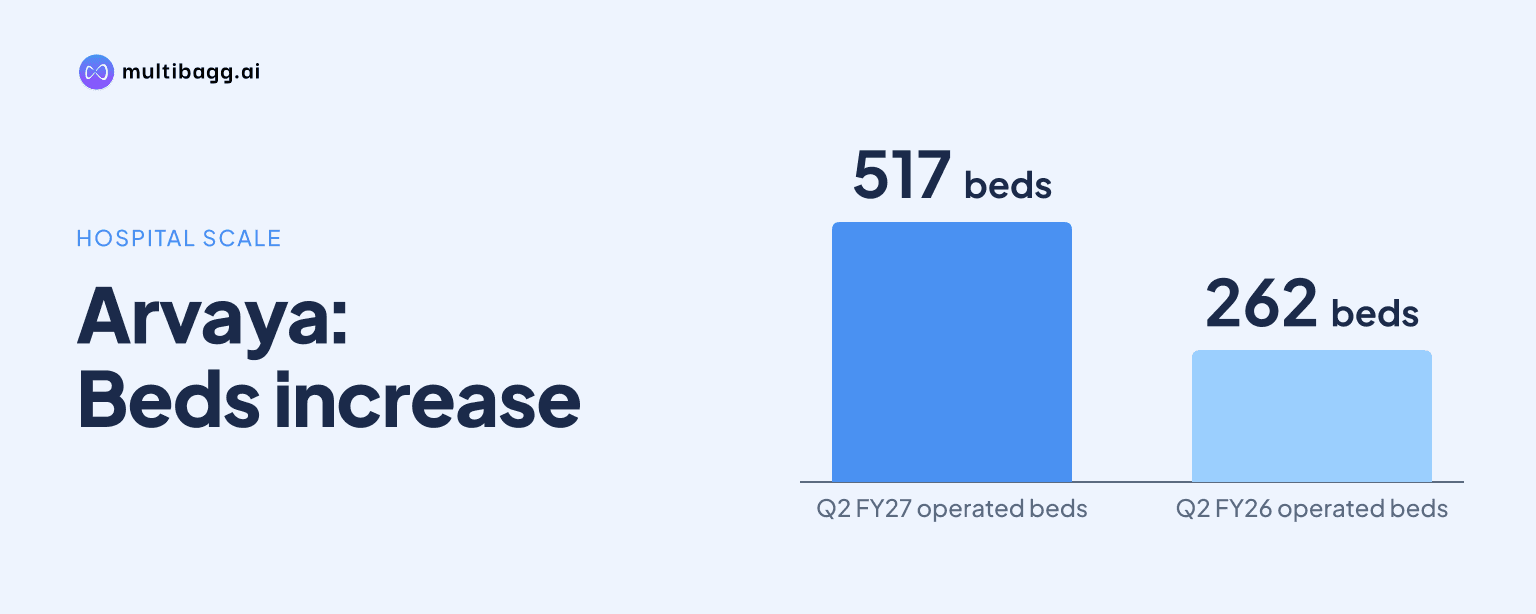
Arvaya Healthcare Limited operated 517 beds in Q2 FY27, with all-hospital occupancy recovering to 38% from 35% in Q1 FY27 but remaining below 48% in Q2 FY26. The network added 255 beds year on year, while inpatient discharges rose 38% to 5,526 and average revenue per occupied bed-day reached Rs 23,651.
Know Arvaya Healthcare inside out
Results, valuation, peers and who's buying, in one view.
How quickly has Arvaya expanded its hospital network?
Arvaya increased operational beds from 262 in Q2 FY26 to 417 in Q1 FY27 and 517 in Q2 FY27. That is an addition of 255 beds over 12 months and 100 beds during the latest quarter. Its SeCURE Hospitals network comprises nine multi-specialty hospitals across seven cities in Karnataka and Maharashtra, with more than 22 specialties.
The 517-bed portfolio includes tertiary and quaternary-care services such as cardiology, neuro and neurosurgery, surgical oncology, urology and kidney transplant, robotic surgery, obstetrics and gynaecology, paediatrics, critical care and gastroenterology. The presentation also reports 320 practising consultants, including 72 on payroll, and 814 hospital staff, including 331 nurses, in H1 FY27.
The expansion changed the capacity base against which utilisation is measured. Arvaya's Q2 FY27 bed count was nearly double the 262 beds reported a year earlier, while all-hospital occupancy was 10 percentage points lower than the Q2 FY26 level. The presentation does not provide separate reported occupancy figures for established and newer hospital cohorts, despite listing those cohort labels in its operating-metrics table.
What does Arvaya's 38% occupancy indicate?
Arvaya's 38% occupancy in Q2 FY27 indicates a 3-percentage-point sequential recovery after the network reached 517 beds, although it was below the 48% reported in Q2 FY26. Inpatient discharges rose from 4,214 in Q1 FY27 to 5,526 in Q2 FY27, an increase of 1,312, alongside the addition of 100 operational beds.
Year on year, inpatient discharges increased by 1,521 from 4,005 in Q2 FY26 to 5,526 in Q2 FY27. Outpatient visits also increased to 35,429, compared with 33,144 in Q1 FY27 and 31,802 in Q2 FY26. The source does not disclose outpatient-to-inpatient conversion, average length of stay, specialty-level occupancy or reasons for the occupancy movement.
Arvaya reported average revenue per occupied bed-day, or ARPOB, of Rs 23,651 in Q2 FY27. This was Rs 1,186 above the Rs 22,465 reported in Q1 FY27 and Rs 3,441 above the Rs 20,210 reported in Q2 FY26. The presentation describes the year-on-year ARPOB increase as 17%, while noting that the measure concerns occupied bed-days rather than the share of available beds occupied.
Got a follow-up? Ask IRIS
Which Arvaya hospitals have the highest utilisation?
Hubballi, comprising two units, had the highest reported occupancy at 56.5% in H1 FY27 and was also the largest location, with 135 operational beds in September 2026. Mysuru-II reported 46.3% occupancy across 100 beds, followed by Mysuru-I at 42.8% across 65 beds. Hubballi's ARPOB was Rs 28,200, while Mysuru-II recorded the portfolio's highest reported ARPOB at Rs 31,100.
Shivamogga reported the lowest occupancy at 12.3% across 60 beds in H1 FY27. Solapur had 16.4% occupancy across 50 beds and Chikkamagaluru had 19.3% across 35 beds. Together, these three locations accounted for 145 of the network's 517 operational beds, based on the September 2026 portfolio table.
Occupancy and ARPOB differed across individual hospitals in H1 FY27. Solapur's 16.4% occupancy was accompanied by ARPOB of Rs 25,500, above Kolhapur's Rs 18,200 at 29.5% occupancy. Gadag reported 33.6% occupancy but the lowest ARPOB, at Rs 10,000. Arvaya does not disclose hospital-level revenue, costs or profit, so the presentation does not establish each unit's financial contribution.
How is Arvaya funding its next hospital additions?
Arvaya says all operating units use leased premises, except one Gadag unit owned for historical reasons. Under this asset-light model, the company directs capital towards medical equipment, doctors and technology rather than real estate. The presentation estimates that a new 100-bed hospital in a developer-built leased building costs about Rs 23.6 crore to establish.
Arvaya says the taken-over Kolhapur and Mysuru-II hospitals broke even from their first month. For new-build hospitals, management plans for break-even in about two years. This is a stated plan for new facilities rather than a reported network-wide profitability result, and the presentation does not provide lease costs, total capital expenditure or hospital-level earnings.
The company lists a pipeline of about 791 beds by December 2026, compared with 517 operational beds in September 2026. It also identifies more than 220 beds under memoranda of understanding in Jalna, Sangli and Shivamogga by March 2028, and a target of about 2,400 beds by FY30. Separately, the ArvayaSecure app had 30,000 enabled members and a past patient base of 2 lakh, with rollout across iOS, Android, web and WhatsApp in four languages planned in FY27.
Conclusion
Arvaya has expanded its hospital base to 517 beds while utilisation has not returned to its Q2 FY26 level. The Q2 FY27 occupancy recovery to 38%, 38% year-on-year growth in inpatient discharges to 5,526, and ARPOB of Rs 23,651 show higher patient activity, but H1 FY27 occupancy ranged from 12.3% in Shivamogga to 56.5% in Hubballi.
The next disclosed milestones are a pipeline of about 791 beds by December 2026, more than 220 beds under memoranda of understanding by March 2028 and a target of about 2,400 beds by FY30. The key reported measures to watch are occupancy, inpatient discharges and ARPOB as capacity is added, alongside management's plan for new-build hospitals to break even in about two years.