










Asahi Songwon’s Dahej plant has 2,400 TPA Azo pigment capacity
Key highlights
- Asahi Songwon has 2,400 TPA of available red and yellow Azo pigment capacity at Dahej.
- The Dahej facility was set up in 2020 on a 60,000 square metre plot.
- Azo pigments represent 55% of global organic and specialty pigment market volume, according to management.
- China accounts for more than 50% of global pigment production, according to Asahi Songwon.
powered by IRIS
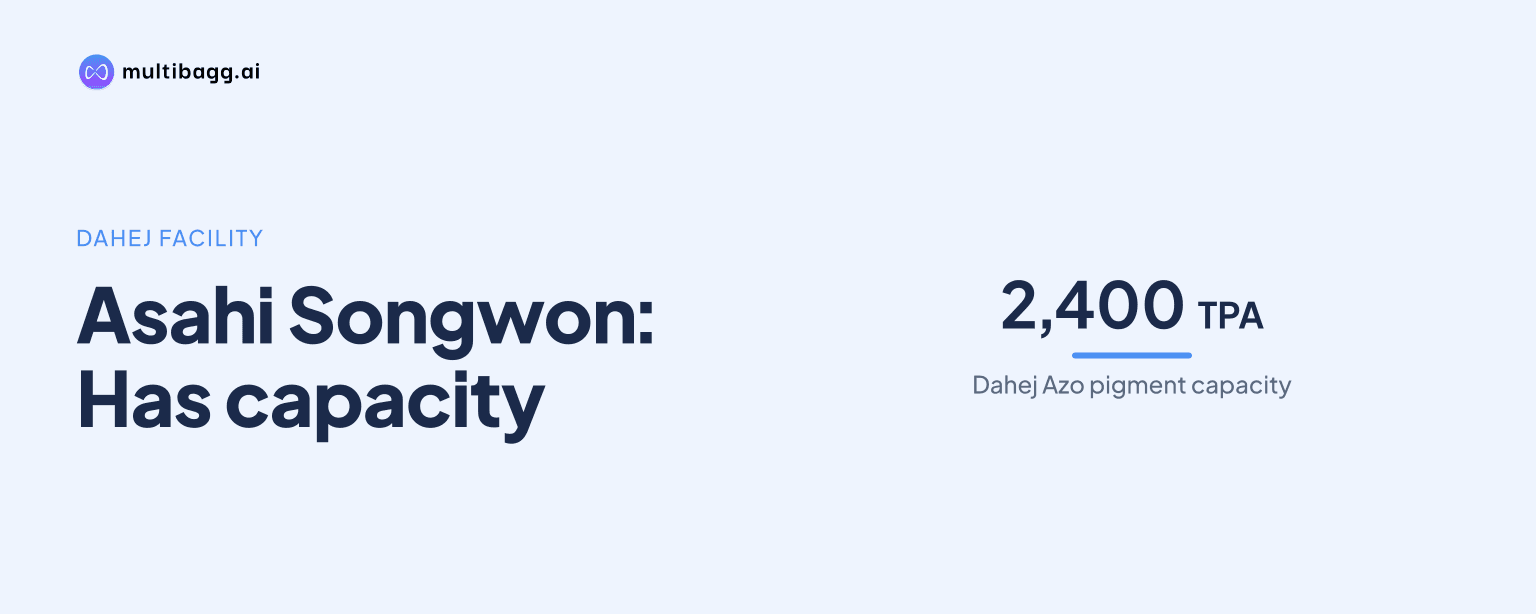
Asahi Songwon Colors Limited has 2,400 tonnes per annum (TPA) of available red and yellow Azo pigment capacity at its Dahej site, established in 2020; management presents the plant as its route into import substitution and customer sourcing shifts away from China.
Know Asahi Songwon Colors inside out
Results, valuation, peers and who's buying, in one view.
Why is Asahi Songwon pursuing Azo pigments?
Asahi Songwon is pursuing red and yellow Azo pigments through a joint venture with Tennants Textiles Colours Limited, described in the presentation as the UK’s leading colour manufacturer. Management identifies demand largely met by imports from China, the prospect of lower domestic production costs and very few operational domestic players as reasons for entering the Azo segment.
The Azo initiative broadens Asahi Songwon beyond its established phthalocyanine pigment range of CPC Blue crude, Beta Blue and Alpha Blue. The presentation describes phthalocyanine as a mature market expected to grow at a mid-single-digit rate, while identifying Azo as a growth driver. This is a portfolio comparison rather than a disclosed revenue forecast for the red and yellow products.
Azo is the largest segment by volume in the global organic and specialty pigment market, according to management’s presentation. It assigns 55% of the market to Azo pigments, compared with 25% for high-performance pigments (HPP) and other products, and 20% for phthalocyanine pigments.
What capacity does Asahi Songwon have at Dahej?
Asahi Songwon has 2,400 TPA of available capacity for red and yellow pigments at Dahej. The site was set up in 2020 on a 60,000 square metre plot and has waste and effluent treatment facilities. The presentation does not disclose Dahej production, capacity utilisation, sales volumes or revenue, so the 2,400-TPA figure is available capacity rather than reported output.
Asahi Songwon says the Dahej site has capacity expandable up to 40,000 square metres and available area for further expansion to meet future demand requirements. This discloses physical expansion potential, but no capital expenditure, additional pigment tonnage, construction schedule or commissioning date. Any capacity increase therefore remains an undeclared future step rather than an announced project.
Dahej is located in a chemical-company cluster, which Asahi Songwon says provides skilled labour, common infrastructure and nearby raw-material availability. Management says proximity to raw materials can create logistics-cost savings. It does not quantify those savings or provide a cost comparison between the 2020 Dahej site and the Padra pigment facility.
Got a follow-up? Ask IRIS
How does China-plus-one affect Asahi Songwon’s Azo plan?
Management’s China-plus-one rationale is that China accounts for more than 50% of global pigment production, while Azo demand is largely met through Chinese imports. Asahi Songwon says global customers are looking to shift sourcing from China, creating a potential opening for an Indian supplier of red and yellow Azo pigments.
The presentation connects this potential shift to an earlier supply-chain realignment. It says a Chinese government crackdown a few years ago raised global dye and pigment prices and prompted end-users to reassess their reliance on China. This is management’s account of the market mechanism, not evidence of disclosed customer contracts, committed orders or Azo revenue.
Asahi Songwon’s phthalocyanine business offers a historical, but not directly comparable, industry example. Over the past 15 years, India has taken share from China in phthalocyanine pigments, where China had previously contributed more than 70% share. India now caters to more than 70% of global phthalocyanine pigment demand, but the presentation does not say that Azo pigments have undergone the same transition.
How does Azo compare with Asahi Songwon’s mainstay pigment business?
Azo’s 55% market share by volume exceeds phthalocyanine pigments’ 20% share by 35 percentage points in management’s market breakdown. Asahi Songwon’s Padra site manufactures CPC Blue crude, Beta Blue and Alpha Blue, whereas Dahej holds the disclosed 2,400-TPA available capacity for red and yellow Azo pigments. The products therefore address different pigment categories and colour ranges.
The two facilities also have different disclosed land footprints and expansion areas. Padra, set up in 2004, occupies a 98,000 square metre plot with 25,000 square metres available for further expansion. Dahej, established in 2020, occupies 60,000 square metres and is described as expandable up to 40,000 square metres, with further area available for future demand requirements.
Asahi Songwon cites long customer approval periods and high switching costs in phthalocyanine pigments, where approvals can sometimes take years. It does not explicitly apply that process to Azo pigments. Similarly, the company’s stated record of zero product returns over the last three decades is presented as a group strategic advantage, without Azo-specific returns, customer-approval data or named Dahej customers.
Conclusion
Asahi Songwon’s Azo plan combines 2,400 TPA of available Dahej capacity for red and yellow pigments with a market segment that management says represents 55% of global organic and specialty pigment volume. Its case rests on imports from China, China’s more-than-50% share of global pigment production and customer efforts to diversify supply sources, rather than on disclosed Azo sales or contracts.
The next item to watch is whether future demand leads Asahi Songwon to use Dahej’s stated expansion potential of up to 40,000 square metres. Management has disclosed the site, the joint-venture route and the market rationale, but has not set out the timing, investment, additional tonnage, utilisation, customer approvals or financial contribution associated with an expansion.