










Asahi Songwon lowers ink revenue reliance to about 55%
Key highlights
- Asahi Songwon says ink-industry revenue contribution fell from more than 90% to about 55%.
- Asahi Songwon had 4 manufacturing facilities in 2026, compared with 1 in 2014.
- Asahi Songwon served more than 101 customers in 2026, up from 19 in 2014.
- Exports contributed 68% of Asahi Songwon's standalone revenue in H1FY27.
powered by IRIS
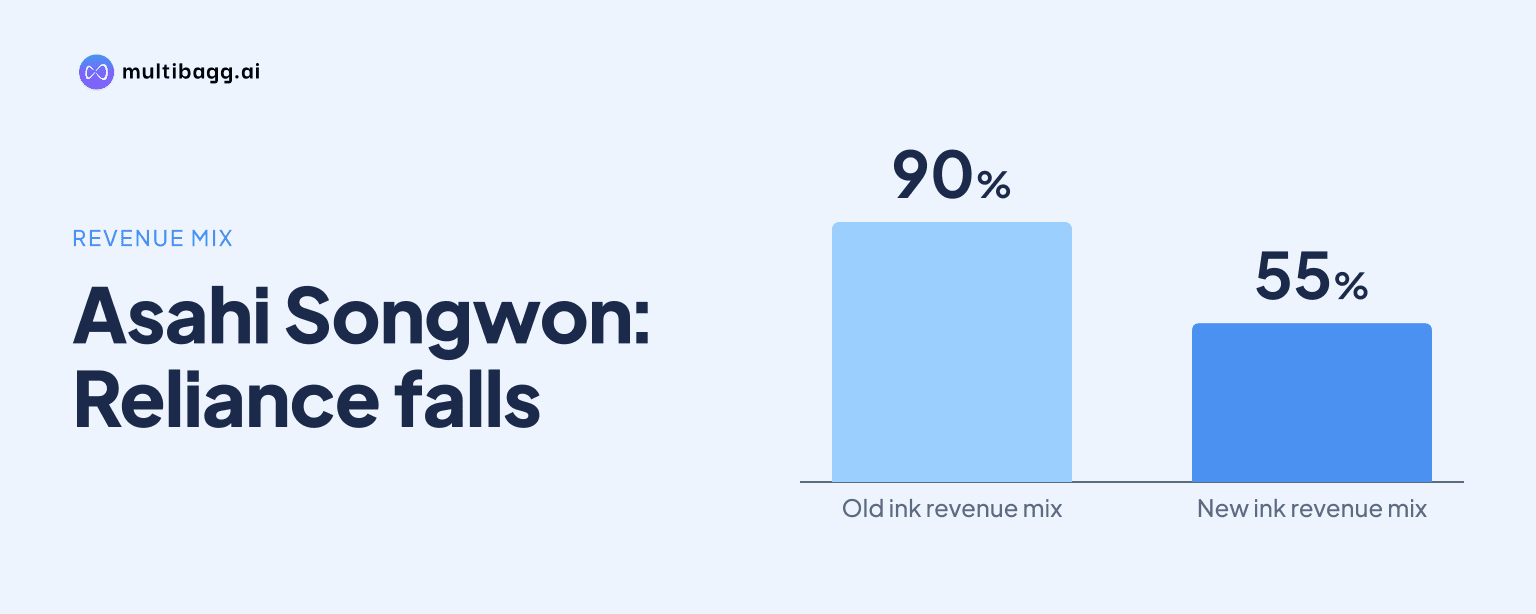
Asahi Songwon Colors Limited says the ink industry's revenue contribution fell from more than 90% to about 55% over the last few years, as its pigment business expanded into coatings, plastics and textile applications. By 2026, Asahi Songwon had four facilities, compared with one in 2014, and offered blue pigments, AZO pigments and active pharmaceutical ingredients (APIs).
Know Asahi Songwon Colors inside out
Results, valuation, peers and who's buying, in one view.
How did Asahi Songwon reduce its dependence on ink applications?
Asahi Songwon reduced ink-industry revenue contribution from more than 90% to about 55% over the last few years, according to its 2026 investor presentation. The company identifies coatings and plastics as key focus areas alongside inks, linking the change in end-use exposure to a wider pigment-market strategy.
The presentation compares a 2014 business focused only on pigments for ink applications with a 2026 model addressing ink, paint, plastic and textile applications. This is a shift in stated end markets as well as revenue concentration: ink accounted for about 55% of revenue at the later point, rather than more than 90% previously.
Asahi Songwon also describes the 2015-2018 period as one of subdued financial growth and business-model strengthening, followed by a 2019-2026 phase that is ready for the next leg of growth. The presentation does not state the precise financial years at the beginning and end of the decline from more than 90% to about 55%, nor does it give a future ink-revenue target.
Which products and plants support Asahi Songwon's wider portfolio?
Asahi Songwon supports its wider portfolio through four manufacturing facilities in 2026, compared with one facility in 2014. Padra produces blue pigments, Dahej produces red and yellow pigments, while Odhav and Chhatral are designated for APIs and API intermediates.
The company says it has recently ventured into yellow and red AZO pigments, in addition to APIs. Its established blue phthalocyanine pigment range serves ink, plastics, paint, textile and paper industries, while the Dahej facility adds red and yellow pigment production to the disclosed manufacturing footprint.
The move from a single blue-pigment product in 2014 to blue pigments, AZO pigments and APIs in 2026 broadens both colour range and product categories. However, Asahi Songwon does not disclose capacity, utilisation, revenue, margin or capital expenditure for Padra, Dahej, Odhav or Chhatral, so the financial scale of each product line cannot be measured from the presentation.
The company reports that 80% of process water was recycled in 2026, compared with 0% in 2014. It presents this operating measure alongside cost reduction and ramping up operations, but does not quantify savings from recycling or explain how the 80% measure is distributed across its four sites.
Got a follow-up? Ask IRIS
How broad are Asahi Songwon's customer base and exports?
Asahi Songwon served more than 101 customers in 2026, up from 19 customers in 2014. The increase occurred alongside the move from a blue-pigment-only business focused on inks to a portfolio covering blue pigments, AZO pigments and APIs for several stated end-use industries.
Exports contributed 68% of revenue in the first half of financial year 2027, or H1FY27, on a standalone basis. The pigment business exports to 19 listed markets, including the United States, Japan, China, Brazil, Italy, the United Kingdom, the United Arab Emirates and Thailand.
The 68% export contribution is a standalone H1FY27 measure, not a full-year or consolidated figure. Asahi Songwon also says its domestic market share is substantial and growing, but it does not provide a domestic revenue share, a comparison with earlier export ratios, or a breakdown of export revenue by pigment application.
The presentation does not split its more than 101 customers among inks, coatings, plastics, textiles, AZO pigments or APIs. It therefore establishes broader customer reach and international sales coverage, but does not show which end-use segment or product family accounts for the customer-base increase from 19 to more than 101.
What customer continuity does Asahi Songwon report?
Asahi Songwon says it has not lost a customer in more than three decades and that 80% of its business comes from repeat customers. The presentation does not specify whether the 80% repeat-business measure is calculated by revenue, customer count, order volume or another method.
The company reports a 21-year collaboration with Clariant, 18-year supply agreements with DIC and SunChemical, 13 years of repeat business with BASF, and 12 years with Siegwerk. It says BASF has recorded no quarter without sales and Siegwerk has recorded no quarter with zero sales during the stated relationships.
These disclosures sit alongside the expansion to more than 101 customers in 2026, but they do not quantify sales to any named customer. Asahi Songwon also does not disclose customer concentration, contract volumes, pricing arrangements or whether Clariant, DIC, SunChemical, BASF or Siegwerk buy products for inks, coatings, plastics or other applications.
What is still unknown about Asahi Songwon's diversification?
Asahi Songwon discloses the direction of its revenue-mix change, from more than 90% ink exposure to about 55%, but not the individual contributions from coatings, plastics or textiles. The presentation consequently supports a broader end-use profile, without establishing the size, growth rate or ranking of each non-ink application.
The company identifies Dahej for red and yellow pigments and Odhav and Chhatral for APIs and API intermediates, yet provides no segment sales or profit figures for these operations. Its 2019-2026 chronology says the company is ready for the next leg of growth, but gives no target date for further revenue-mix changes or financial targets for AZO pigments and APIs.
Conclusion
Asahi Songwon's reported diversification is marked by a reduction in ink-industry revenue contribution from more than 90% to about 55%, alongside expansion from one facility in 2014 to four in 2026. The wider platform includes blue pigments, AZO pigments and APIs, while its stated pigment applications now include inks, paint, plastics and textiles.
The next disclosure to watch is whether Asahi Songwon provides product-level sales, capacity or margin data for Dahej's red and yellow pigments and the API operations at Odhav and Chhatral. Management's 2019-2026 plan describes the business as ready for its next leg of growth, while H1FY27 standalone export contribution of 68% provides a disclosed operating measure to track as the portfolio expands.