










Asian Paints maintains 18-20% margin target despite inflation
Key highlights
- Asian Paints reported H1 standalone PBDIT margin of 19.6% and consolidated PBDIT margin of 18.2%.
- Asian Paints announced a nearly 3.5% November price increase after a 7% increase in Q1 and nearly 5% in Q2.
- Asian Paints reported a Q2 standalone PBDIT margin of 17.1%, versus 18.5% in the comparable quarter.
- Asian Paints expects VAE technology to provide a 300 to 500 basis-point advantage on relevant products at full potential.
powered by IRIS
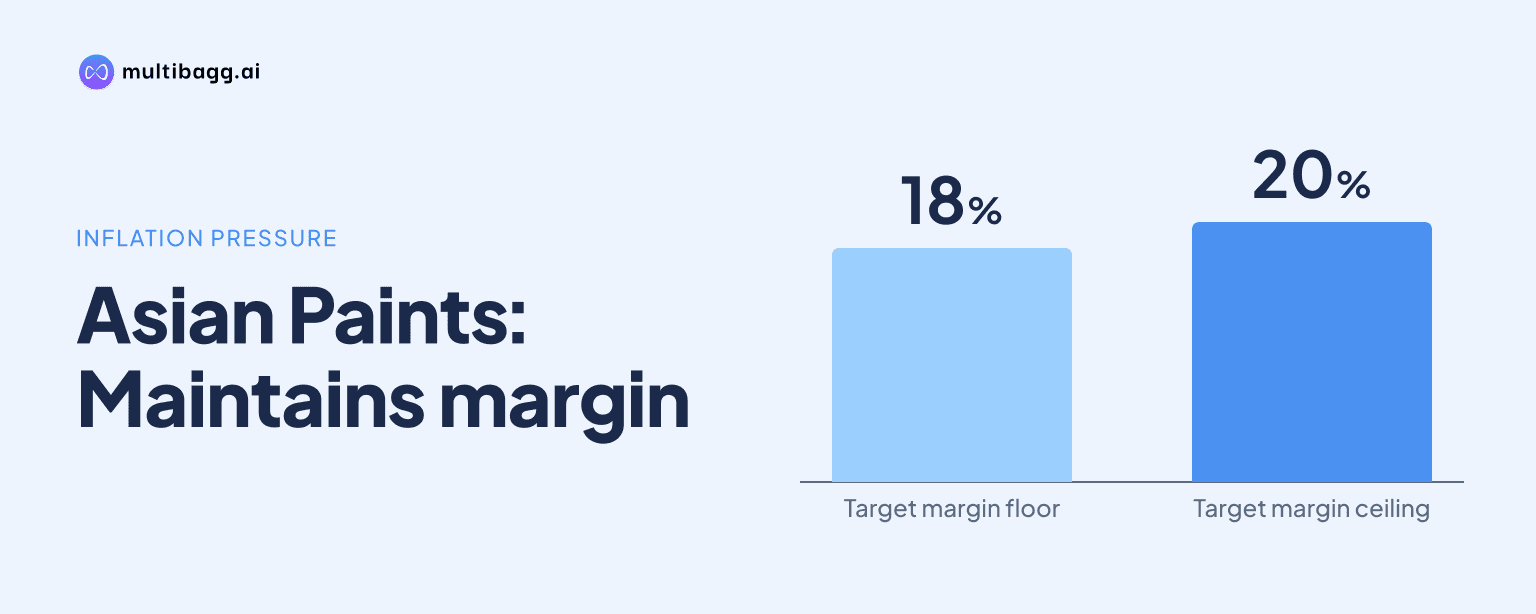
Asian Paints Limited said it expects to maintain its 18% to 20% margin band for the year despite input inflation, supported by a 19.6% standalone PBDIT margin and an 18.2% consolidated PBDIT margin in H1. Management cited calibrated pricing, cost excellence and the phased use of VAE technology as offsets.
Know Asian Paints inside out
Results, valuation, peers and who's buying, in one view.
Can Asian Paints maintain its 18% to 20% margin target?
Asian Paints said it believes it can maintain the 18% to 20% margin band for the year, although it acknowledged continuing volatility in raw-material costs. Management pointed to H1 as the more representative period, with standalone PBDIT, or profit before depreciation, interest and tax, margin at 19.6% and consolidated PBDIT margin at 18.2%.
Q2 results explain why management emphasised the first-half measure. Standalone net sales rose 14.8% in Q2, while PBDIT increased 5.9% and the PBDIT margin fell to 17.1% from 18.5% in the comparable quarter. Consolidated Q2 net sales grew about 17%, but PBDIT margin was 15.6%, down 202 basis points, as the quarter carried a more seasonal product mix.
How much of input inflation has Asian Paints recovered through pricing?
Asian Paints had taken a 7% price increase in Q1 and nearly 5% in Q2 before announcing another nearly 3.5% increase for November. Those disclosed actions total nearly 15.5% through November. An analyst on the call cited a 28% cost increase, while management said the November action accounted for anti-dumping duties and other cost pressures.
The pricing actions had not fully matched inflation in Q2. Management said gross margin had declined from the earlier 45% to 44% range, partly because inflation was about 3% during Q2 itself. For the second half, management indicated a 41% to 43% gross-margin band, while saying the eventual outcome would depend on further input inflation.
Asian Paints said the anti-dumping duty on titanium dioxide, or TiO₂, took effect on 24 October. The company included that cost impact in its November increase and said it would continue to calibrate pricing in Q3 and Q4 rather than take actions that could disrupt consumer demand.
How will VAE technology and cost actions support Asian Paints margins?
Asian Paints expects its vinyl acetate-ethylene, or VAE, technology and cost-excellence programme to partly offset inflation alongside price increases. Phase one of the VAE facility was commissioned in September, and formulations have begun. Management said the differentiated emulsion could improve product characteristics and lower costs in relevant formulations.
Management estimated that VAE could deliver a 300 to 500 basis-point advantage on relevant products when it reaches full potential. It said phase one would provide only a partial benefit, with fuller gains dependent on progress into a substantial part of phase two and wider formulation use.
The margin plan also relies on product innovation and commercial investment. New products accounted for about 18% of revenue, according to management, while Asian Paints continued brand-building and service initiatives. The company therefore described the margin defence as a combination of formulation benefits, cost discipline, differentiated products and calibrated pricing.
Got a follow-up? Ask IRIS
Which Asian Paints businesses face the biggest price-recovery lag?
Asian Paints identified industrial and international businesses as areas where price realisation has lagged cost inflation. In PPGAP, its auto original-equipment and refinishes joint venture, revenue grew almost 34% in Q2, while profit before tax rose almost 10%. Its margin nevertheless fell 309 basis points to about 14.2% as input inflation weighed on profitability.
APPPG, the general-industrial coatings joint venture, reported about 28% revenue growth in Q2 in protective and powder coatings. Management said pricing increases in this business arrived with a greater delay than in PPGAP, and it expected gradual improvement in later quarters. The difference reflects the pricing lag in business-to-business contracts rather than a lack of revenue momentum.
International operations grew about 30% in Q2 and about 28% in H1 across Asia, Africa and the Middle East. However, international profit-before-tax margin declined to about 4.8% because price increases were staggered. Management expected price-realisation benefits to improve the margin in Q3 and Q4, while describing Middle East and African markets as more difficult than Asian markets amid geopolitical conditions.
What demand conditions could help Asian Paints protect profitability?
Asian Paints expects Q3 volume growth of about 8% to 9%, helped by a longer Diwali period in November and the wedding season. Decorative-paint volume increased 6.4% in Q2 and about 8% in H1, while decorative value growth was 14.5% in Q2 and close to 16% in H1. Management said Q2 included the full effect of inventory built before earlier price increases.
Rural decorative markets continued to lead urban markets, while business-to-business demand was stronger in some Tier 1 and Tier 2 cities. Combined decorative and industrial operations delivered 16.4% value growth and 6.8% volume growth in Q2, compared with decorative-only growth of 14.5% and 6.4%. Industrial coatings therefore lifted reported growth even as their delayed pricing constrained margins.
Bath, Kitchen and Weatherseal recorded good growth in Q2, while White Teak grew more slowly. Management said Kitchen and Bath were being ramped toward improved bottom-line contribution, but it gave no revenue or margin figures for these categories. Their precise effect on the 18% to 20% group margin band cannot therefore be quantified from the call.
Conclusion
Asian Paints’ maintained margin target rests primarily on H1 profitability, when standalone PBDIT margin was 19.6% and consolidated PBDIT margin was 18.2%, rather than on Q2 margins of 17.1% and 15.6%. The Q2 decline reflected input inflation that exceeded earlier price increases, a seasonal product mix and delayed price recovery in industrial and international operations.
The next test is Q3, when management expects the November Diwali period and wedding season to support 8% to 9% volume growth. Investors will watch the effect of the nearly 3.5% November price increase, the TiO₂ anti-dumping duty effective from 24 October, and the partial cost benefit expected from phase-one VAE formulations as Asian Paints works toward its stated margin band.