










Asian Paints VAE Phase 1 targets full 150 KT next year
Key highlights
- Asian Paints commissioned VAE Phase 1 in September and targets full 150 KT utilisation next year.
- Management estimates VAE could provide a 300 to 500 basis-point benefit on relevant products at full potential.
- Asian Paints reported quarterly decorative volume growth of 6.4% and value growth of 14.5%.
- Standalone quarterly PBDIT margin was 17.1%, versus 18.5% in the comparable prior-year quarter.
powered by IRIS
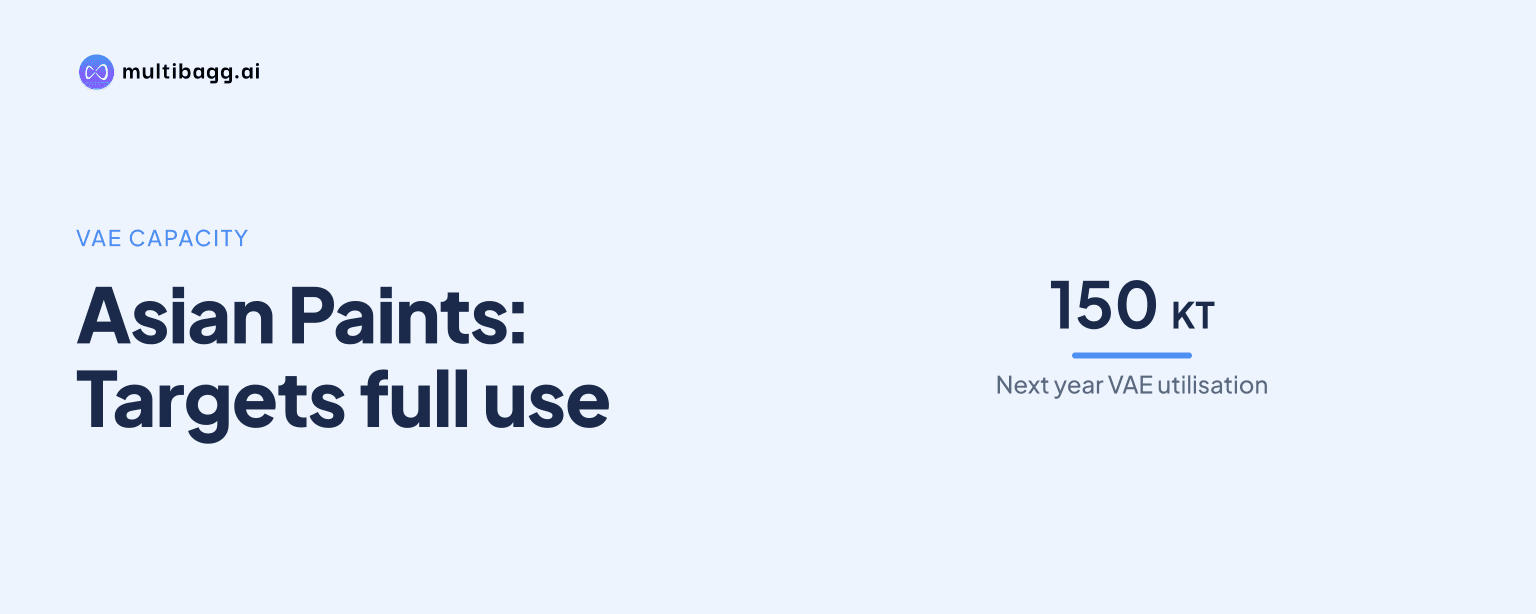
Asian Paints Limited commissioned Phase 1 of its differentiated vinyl acetate ethylene, or VAE, plant in September and targets full utilisation of its 150 kilotonnes, or KT, capacity next year. Management said the India-first chemistry could eventually provide a 300 to 500 basis-point benefit on relevant products, alongside differentiated and lower-volatile-organic-compound formulations.
Know Asian Paints inside out
Results, valuation, peers and who's buying, in one view.
What has Asian Paints commissioned at its VAE plant?
Asian Paints has commissioned Phase 1 of its VAE facility, started formulations and plans to use part of its capacity through March before reaching full 150 KT utilisation next year. Management described the material as differentiated VAE rather than general VAE available globally, and said the September commissioning was part of its GenNext Green Technology programme covering vinyl acetate monomer, or VAM, and VAE chemistry.
Asian Paints cited total capital expenditure of about Rs 3,250 crore for the initiative but did not disclose Phase 1 capital expenditure, plant location or a Phase 2 completion date. The company said the facility was implemented in record time with safety as a priority. It also characterised the chemistry as green and low in volatile organic compounds, or VOCs, with potential applications across product categories.
How could Asian Paints VAE change product margins?
Asian Paints said its VAE chemistry could improve margins by 300 to 500 basis points on relevant products when operating at full potential. One basis point equals one-hundredth of a percentage point, making the indicated range 3 to 5 percentage points. Management said Phase 1 would deliver a partial benefit, while the full benefit would require a good part of Phase 2.
Asian Paints said the applications will be in specific segments across price ranges, rather than restricted to premium products. The company said VAE can improve consumer-facing characteristics in existing products, support new lower-VOC formulations and enable products that may enter the patent zone. It did not identify the paint categories, brands or stock-keeping units that will use the new emulsion.
The VAE programme is also intended to address raw-material costs. Asian Paints said the local chemistry could help balance part of input inflation while adding differentiated formulations. New products accounted for about 18% of revenue in the quarter, although the company did not disclose what proportion of that contribution was linked to VAE-based products.
Why is Asian Paints adding VAE capacity now?
Asian Paints is introducing VAE while pricing has lagged raw-material inflation and reduced quarterly margins. The company took a 7% price increase in the first quarter, about 5% in the second quarter and announced a further nearly 3.5% increase for November. Management said the increases did not fully match inflation, including about 3% inflation in the second quarter.
Standalone net sales rose 14.8% in the second quarter, while profit before depreciation, interest and tax, or PBDIT, increased 5.9%. The standalone PBDIT margin was 17.1%, compared with 18.5% in the comparable prior-year quarter, a decline of 140 basis points. Management attributed part of the quarterly movement to a seasonal product mix and said the first-half result was more representative.
For the first half, Asian Paints reported a standalone PBDIT margin of 19.6% and a consolidated PBDIT margin of 18.2%. Management said it expects to maintain its 18% to 20% annual PBDIT margin band through calibrated pricing, its cost-excellence programme and VAE incorporation. That is management’s expectation, conditional on inflation and price realisation, rather than a reported outcome.
Titanium dioxide, or TiO₂, is another cost variable. Asian Paints said the anti-dumping duty effective from 24 October could have a 2% to 3% impact and cited more efficient TiO₂ use and differential grades as responses. Management said VAE-derived savings could offset part of this inflation, not remove exposure to the duty or to further raw-material volatility.
Got a follow-up? Ask IRIS
What demand conditions will support Asian Paints VAE ramp-up?
Asian Paints recorded 6.4% decorative volume growth and 14.5% decorative value growth in the quarter, with price increases contributing to the gap. In the first half, decorative volume increased about 8% and value rose close to 16%. Management said rural markets continued to lead urban markets, while business-to-business demand was stronger in some Tier 1 and Tier 2 cities.
Decorative and industrial businesses combined delivered quarterly value growth of 16.4% and volume growth of 6.8%, compared with decorative-only growth of 14.5% and 6.4%, respectively. Industrial operations lifted the combined result: the PPG Asian Paints automotive original-equipment and refinishes joint venture grew about 34%, while the general-industrial joint venture reported 28% revenue growth in the second quarter. Management said industrial price realisation has lagged cost increases, particularly in the general-industrial business.
Management expects the longer Diwali period in October and November and the wedding season to aid third-quarter demand. It said volume growth of about 8% to 9% going forward was a reasonable expectation, while noting that a monsoon deficit could affect rural markets. This was management’s assessment of demand conditions, not a sales target.
Asian Paints also expects a different third-quarter product mix as exterior sales return after the seasonally distinct second quarter. Management guided to a gross-margin range of 41% to 43%, depending on inflation. That gross-margin view is separate from the 300 to 500 basis-point VAE opportunity, which management said applies only to relevant products.
How does VAE fit Asian Paints product strategy?
Asian Paints is positioning VAE as a product-development and cost mechanism, rather than solely as backward integration. Management said the chemistry can support green products, differentiated existing formulations and new products at premium price points. It did not provide a product-launch timetable, a patent-filing schedule or a revenue target for VAE-enabled products.
The project sits alongside wider innovation and service initiatives. Asian Paints said its Chromacosm colour system includes more than 5,000 shades, while Bath, Kitchen and Weatherseal showed good growth in the quarter and White Teak grew more slowly. The company did not quantify these category results or establish a direct VAE link to them.
International operations grew about 30% in the second quarter and 28% in the first half, but profit before tax margin was 4.8% amid inflation and staggered price increases. Management expects pricing benefits to support international margin improvement in the third and fourth quarters. The VAE facility, however, was presented as an India-first operation rather than a specified solution for overseas profitability.
Conclusion
Asian Paints has shifted its VAE programme from construction to initial use, with Phase 1 commissioned in September and formulations under way. The disclosed case combines 150 KT of planned Phase 1 capacity, differentiated and lower-VOC products, and a potential 300 to 500 basis-point benefit on relevant products, while input inflation continues to shape group margins.
The next disclosed milestone is use of part of Phase 1 capacity through March, followed by management’s target of full 150 KT utilisation next year. Investors can also watch whether the nearly 3.5% November price increase, the cost-excellence programme and VAE incorporation help Asian Paints maintain its stated 18% to 20% annual PBDIT margin band amid TiO₂ duty effects and raw-material volatility.