










Additional Surveillance Measure raises trading costs and curbs
Key highlights
- ASM can impose a margin requirement of up to 100% of the trade value.
- Advanced ASM stages can apply a 5% price band and trade-to-trade settlement.
- Stage II escalation cited in the framework includes 25% or more close-to-close variation for five days and 30% or more client concentration.
- Some securities have reportedly remained in ASM for more than 500 days each over the past three years.
powered by IRIS
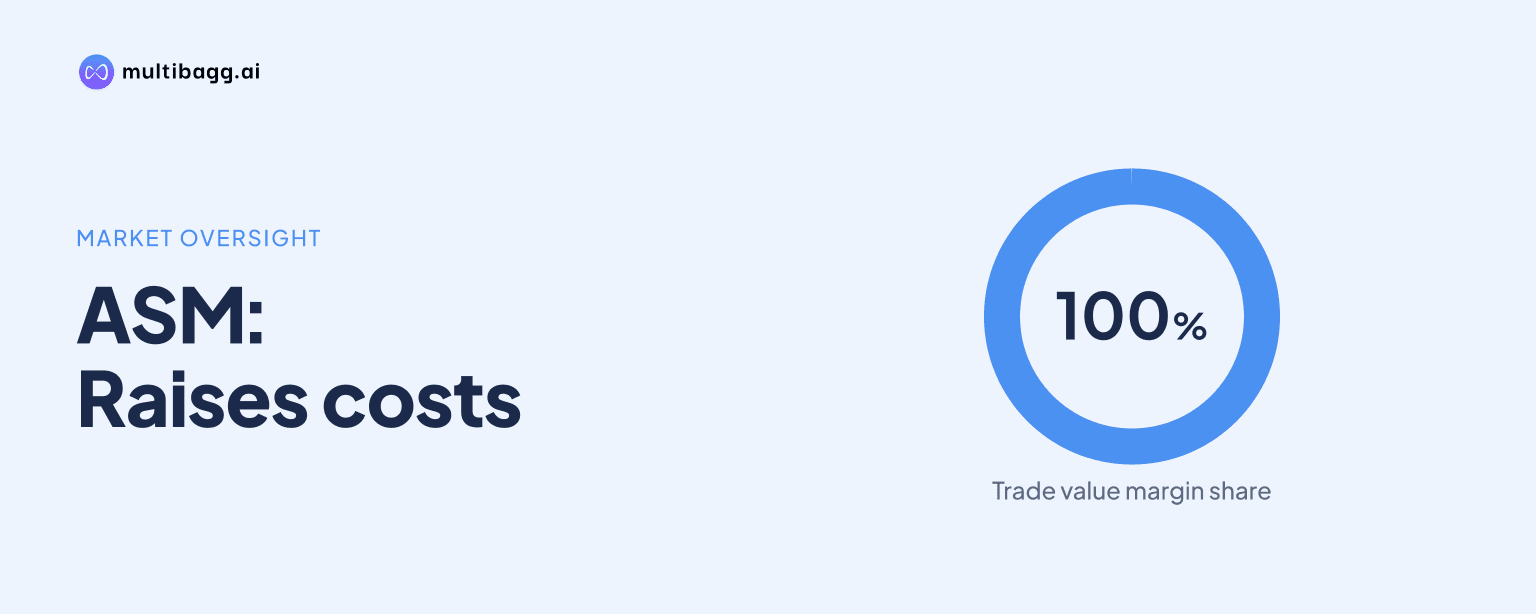
Additional Surveillance Measure, a Securities and Exchange Board of India and stock-exchange surveillance framework, can raise the upfront trading requirement to 100% of a share's value while tightening price bands and settlement rules for securities showing unusual activity. The framework is intended to address excessive volatility and safeguard investors, rather than judge a company's fundamentals.
What is Additional Surveillance Measure in the share market?
Additional Surveillance Measure, or ASM, is a market-surveillance framework used jointly by the Securities and Exchange Board of India and recognised stock exchanges to monitor securities displaying unusual price movements, volume changes or trading patterns. The framework was introduced in March 2018 as an added pre-emptive measure alongside tools such as reduced price bands, periodic call auctions and trade-for-trade treatment.
ASM-listed shares remain tradable. Their inclusion does not by itself mean that the company has committed wrongdoing or that its underlying business is weak. Instead, the designation flags surveillance concerns and asks market participants to apply greater caution and due diligence before trading.
The system is intended to protect market integrity where trading conditions indicate elevated risk. Its effect can be meaningful for retail participants because it changes how much money is needed to place an order, how quickly a position can be exited and, at later stages, whether the transaction must result in delivery.
Why does a stock enter ASM?
A stock can enter ASM when objective surveillance parameters indicate abnormal market activity, including sharp price or volume variation, volatility or concentrated client participation. The shortlisting criteria jointly used by the regulator and exchanges also cover high-low variation, close-to-close price variation, market capitalisation, delivery percentage, the number of unique PANs and price-to-earnings ratio.
Sharp movements in either direction can therefore matter. A rapid rise is not the only trigger, since a substantial fall, unusual turnover or a concentrated trading base may also attract attention. This makes ASM different from a fundamental assessment of a listed company or a recommendation to buy or sell its shares.
Social-media discussions often focus on price action, but the framework considers multiple inputs. Investors should not assume that a stock has been added only because of one day's movement, nor should they treat the ASM label as conclusive evidence about future price direction.
How does ASM change trading for retail investors?
ASM can make trading more cash-intensive and restrictive through higher margins, lower price bands and gross settlement requirements. Depending on the surveillance stage, the margin can rise to 100%, requiring the buyer to provide the full trade value upfront rather than use leverage.
At advanced stages, the price band can be cut to 5%, and a share may move to trade-to-trade, or gross, settlement. Under gross settlement, each purchase and sale is settled separately rather than being offset on a normal net basis. Intraday trading may also be unavailable, requiring investors to take delivery of the shares they buy.
These measures make leveraged speculative trades more expensive and can reduce short-term turnover. They also mean a shareholder seeking to exit during a lower-circuit phase may find fewer buyers and may be unable to sell promptly at a preferred price.
Got a follow-up? Ask IRIS
Does ASM make a share riskier to own?
ASM signals elevated trading risk, but it does not independently establish that a share is fundamentally unsound. The important distinction is between the reason for surveillance and the consequences of the restrictions: the framework addresses unusual market behaviour, while the company's financial condition is a separate matter.
For an existing investor, the immediate issue may be liquidity. Tighter bands and lower participation can widen the gap between buyers and sellers and make sizeable transactions more difficult without influencing the market price. Some securities have reportedly remained in ASM for more than 500 days each over the past three years, showing that the effect can persist rather than disappear quickly.
For a prospective buyer, the higher cash requirement changes position sizing and return expectations. A lower daily price band limits abrupt moves in either direction, but it can also slow an investor's ability to enter or leave a position. The appropriate response is to understand the applicable restrictions and assess the company separately, rather than relying only on the ASM status.
How do ASM stages tighten restrictions?
ASM restrictions can intensify in stages when the specified price variation and client-concentration conditions continue. The framework described in market discussions begins with a 100% margin from the T+3 day at Stage I, while later stages can add lower price bands and trade-to-trade settlement.
The stage-based approach is designed to respond to persistence rather than a single isolated event. It also explains why traders must check the current treatment of an ASM security before placing an order, as the applicable rules may change as surveillance conditions evolve.
Conclusion
ASM is a risk-control framework that keeps securities tradable while making abnormal trading activity more difficult to finance and execute. Its central investor effects are higher upfront cash needs, constrained price movement and potentially weaker liquidity, while its presence alone does not amount to a verdict on a company's fundamentals.
Investors should watch the applicable ASM stage, margin requirement, price band and settlement basis before trading an affected share. The key unresolved matter for any ASM-listed security is whether the price, volume and concentration conditions that led to surveillance continue, because persistent conditions can lead to tighter restrictions.