










India Coal Reliance Persists as Thermal Imports Fall 27.4%
Key highlights
- Coal supports over 70% of India’s electricity generation and nearly 55% of primary energy needs.
- Thermal power plant coal imports fell 27.4% to 45.4 MT in FY2025-26 from 62.5 MT in FY2024-25.
- India approved a ₹37,500 crore coal and lignite gasification scheme in May 2026.
- The National Generation Adequacy Plan projects non-fossil capacity at 63% in 2030 and 69% in 2035.
powered by IRIS
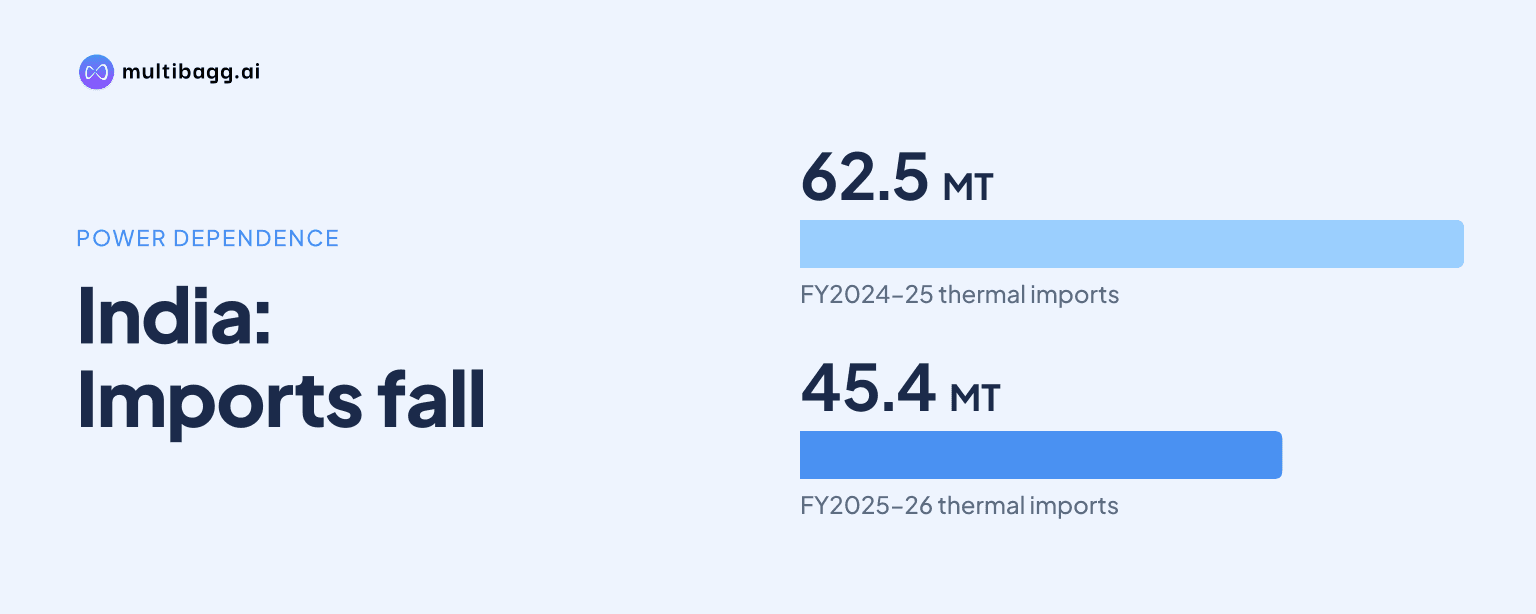
India remains dependent on coal for over 70% of electricity generation, even as coal imports by thermal power plants declined 27.4% to 45.4 million tonnes in FY2025-26 from 62.5 million tonnes a year earlier. The figures underline a policy focus on domestic supply, reliable generation and lower import dependence.
Why does India still depend heavily on coal for electricity?
India still depends heavily on coal because it supports more than 70% of electricity generation and meets nearly 55% of the country’s primary energy needs. The available policy outlook describes coal as a core part of energy security, particularly because of domestic availability compared with oil and gas. Manufacturing expansion, wider energy access and the need to reliably meet rising demand are also part of the discussion around the fuel.
The generation share cited across the source material varies by dataset and definition. One assessment puts coal at around 60% of the power mix, while others place its current contribution at more than 70% or 75% of electricity generation. The consistent finding is that coal remains the dominant source of electricity, despite rapid additions of renewable capacity.
Renewables, including large hydro, account for around 26% of electricity generation in the context provided. This gap between capacity additions and actual generation is central to the policy debate. Renewable capacity can expand quickly, but the electricity system still requires reliable supply across demand peaks and periods when variable generation is lower.
How much have India’s thermal coal imports declined?
India’s coal imports by thermal power plants fell by about 27.4% in FY2025-26, declining to 45.4 million tonnes from 62.5 million tonnes in FY2024-25. The fall is presented as evidence of efforts to reduce import dependence through higher domestic production and related infrastructure development.
The import trend matters because India’s policy framing treats domestic coal as an energy-security asset. The government is implementing measures to increase domestic production and has indicated an ambition to become a net exporter of thermal coal in the next few years. The supplied material does not provide domestic output figures, so the import decline alone cannot establish the scale of any production increase.
A reduction in thermal coal imports also does not change the broader dependence on coal-fired generation. It instead points to a shift in where fuel is sourced. For investors and consumers, this distinction is important: lower imports may improve supply security, while coal’s role in power generation remains substantial.
Got a follow-up? Ask IRIS
What does India’s power plan say about coal and non-fossil capacity?
India’s National Generation Adequacy Plan for 2026-27 to 2035-36 retains coal power as a source of system stability while projecting a larger share for non-fossil capacity. The plan aims for non-fossil sources to reach 63% of installed capacity in 2030 and 69% in 2035, with another outlook placing those shares at approximately 64% and 70%, respectively.
Capacity and generation are different measures. The same context says that, even with the expansion of non-fossil capacity, coal could still provide around 50% of electricity generation by 2030. Total generation is also expected to increase, meaning a lower percentage share does not necessarily mean lower coal-fired output in absolute terms.
The policy pipeline continues to include new coal capacity. India’s electricity plans refer to an additional 25.5 GW for the second half of the decade, alongside 25.6 GW already under construction, while another estimate refers to 51 GW of additional coal capacity between 2022 and 2032. The government has no stated plan in the supplied context to shut coal plants before 2030.
How is coal gasification shaping India’s energy policy?
India is using coal and lignite gasification as part of its domestic-resource strategy, backed by a ₹37,500 crore scheme approved in May 2026. The scheme is expected to use about 75 MTPA of coal and lignite and contribute to the national target of 100 MT of coal and lignite gasification by 2030.
The government expects the programme to mobilise ₹2.5 lakh crore to ₹3 lakh crore of investment. These targets show that policy is not limited to maintaining conventional coal-fired generation. It also seeks to develop new uses for coal and lignite while reducing reliance on imported fuels.
At the same time, India is scaling non-fossil capacity, with a target of 500 GW of non-fossil capacity by 2030. The context states that India had 254 GW of renewable installed capacity and ranked fourth globally by renewable capacity. The key challenge remains converting fast capacity growth into sufficient generation, flexibility and reliability to reduce coal’s role over time.
Conclusion
India’s energy outlook combines two tracks: a continued reliance on coal for electricity reliability and energy security, and an accelerated build-out of non-fossil capacity. The 27.4% decline in thermal coal imports suggests progress on reducing external dependence, but it does not alter coal’s current position as the country’s leading source of power generation.
The next indicators to watch are progress towards the 500 GW non-fossil capacity target for 2030, implementation of the ₹37,500 crore gasification scheme, and the system’s ability to support a projected non-fossil capacity share of 63% in 2030. Coal capacity additions and the delivery of reliable power during peak demand will remain unresolved issues in the policy outlook.