










National Stock Exchange Breadth Recovery Fails to Broaden
Key highlights
- 61% of 2,821 NSE-traded stocks were below their December 2025 closing levels as of November 16.
- On November 16, NSE recorded 2,515 declining stocks against 1,175 advancing stocks.
- 53.5% of 1,514 liquid NSE stocks closed above their 200-day averages on November 12.
- The Nifty Midcap 100 fell 0.51% and the Nifty Smallcap 100 dropped 1.10% in a session when the Nifty 50 gained 0.58%.
powered by IRIS
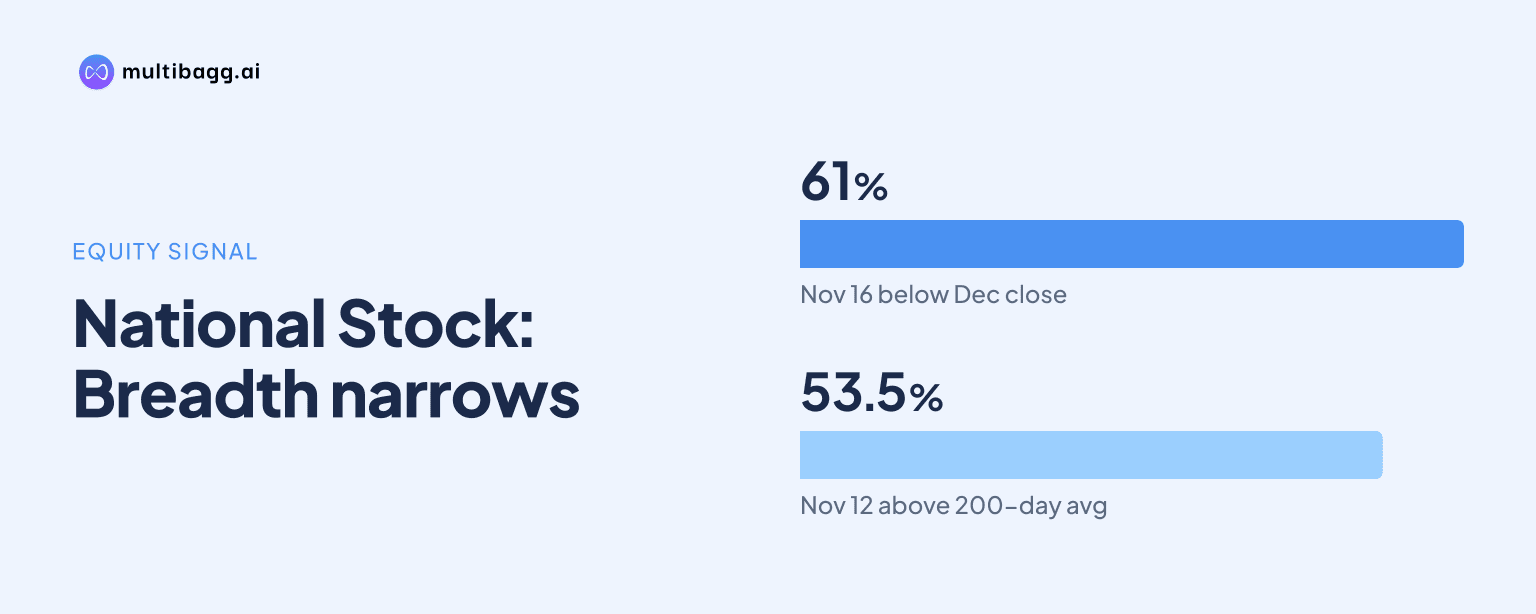
National Stock Exchange breadth recovery has failed to become market-wide in November 2026, as 61% of 2,821 traded stocks remained below their December 2025 closing levels despite occasional gains in the Nifty 50 and Sensex. A 53.5% reading above 200-day averages on November 12 showed improvement, but participation remained uneven.
Why has NSE breadth recovery not become market-wide?
NSE breadth recovery has not become market-wide because benchmark gains have often been led by a limited set of large-cap shares while declines persisted across a larger part of the market. Banking and financial stocks, along with select technology names, were identified as leaders in the recent rally, while mid-cap and small-cap shares remained in recovery mode after steep falls in September and October.
The contrast between headline indices and the broader universe is clear in the December 2025 comparison. Only 1,099 of 2,821 NSE-traded stocks, or about 39%, were above their December 31, 2025 closing levels as of November 16. The other 61% remained below those levels, indicating that gains in prominent indices did not reflect a uniform recovery among listed shares.
What did November sessions show about NSE participation?
November sessions showed that NSE participation could change sharply from day to day, but negative breadth was prominent in several reports. Declining shares outnumbered advancing shares for three consecutive sessions in the period described, tempering the earlier improvement in the proportion of stocks trading above longer-term averages.
On November 16, the Sensex rose 512.34 points, or 0.63%, to 82,104.79, while the Nifty 50 gained 146.80 points, or 0.58%, to 25,291.10. Yet, NSE breadth was decisively negative: 2,515 stocks declined against 1,175 advances, with 84 unchanged among 3,774 traded stocks. That result shows how index gains can coexist with broad weakness outside the shares driving the benchmarks.
Another reported session recorded 1,937 NSE declines against 792 advances and 31 unchanged stocks, a ratio of roughly 2.45 decliners for every advancer. Within the Nifty 50, however, breadth was constructive on November 16, with 31 constituents higher and 19 lower. The difference highlights the gap between the benchmark and the overall listed market.
Got a follow-up? Ask IRIS
Are mid-cap and small-cap stocks confirming the benchmark rally?
Mid-cap and small-cap stocks were not consistently confirming the benchmark rally, as both indices underperformed in a session when the Sensex and Nifty 50 advanced. The Nifty Midcap 100 fell 0.51%, while the Nifty Smallcap 100 declined 1.10%, pointing to selective buying rather than broad-based participation.
Sector trends were also divided. Nifty FMCG gained 1.87%, while banking, private bank, PSU bank and media indices also rose. Nifty Pharma, Realty, Metal, Auto and Energy closed lower. This mix reinforced the view that the market was being led by specific sectors rather than by a sustained advance across the wider equity universe.
There were also sessions with stronger broader-market participation. In one instance, the Nifty Smallcap 100 rose more than 1% and the Nifty Midcap 100 gained 0.4%, while NSE advances numbered 2,208 against 1,313 declines. Such reversals show why a single breadth reading cannot establish a lasting trend. The broader pattern remains mixed rather than uniformly negative.
What does the 200-day average measure say about NSE breadth?
The 200-day average measure says that NSE internal conditions improved from earlier lows, but it does not yet confirm a stable market-wide recovery. On November 12, 53.5% of 1,514 liquid stocks closed above their 200-day averages, a constructive reading after a period of uneven participation.
Other measures still pointed to incomplete recovery. Of the stocks in a universe representing nearly 90% of NSE-listed market capitalisation, 55.8% were above late-February levels while 44.2% remained underwater. The Nifty 50 was only 0.5% above its February 27 level on November 12, while only 44% of its constituents had recovered their February closing prices.
The difference between average and median returns also showed uneven leadership. The average return of Nifty 50 stocks was positive 1.9%, but the median return was negative 2.7%. This means stronger moves in some stocks lifted the average even as the typical constituent remained below its February level.
How should investors interpret weak market breadth?
Investors should interpret weak market breadth as a measure of market participation and risk, not as a standalone signal for the direction of the next few weeks. A 2015-2026 study cited in the discussion found that when breadth was weak or fading, subsequent monthly falls in mid-sized and small companies were deeper and breakouts to new highs failed more often.
The same study found that breadth often peaked two to six months before mid-cap and small-cap indices at major market tops, but it did not predict whether the market would rise or fall in the near term. For that reason, the relevant focus is the trend in participation over time rather than one positive or negative session.
Conclusion
NSE breadth has improved from earlier lows, as shown by the 53.5% of liquid stocks above their 200-day averages on November 12. But the recovery remains narrow because 61% of 2,821 traded shares were still below December 2025 levels and several November sessions saw decliners significantly exceed advancers while benchmarks rose.
The next indication of a broader recovery would be a sustained increase in advancing stocks, particularly in mid-cap and small-cap shares, rather than isolated strength in banking, financial, FMCG or select technology names. The disclosed threshold to watch is whether the number of rising stocks moves from about 1,100 towards 1,500, alongside more durable positive breadth across NSE sessions.