










EdgeVerve Systems Limited Targets $2 Billion With Partnerships
Key highlights
- EdgeVerve set a $2 billion annual revenue target for products and new services by 2020.
- The products, platforms and solutions business represented a little more than 5% of Infosys revenue of about $8 billion.
- EdgeVerve reported 30 wins and 26 go-lives in one update across Finacle, Edge and AssistEdge.
- The Infosys Information Platform was used in more than 127 client engagements, with 16 completed pilots.
powered by IRIS
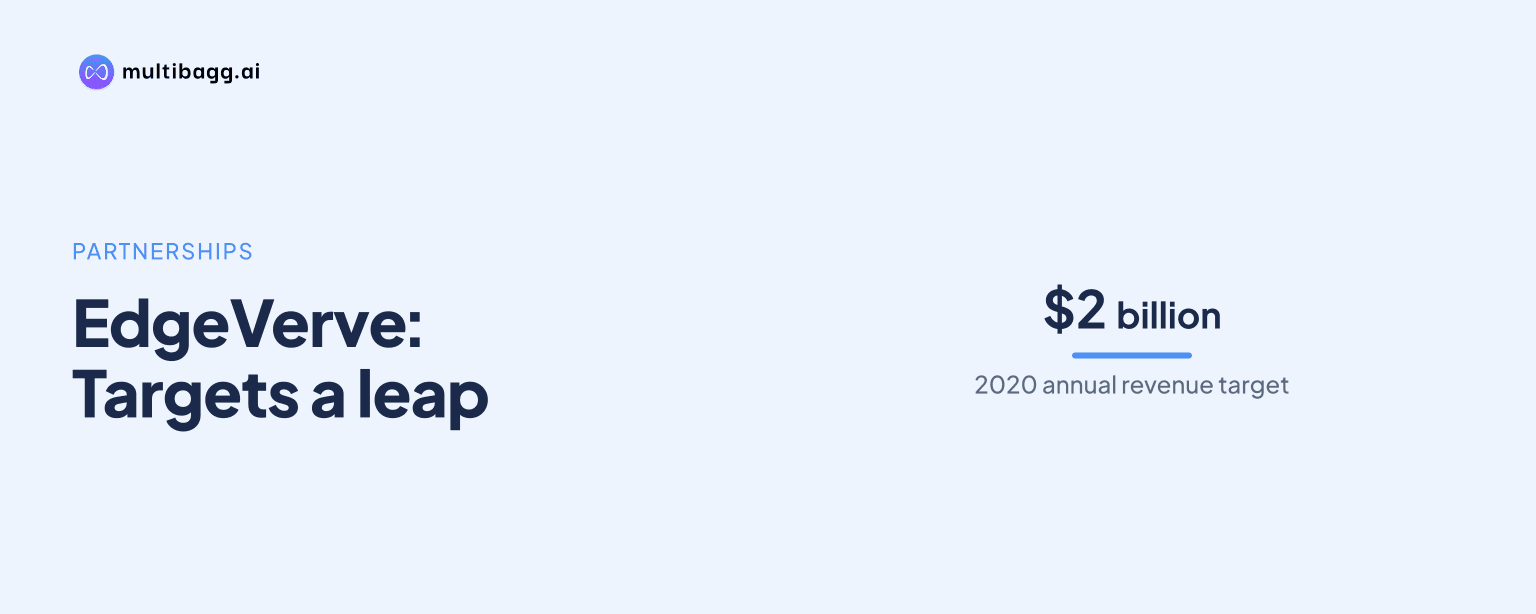
EdgeVerve Systems Limited set a $2 billion annual revenue target for products and new services by 2020, with startup partnerships and structured customer cross-selling positioned as routes to expand its platform business within Infosys, where the unit had represented little more than 5% of revenue.
Why is EdgeVerve seeking startup partnerships?
EdgeVerve is seeking startup partnerships because Infosys expects the traditional services model to shift over time towards platforms, ecosystems and partner-led offerings. The company said it was looking for disruptive technology platforms that could be taken to existing clients, while also offering startups engineering scale and access to its market reach.
The approach included a possible acquisition route for selected candidates. Infosys COO UB Pravin Rao said the company was actively evaluating interesting acquisition candidates that could become part of the EdgeVerve product portfolio. Equity participation was described as a possibility only in rare cases, while partnerships were presented as the more central route.
This strategy reflects the view that not every product idea needs to originate inside Infosys. By combining external technology with its implementation and maintenance capabilities, EdgeVerve can seek revenue from software products as well as the services attached to deploying and supporting them. The company also pointed to growing adoption of cloud, platforms and bundled infrastructure-application offerings as a market shift that could become significant over three to five years.
What revenue base and targets were disclosed for EdgeVerve?
EdgeVerve was a relatively small part of Infosys revenue when the growth plans were outlined, but management set a much larger ambition for products and new services. The unit, then described as the products, platforms and solutions business, accounted for a little more than 5% of Infosys revenue of about $8 billion. In another disclosure, it was described as contributing less than 6% of Infosys revenue of $8.25 billion.
The company said the business could grow significantly faster over the following 12 months than Infosys' 7% to 9% outlook. Separately, Infosys outlined a target of generating $2 billion in annual revenue from products and new services by 2020. The context does not provide a later revenue outcome against that target, so the figure should be treated as a stated objective rather than a reported achievement.
The unit was made a wholly owned subsidiary for about $80 million, or Rs 480 crore, as Infosys renewed its focus on products and platforms. Management said the subsidiary structure would give teams dedicated growth objectives and greater focus on developing intellectual property, products and solutions.
Got a follow-up? Ask IRIS
How does EdgeVerve identify cross-sell opportunities?
EdgeVerve uses a Customer Growth Advisory process to identify upsell and cross-sell opportunities across its existing customer base. The function builds a 360-degree view of a customer, matches customer needs with EdgeVerve offerings, and passes identified opportunities to customer service and sales teams for follow-through.
The process has three stated steps: selecting customers considered ready for growth, building account intelligence through customer research, and documenting potential opportunities in a customer canvas deck. The research can include products or services used by the customer and contract renewals that are due, allowing sales teams to assess where a further product conversation may be relevant.
Customer selection is supported by the RFMI framework, which follows the logic of RFM analysis. Recency measures how recently a customer bought a licence or product, with purchases in the preceding two quarters receiving the highest score. Frequency gives the highest score to customers that purchased in each of the preceding five quarters, while the monetary measure considers the share of EdgeVerve revenue coming from that customer over the last five quarters.
Which product and client signals support EdgeVerve's strategy?
EdgeVerve reported several win and go-live updates that indicate efforts to build adoption across its portfolio. One quarterly update cited 12 wins and three client go-lives, while another reported 14 wins and four go-lives at the beginning of a year. A further update reported 30 wins and 26 go-lives across Finacle, Edge and AssistEdge. These were separate disclosures and should not be added together as a single period figure.
The client examples also show the use of platform products in specific business functions. Syngenta went live with TradeEdge Dealer Management System to manage distributors in two Indian states, with a planned rollout to distributors in other states the following year. ProcureEdge was selected by another client for a worldwide source-to-settle transformation.
Finacle was integrated with EdgeVerve to form one combined entity, with management discussing bundled solutions for clients. The company also reported more than 127 client engagements using the Infosys Information Platform, 16 completed pilots and 15 new Panaya deals through joint offerings. EdgeVerve's current positioning includes AI Next, a unified AI platform designed around generative AI and agentic AI, alongside cloud-native architecture and automation.
Conclusion
The disclosures show EdgeVerve's growth plan as a combination of product development, external technology partnerships and disciplined expansion within existing accounts. The $2 billion annual revenue target underscored the scale of the ambition, while the smaller revenue contribution at the time showed why Infosys sought a more focused subsidiary structure and new go-to-market capabilities.
Investors would need to watch evidence of execution rather than the target alone. Relevant signals include future client wins and go-lives, the conversion of pilots and joint offerings into recurring business, progress in bundled Finacle and EdgeVerve solutions, and whether startup partnerships or acquisitions produce products that can scale through the Infosys client base.