










Crystal Crop Protection IPO Priced Above Peer P/E Average
Key highlights
- Crystal's upper-band valuation is 24.59x FY26 diluted EPS, above the disclosed peer average of 20.07x.
- Crystal reported FY26 revenue of ₹3,151.97 crore and PAT of ₹144.91 crore.
- The fresh issue is about ₹354.77 crore, with about ₹270 crore planned for debt repayment.
- Crystal had ₹962.67 crore of fund-based borrowings as of August 2026.
powered by IRIS
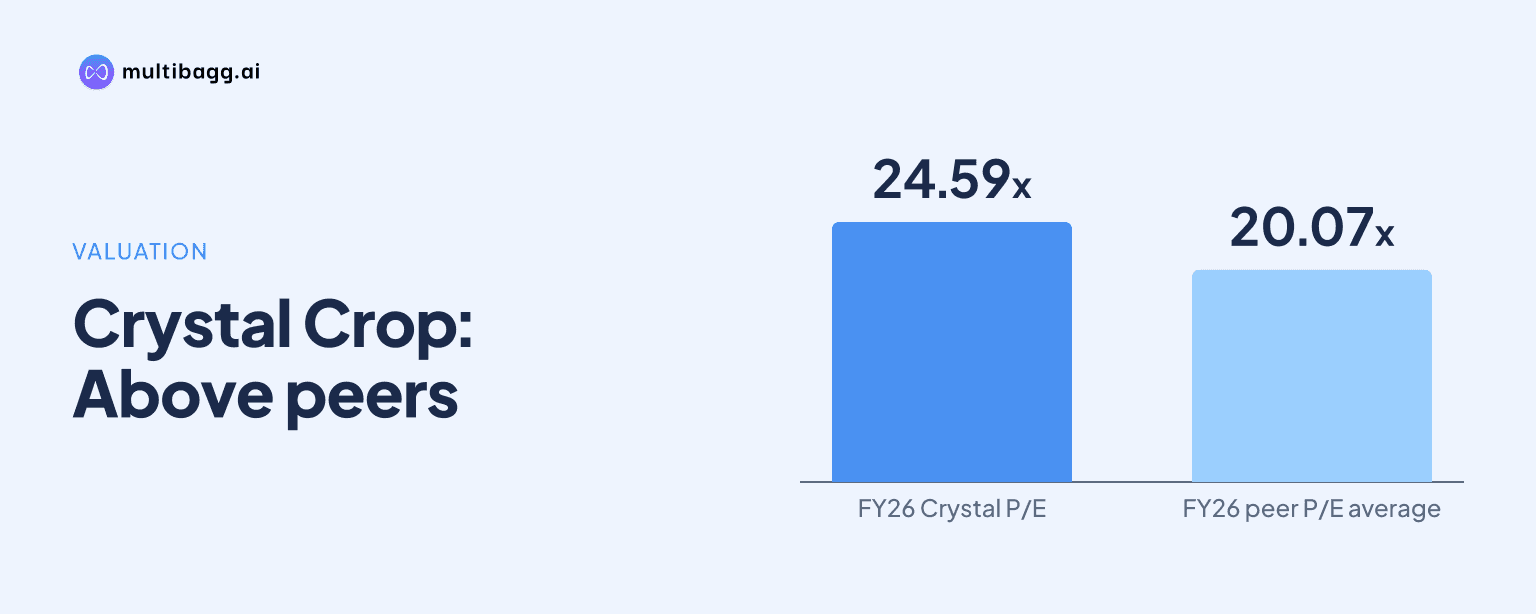
Crystal Crop Protection's IPO is priced above its disclosed peer P/E average, with the upper band of ₹272 implying 24.59 times FY26 diluted EPS against a peer average of 20.07 times. The issue also comes as Crystal plans to use ₹270 crore of fresh-issue proceeds for debt repayment while pursuing the FMC India acquisition.
Why is Crystal's IPO valuation above the peer average?
Crystal's ₹259 to ₹272 price band implies a FY26 diluted earnings multiple of about 23.42 to 24.59 times, compared with the disclosed peer average of 20.07 times. At the upper end, the valuation is above Kaveri Seeds at 12.13 times, Dhanuka Agritech at 14.38 times, Rallis India at 19.93 times and Bayer CropScience at 22.73 times, while remaining below Sumitomo Chemical India at 31.20 times.
The comparison needs to be read carefully because the peer set includes seed, agrochemical and broader crop-science businesses with different product mixes and seasonal patterns. Still, the available numbers show that Crystal is not being offered as a low-multiple issue. Its FY26 return on net worth of 7.14% also trails four of the five disclosed peers, making sustained earnings improvement important to the investment case.
What do Crystal's FY26 financials show?
Crystal reported FY26 revenue of ₹3,151.97 crore and profit after tax of ₹144.91 crore, versus revenue of ₹2,229.93 crore and profit after tax of ₹87.24 crore in FY24. This means revenue grew about 41% and profit about 66% over the two-year period cited in the issue discussion.
Operating performance also improved, with EBITDA rising from ₹209.06 crore in FY24 to ₹456.23 crore in FY26. The FY26 EBITDA margin was reported at 14.47%, but the net profit margin was only 4.56%. That gap matters because the business has distribution, financing and working-capital demands that can limit the conversion of operating gains into net profit.
The return metrics reinforce this distinction. FY26 return on equity was 7.94%, return on capital employed was 16.06%, and return on net worth was 7.14%. These figures indicate that Crystal's operating progress has not yet translated into high shareholder returns. Revenue growth by itself therefore does not settle whether the offer valuation is attractive.
Why should investors focus on FY26 earnings rather than one quarter?
Investors should focus on full-year FY26 earnings because Crystal operates in a seasonal and monsoon-linked business where a strong June quarter may not represent the full year. The discussion around the offer cites an annualised P/E of 8.17 times using the peak Q1 FY27 quarter, but that approach assumes the quarter's earnings can be repeated through the year.
A more conservative benchmark is the disclosed FY26 diluted EPS of ₹11.06, which produces a 24.59 times P/E at ₹272. Other calculations in the available material use different share counts or earnings bases: pre-issue FY26 EPS of ₹9.65 results in about 28.2 times, while dividing the stated post-issue market capitalisation by FY26 consolidated PAT gives about 30.63 times.
These differing outputs do not change the central point that investors need to check the earnings and share-count basis before comparing multiples. The post-issue market-capitalisation-to-PAT cross-check is particularly relevant because the fresh issue increases the equity base. Future interest savings from debt repayment may support profit, but those savings should not be treated as historical FY26 earnings.
Got a follow-up? Ask IRIS
How do debt repayment and the FMC India deal affect Crystal?
Crystal plans to deploy about ₹270 crore from the ₹354.77 crore fresh issue toward debt repayment, while it has committed about ₹1,846 crore plus a ₹422 crore licence fee to acquire FMC India. The transaction strategy makes balance-sheet execution a key issue alongside the valuation.
The company had ₹962.67 crore of fund-based borrowings as of August 2026, according to the context provided. Reducing debt could lower finance costs and strengthen future profitability, but the larger acquisition commitment means investors must also assess funding needs, integration and the pace at which acquired assets contribute to earnings.
The issue includes an offer for sale of about ₹100.71 crore, taking the total issue size to about ₹455.49 crore. Fresh capital is therefore not wholly available for growth investment after the stated debt-repayment use. The company has grown through acquisitions, plants and people, and the value of that expansion will depend on working-capital control, cash generation and capital productivity.
What are the key risks before applying for Crystal's IPO?
Crystal's principal risks are thin net margins, seasonal sales, long receivable cycles, borrowings and regulatory or audit-related overhangs mentioned in the issue discussion. Its crop-protection and seed operations are exposed to monsoon patterns, so sales and profit can vary significantly across quarters.
The issue material also points to an audit qualification, regulatory litigation and an unexplained jump in net worth as matters requiring investor attention. These factors do not negate the reported revenue and EBITDA improvement, but they raise the importance of reading the offer documents rather than relying only on quarterly performance or grey-market commentary.
For retail applicants, the minimum investment at the upper band is ₹14,960 for a lot of 55 shares. The offer opens on 18 November 2026 and closes on 20 November 2026, with tentative listing scheduled for 26 November 2026. Subscription demand may indicate market interest, but it does not alter the underlying FY26 valuation and business risks.
Conclusion
Crystal combines meaningful FY24-to-FY26 growth, an established crop-protection and seed presence, and improved EBITDA with a valuation that is above the disclosed peer-average P/E. At ₹272, the offer requires investors to place weight on continued growth and better financial efficiency despite a 4.56% FY26 net margin and comparatively modest return metrics.
The next items to watch are the use of ₹270 crore for debt repayment, the funding and execution of the FMC India acquisition and licence commitment, and whether future results show lower finance costs, steady working capital and stronger returns. The subscription window runs from 18 November to 20 November 2026, followed by the tentative 26 November listing.