










Galaxy Surfactants Limited Faces Growth Gap Despite Valuation Case
Key highlights
- One cited forecast puts Galaxy revenue growth at 4.7% annually over three years, versus 12% for India’s chemicals industry.
- Galaxy targets 8% to 10% volume CAGR in India and 10% to 12% in AMET and rest-of-world markets over FY25-30.
- The company guides to EBITDA per metric tonne of ₹24,000 to ₹25,000 for FY26-FY27.
- Vision 2030 targets doubled volumes, 2.5 times EBITDA and RoCE above 22% over five years.
powered by IRIS
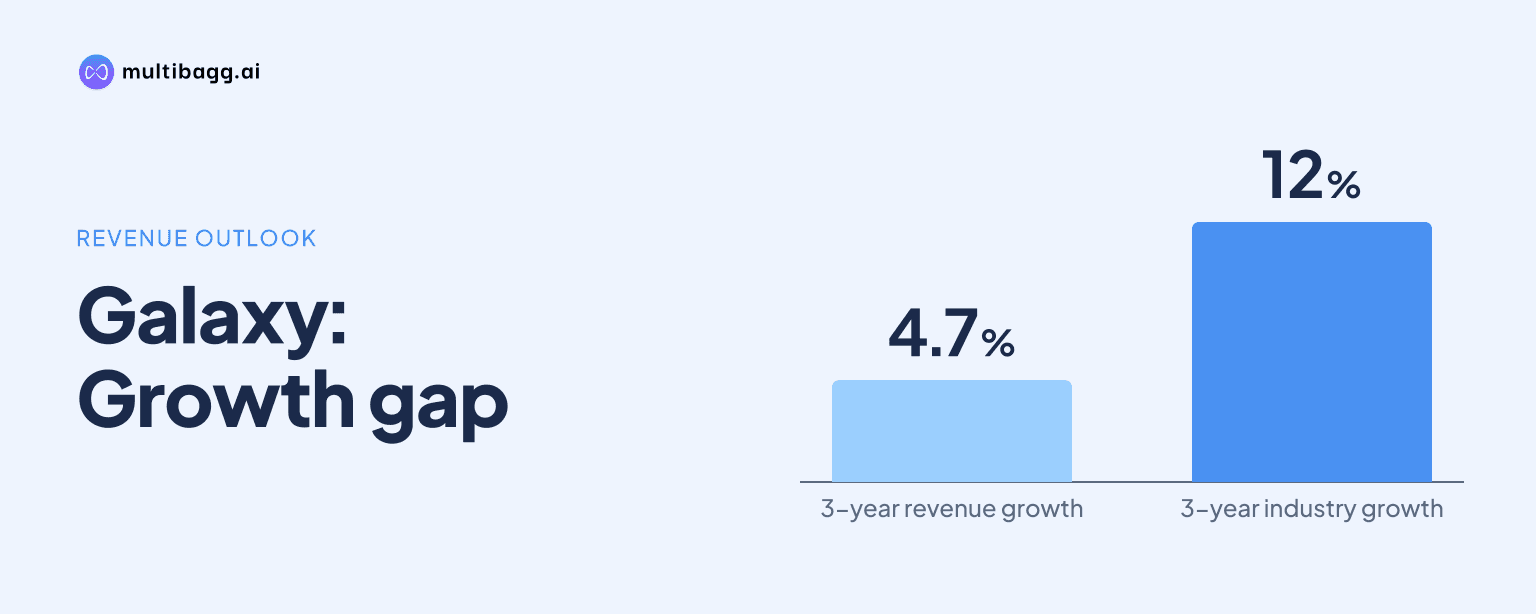
Galaxy Surfactants Limited faces a growth gap despite its valuation case: one cited three-year revenue forecast puts annual growth at 4.7%, against 12% for India’s chemicals industry. Other analyst estimates are higher, but the range of forecasts makes delivery on volumes, margins and the Vision 2030 plan central to the investment view.
Why is Galaxy’s growth outlook being debated?
Galaxy’s outlook is being debated because the growth estimates in circulation vary materially. One forecast expects revenue to grow 4.7% a year over the next three years, compared with 12% for the Indian chemicals industry. Other estimates in the discussion put Galaxy’s three-year revenue growth at 6.6%, 7.3%, 7.4% and 10.0% annually.
The difference matters because Galaxy is often viewed as a play on personal and home care consumption rather than a broad chemicals cycle. Its products serve the global home and personal care, or HPC, industry, where premiumisation and consumption growth are cited as long-term demand drivers. Historical performance also provides context: revenue rose 8% annually over the four fiscal years to FY17, reaching ₹2,171 crore, while net profit increased 25% annually to ₹146 crore.
What could drive Galaxy’s volumes over FY25-30?
Galaxy’s volume case rests mainly on India, emerging markets and a recovery in developed-market specialty products. Management expects volume growth of 8% to 10% CAGR in India and 10% to 12% CAGR in AMET and rest-of-world markets over FY25-30. A brokerage estimate separately projects 9% volume CAGR between FY24 and FY27, supported by domestic demand and improving specialty-care volumes in developed markets.
India’s personal-care market is seen as an important opportunity because of rising disposable income, premium products and deeper use of categories such as baby care, face wash, serums and liquid laundry and dishwashing formats. The cited outlook projects Indian market volume growth of 8% to 10% over FY25-30. Growth in direct-to-consumer brands and private labels could also create opportunities for customised customer solutions.
Galaxy’s FY17 volumes increased 11.9% year on year to 177,479 metric tonnes. That history is useful, but it does not establish that similar growth will recur. The current thesis depends on customer additions, a higher wallet share with existing customers, and the company’s annual research and development spending of ₹400 million to ₹500 million.
Is Galaxy’s valuation supported by earnings expectations?
Galaxy’s valuation support depends on whether margin improvement and earnings growth accompany revenue expansion. One historical valuation view described the IPO price as 35 times annualised earnings, a 26% discount to the FMCG-company average, while another cited 19 times FY22E earnings as leaving scope for upside. More recent figures cited in the discussion include about 22 times FY26E EPS of ₹118.3 and about 14 times FY26E EV/EBITDA.
Analyst fair-value and target estimates also show a wide range. The consensus price target cited is ₹2,694, with estimates ranging from ₹2,228 to ₹3,448. A separate brokerage target is ₹3,865, based on 30 times September 2026 estimated EPS. These are estimates, not assured outcomes, and their differing assumptions underline the importance of the earnings trajectory.
A refreshed valuation view lifted fair value from ₹2,593.64 to ₹2,690.73 per share. It also raised the assumed future P/E from 26.0 times to 28.0 times, while revenue growth assumptions moved slightly higher from 7.26% to 7.43%. Another set of assumptions envisages earnings of ₹5.0 billion and EPS of ₹140.49 by about August 2029, with net margin rising from 6.2% to 7.0%.
Got a follow-up? Ask IRIS
Can mix improvement lift Galaxy’s profitability?
Galaxy’s profitability case is linked to mix improvement and higher EBITDA per metric tonne rather than volume alone. The refreshed thesis points to EBITDA per metric tonne guidance of ₹24,000 to ₹25,000 for FY26-FY27. It also cites renewed North American project momentum, a reduced 18% tariff on Indian exports and a Mexico EPC project as possible supports for regional revenue and EBITDA.
The company operates across performance surfactants and premium specialty care. In FY19, performance surfactants accounted for 63% of the business and premium specialty care made up 37%. Historical figures cited for FY15-FY19 show EBITDA CAGR of 16.8%, PAT CAGR of 29.7%, RoCE of 27.2% and RoE of 23.9% in FY19, despite currency and commodity fluctuations.
The forward risk is that better mix may not fully offset external pressures. The discussion identifies raw-material inflation, trade uncertainty, geopolitical instability, global competition, weak demand and customer destocking as potential headwinds. It also notes a forecast for net income to rise 14% next year, below the 18% growth forecast for the Indian chemicals industry.
What does Vision 2030 mean for Galaxy investors?
Vision 2030 sets a clear operational benchmark for Galaxy: double volumes, grow EBITDA by 2.5 times and maintain RoCE above 22% over the next five years. The plan focuses on consolidating leadership in India and AMET markets while expanding premium specialty segments in the United States and Europe. It therefore provides a longer-term framework against which annual execution can be assessed.
For investors, the roadmap makes volume growth, EBITDA per tonne and return ratios the most relevant indicators. The company’s stated India and regional volume ambitions are above several near-term revenue-growth forecasts, so the conversion of volumes into revenue and profit will be important. The market view remains neutral overall, with mixed earnings expectations and a relative valuation assessment described as broadly in line with the market.
Conclusion
Galaxy has a demand narrative tied to personal and home care consumption, domestic premiumisation and a possible developed-market specialty recovery. However, the available forecasts point to a meaningful range in expected revenue growth, and at least one projection places the company well below the broader Indian chemicals industry. That makes valuation support more dependent on earnings quality, margin gains and operating execution.
The next watchpoints are the FY26-FY27 EBITDA-per-tonne guidance of ₹24,000 to ₹25,000, progress in North American and Mexico projects, and delivery against Vision 2030 targets of doubled volumes, 2.5 times EBITDA and RoCE above 22%. Investors will also need to monitor whether raw-material costs, demand conditions and customer destocking affect the expected margin improvement.