










Fast-Moving Consumer Goods Stocks Rally, Lag BSE 500 by 20 Points
Key highlights
- The BSE FMCG index gained 19% in the past year, versus a 39% gain for the BSE 500.
- Jubilant Foodworks rose 22% in one month, the highest reported gain in the BSE FMCG Index.
- Dabur India gained 12.6% in one month and hit a new high.
- Marico's Q2 FY27 net profit rose 31% year-on-year to Rs 550 crore.
powered by IRIS
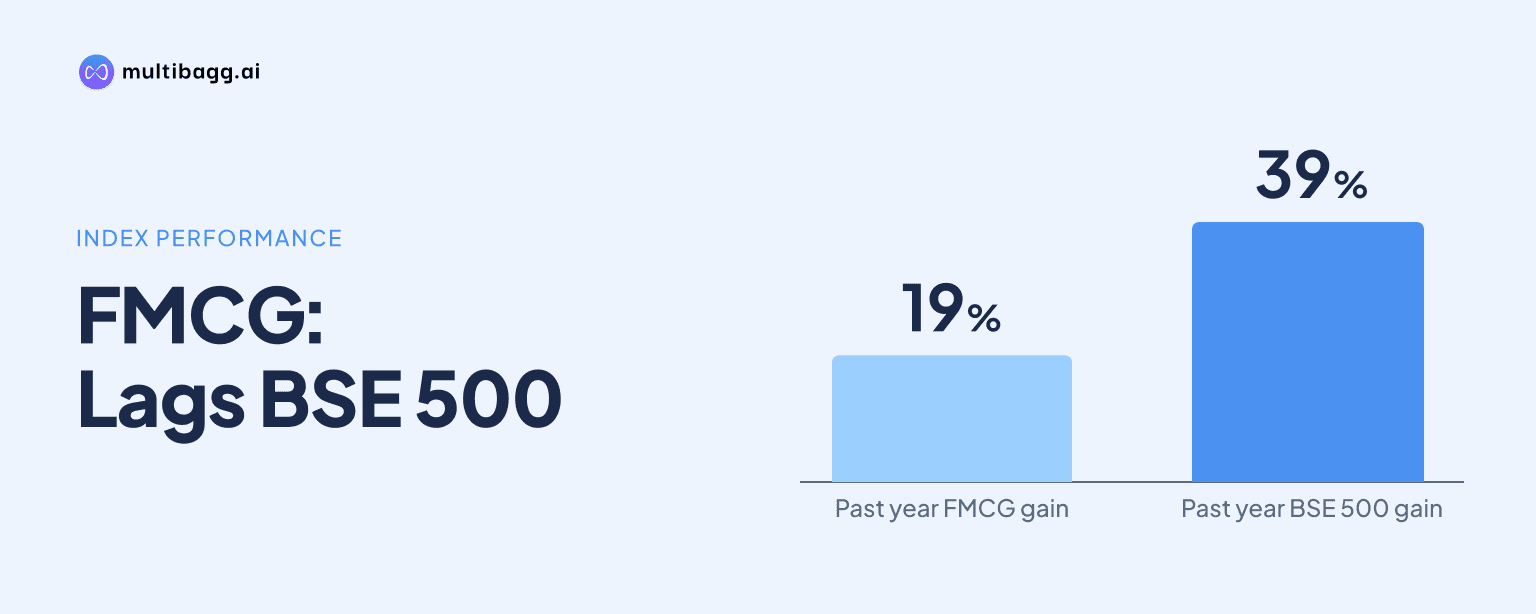
FMCG stocks are rallying selectively even though the BSE FMCG index gained 19% in the past year, trailing the BSE 500's 39% rise by 20 percentage points. Recent gains have been led by individual names, with Jubilant Foodworks up 22% in one month.
Why are FMCG stocks rallying now?
FMCG stocks have participated in a broader market advance supported by falling crude prices, softer US Treasury yields and foreign institutional investor buying. In the cited market session, the Sensex rose 1,225 points and the Nifty climbed 370 points, while FMCG and realty shares were among the leading sectors.
The buying has not been uniform across the sector. One market update showed the Nifty FMCG index up 1.18%, with nine of its 15 constituents trading higher. ITC, United Breweries, Godrej Consumer Products, United Spirits and Nestle India were among the gainers, while Marico, P&G Hygiene, Jubilant Foodworks, Varun Beverages and Hindustan Unilever were lower in that snapshot.
How far have FMCG stocks lagged the broader market?
FMCG stocks have lagged the broader market over the past year, despite the recent improvement in sentiment. The BSE FMCG barometer rose 19% over that period, compared with a 39% gain for the BSE 500, showing that the current rally follows a comparatively weak period for the sector.
The gap reflects pressures cited in market discussions, including competition from regional players, slow rural market growth and inflation. Rising commodity prices also remain relevant for consumer goods companies because they can raise input costs, although analysts expect volume growth at some larger companies could partly offset that pressure.
Which FMCG stocks have led the recent gains?
FMCG stock gains have been led by a mix of consumer, food and rural-facing names rather than a single broad theme. Jubilant Foodworks was reported as the top performer in the BSE FMCG Index, rising 22% over one month, while Nestle India gained 6.4%, slightly ahead of the cited 5.8% sectoral increase.
Dabur India, whose herbal portfolio is described as popular with rural consumers, reached a new high and gained 12.6% in the same period. Emami rose 7.8%. This spread in returns is important because it shows that recent market performance has depended on company-specific factors even as investors debate urban and rural demand trends.
Got a follow-up? Ask IRIS
Is urban demand driving FMCG stock returns?
Urban consumption growth is being treated as a leading indicator for parts of the consumption recovery, but it does not fully explain FMCG stock performance. Companies with more urban-oriented product portfolios may benefit if urban consumption continues to outpace rural demand, yet rural-linked companies have also posted notable gains.
Dabur India's 12.6% monthly rise and Emami's 7.8% gain illustrate why a simple urban-versus-rural investment framework can be incomplete. The market discussion points instead to selective stock picking, where portfolio mix, volume growth, margins and company developments can matter alongside the broader consumption trend.
What company developments are investors tracking in FMCG stocks?
FMCG investors are tracking earnings, volume trends and margins at major companies. Marico reported a 31% year-on-year increase in Q2 FY27 net profit to Rs 550 crore, while revenue rose 12% to Rs 3,897 crore; improved margins and strong volume growth led Jefferies, Systematix and Dolat Capital to maintain or upgrade Buy ratings and raise target prices.
ITC shares gained 2% despite an 18.5% year-on-year decline in Q2 net profit, as its FMCG business recorded strong growth. Separately, Quant Mutual Fund reduced exposure to frontline IT stocks as part of profit booking and increased FMCG investments, citing disappointing earnings at key technology companies and taking a cautious view on manufacturing amid supply-chain issues.
What could limit FMCG gains?
FMCG gains could be constrained if higher commodity prices hurt margins or if weak rural demand persists. The sector has experienced slower volume growth amid rising costs, and rural weakness has been reported to affect smaller regional manufacturers more sharply than larger companies.
The technical picture has improved in some market commentary, with the Nifty FMCG index said to have broken out of a range that lasted about 31 months. Technical analysts cited potential for a 5-7% short-term rally, but this is an outlook rather than a reported outcome and does not remove the underlying risks around costs, demand and uneven company performance.
Conclusion
FMCG stocks have regained attention during a supportive market phase, but the sector's recent momentum should be viewed against its 20-percentage-point underperformance versus the BSE 500 over the past year. The reported gains in Jubilant Foodworks, Dabur India, Emami and Nestle India indicate that company-level factors are currently shaping returns as much as the urban consumption narrative.
The next signals to watch are commodity-cost movements, rural and urban volume trends, and the ability of large companies to protect margins. Investors will also track follow-through in quarterly performance after Marico's Q2 FY27 growth and ITC's stronger FMCG business growth despite lower overall net profit.