










Nifty 50 Gains Mask Midcap and Smallcap Market Weakness
Key highlights
- Nifty rose 10.75% in 10 sessions and crossed 25,000.
- The Nifty Smallcap 250 fell around 8% in one week.
- The Nifty Midcap 100 declined 6% in the same weekly sell-off.
- The BSE MidCap 150 and BSE SmallCap 250 fell 3% and 4.6%, respectively.
powered by IRIS
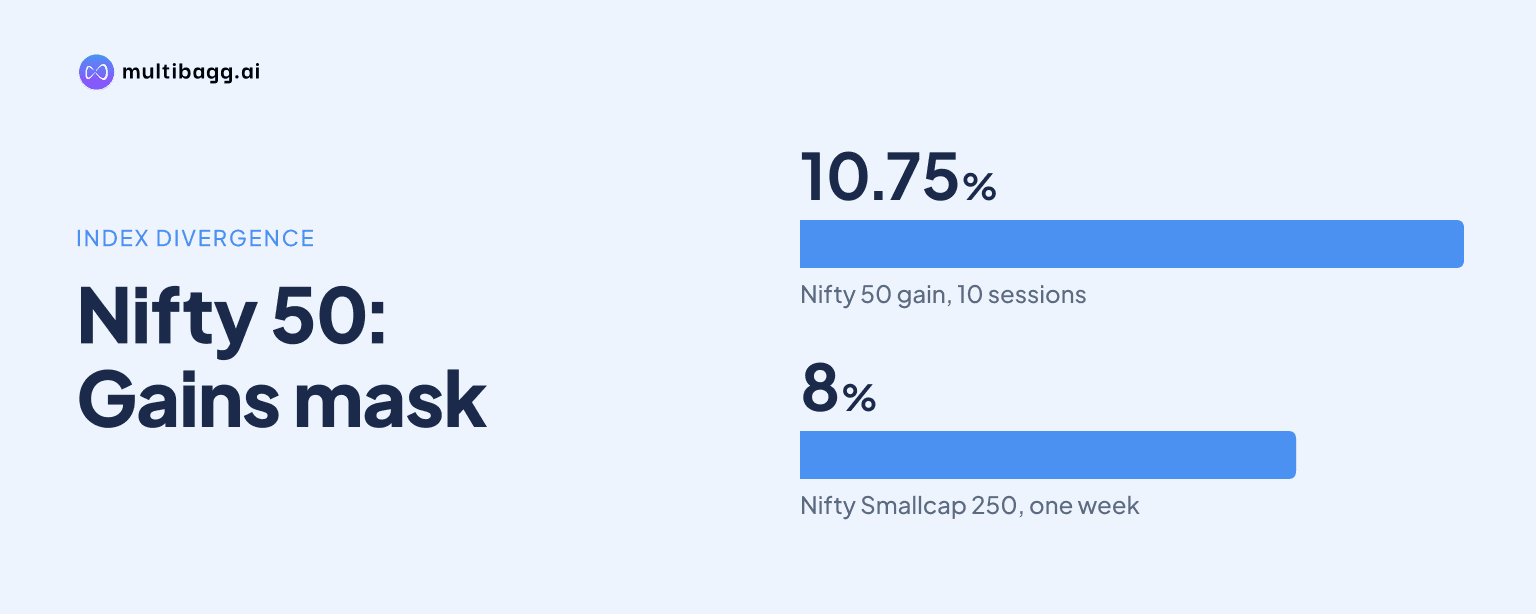
Nifty 50's 10.75% surge in 10 sessions above 25,000 has masked a weaker broader market, with foreign investor buying supporting heavyweight shares while the Nifty Smallcap 250 fell around 8% in a week and the Nifty Midcap 100 declined 6%.
Why did Nifty rise while midcap and smallcap indices fell?
Nifty rose because buying was concentrated in large, heavyweight stocks, particularly banking and financial shares, rather than being spread across the market. Foreign institutional investor inflows were cited as a key support for these stocks, helping the benchmark recover even as broader indices remained under selling pressure.
The divergence was visible during a period when Nifty crossed 25,000 after rising 10.75% in 10 sessions. At one reported close, Nifty ended at 25,030.35, up 493.75 points or 2.01%, while the Nifty Midcap 100 slipped 0.02% and the Nifty Smallcap 100 fell 0.82%. The benchmark rally therefore did not translate into a broad-based rise in stock prices.
How large was the decline in broader market indices?
Broader-market losses were considerably sharper than the moves in Nifty, with midcap, smallcap and microcap shares facing sustained selling. The Nifty Smallcap 250 fell around 8% in one week, while the Nifty Midcap 100 was down 6%, despite commentary pointing to a resilient earnings growth outlook.
Other reported market snapshots also showed weak breadth. The BSE MidCap 150 and BSE SmallCap 250 declined 3% and 4.6%, respectively. On another session, the Nifty Midcap 100 traded 0.47% lower at 60,337.85 and the Nifty Smallcap 100 was down 1.17% at 18,908.10.
The contrast matters because benchmark gains can give an impression of a healthier market than many retail portfolios experience. Investors with larger allocations to smaller companies may have seen declines even when Nifty was recovering or holding near major levels.
Got a follow-up? Ask IRIS
What is pressuring midcap and smallcap stocks?
Pressure on midcap and smallcap stocks has been linked to concerns over valuations, weak market breadth and an intensifying smallcap sell-off as margin trading facility positions decline from record levels. Analysts warned that valuations in parts of the broader market remained difficult to justify after the sharp weekly correction.
External conditions also added to the uneven trading environment. Indian equities turned lower when crude oil crossed $116 per barrel, raising concerns around inflation and economic growth. Auto and realty shares led losses in one session when Nifty fell 155 points to 25,144, while Sensex declined 318 points to 81,592.
Falling crude oil prices later supported recoveries in the headline indices. In one such session, Sensex closed at 81,106.65, up 107.25 points, and Nifty ended at 25,044.65, up 58.25 points. However, cooling oil did not by itself resolve the continuing weakness reported across smaller-company indices.
What does the narrow Nifty rally mean for retail investors?
The narrow Nifty rally means index performance and individual portfolio performance can differ sharply when gains are concentrated in a limited group of large companies. Retail investors holding midcap, smallcap or microcap stocks may not benefit meaningfully from a benchmark advance led by heavyweight shares.
The data also points to a change in market leadership, with largecaps regaining prominence while smaller stocks remain under pressure. Nifty had recovered to broadly flat returns in October, whereas midcap and smallcap indices had declined. Large-cap fund inflows were reported at ₹4,575 crore, while foreign purchases and banking-sector strength continued to support benchmark stocks.
This does not establish that every large-cap stock will outperform or that every smaller stock will remain weak. It does show that investors should separate the movement of Nifty from market breadth and from the performance of the segments in which they are invested.
Conclusion
Nifty's move above 25,000 reflected concentrated strength in heavyweight shares rather than a market-wide recovery. Foreign investor inflows, buying in banking and financial stocks, and periods of softer crude prices supported the benchmark, while valuation concerns and falling margin trading facility positions accompanied sharp losses in smaller-company indices.
The next signals to watch are whether foreign buying continues to favour largecaps, whether crude oil remains contained after crossing $116 per barrel, and whether selling in midcap and smallcap shares eases. Market breadth, the direction of margin-funded positions and the relative performance of the Nifty Midcap 100 and Nifty Smallcap 250 will indicate whether the recovery is broadening.