










FMCG Stocks Rally as Nifty FMCG Index Climbs 3.65% in Session
Key highlights
- The Nifty FMCG index gained 3.65%, the strongest listed sectoral rise in the reported Tuesday session.
- The Nifty 50 added 370.05 points to close at 23,810.85 in the broad-based rally.
- The BSE Sensex rose more than 1,200 points, or 1.62%, to finish at 76,917.85.
- Future Consumer rose 4.55% in a cited Monday morning FMCG trading update.
powered by IRIS
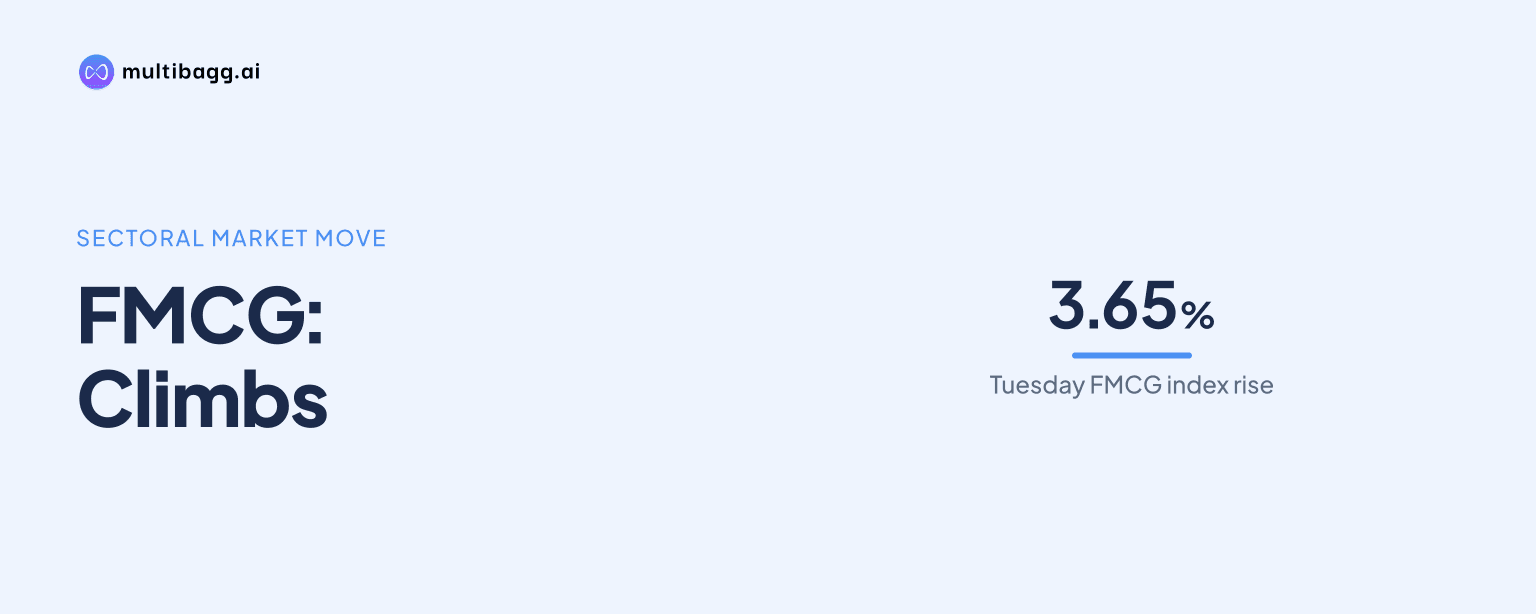
During Tuesday's reported trading session, fast-moving consumer goods stocks led the market advance, with the Nifty FMCG index rising 3.65% while the Nifty 50 gained 370.05 points to close at 23,810.85. The move came amid lower crude prices, softer US Treasury yields and reported foreign institutional investor buying.
Why did FMCG stocks lead the market rally?
FMCG led because the sector recorded the strongest gain among the indices cited for Tuesday, advancing 3.65%. Realty, financial services and auto also rose, pointing to buying beyond a single pocket of the market rather than a narrow index move.
Market commentary linked the broader positive tone to falling crude prices, softer US Treasury yields and foreign institutional investor buying. These were reported as sentiment drivers, alongside gains in FMCG and realty shares. The available discussion does not provide company-specific earnings or valuation reasons for the sector-wide FMCG advance.
The same trend appeared in other market updates, where FMCG was identified as a leading or top-performing sector. On one reported Monday morning, Future Consumer, Tasty Bite Eatables, Colgate Palmolive (India), Varun Beverages, Zydus Wellness, Britannia Industries, Parag Milk Foods, Heritage Foods, Godrej Consumer Products and Hindustan Unilever were among the FMCG gainers.
How did the Nifty FMCG index compare with other sectors?
The Nifty FMCG index outperformed the listed major sectors in the Tuesday session with a 3.65% increase. Nifty Realty rose 2.33%, Nifty Financial Services gained 1.84%, and Nifty Auto advanced 1.71%, while Bank Nifty added 0.98%.
Sector leadership was not uniform across every update in the discussion. In another reported market snapshot, Nifty FMCG gained 0.66% to 46,970.70 points, while PSU banks led with a 2.63% rise. That snapshot also showed weakness in IT, down 1.04%, and Realty, down 1.14%, underlining that sector rankings changed across sessions.
What happened to the Sensex and Nifty 50?
The Sensex rose by more than 1,200 points, or 1.62%, to 76,917.85, while the Nifty 50 closed at 23,810.85 after adding 370.05 points in the reported broad-based rally. FMCG, financial services and realty were described as the leading sectors in that session.
Other social-media discussions referred to a 10-session winning streak for the benchmark indices, although one Monday update said financial and realty stocks offset losses in IT, FMCG and auto shares. Another update said the Sensex gained 773 points and the Nifty closed above 25,250 during a nine-session regular-session winning streak.
These reported figures should be read as separate market snapshots rather than one continuous set of closing data. They nevertheless show that the rally’s leadership rotated between FMCG, banks, financials, realty and auto, while IT, pharma and healthcare were relatively weaker in some sessions.
Got a follow-up? Ask IRIS
Which FMCG shares were cited among the gainers?
The cited FMCG gainers included Future Consumer, Tasty Bite Eatables, Colgate Palmolive (India), Varun Beverages, Zydus Wellness, Britannia Industries, Parag Milk Foods, Heritage Foods, Godrej Consumer Products and Hindustan Unilever. The reported advances ranged from 0.99% for Hindustan Unilever to 4.55% for Future Consumer in the Monday morning snapshot.
Britannia Industries, Hindustan Unilever and Nestle India also appeared among gainers in the Nifty pack in that update. However, the supplied discussion provides intraday percentage moves only for selected shares and does not give closing prices, quarterly figures, management commentary or forward guidance for these companies.
For retail investors, the key distinction is between a sector-led move and evidence of a change in individual business performance. The available information supports the former: FMCG stocks attracted buying as part of a wider improvement in risk appetite. It does not establish whether every cited company participated for the same reason or whether the gains were sustained after the session.
What factors shaped the broader market mood?
Lower crude prices, softer US Treasury yields and foreign institutional investor buying were the main factors cited as supporting the market mood. Better-than-expected second-quarter earnings from various sectors and a stronger Indian rupee against the US dollar were also mentioned in a separate update as constructive conditions.
Global positioning was another element in the discussion. A November 3 market update linked gains in FMCG, chemical and IT shares to an unwinding of AI-related trades in global markets, while weak energy prices were also cited. These are market-level observations and do not amount to company-specific forecasts for FMCG businesses.
Broader-market participation was reported in one session, with midcap and smallcap indices gaining about 0.8% and 1.6%, respectively. Such participation can indicate improving risk appetite, but investors should note that the supplied updates also recorded mixed sector performance, including declines in pharma, healthcare, IT and, in one snapshot, realty.
Conclusion
The available market updates show FMCG as a prominent participant in the Indian equity rally, led by a 3.65% rise in the Nifty FMCG index during one reported session. The move coincided with a 370.05-point Nifty 50 gain and a more than 1,200-point advance in the Sensex, supported by favourable macro and fund-flow commentary.
Investors should watch whether foreign institutional investor buying, crude prices and global bond yields continue to support the market. They should also track whether FMCG remains a sector leader as leadership rotates among financials, realty, auto and banks, and as later sessions test the durability of the benchmark indices' winning streak.