










Indian Oil Corporation outlook balances valuation and margin risks
Key highlights
- The analyst poll places IOCL's average 12-month target at ₹157.42, implying 7.70% upside from its reference price.
- Motilal Oswal retained a Neutral rating with a ₹135 target and cut FY27 standalone EBITDA estimates to ₹412 billion from ₹576 billion.
- PL Research forecasts FY27 consolidated EBITDA of ₹378 billion and FY28 EBITDA of ₹567 billion.
- Panipat, Gujarat and Barauni refinery expansions are targeted for completion in December 2026.
powered by IRIS
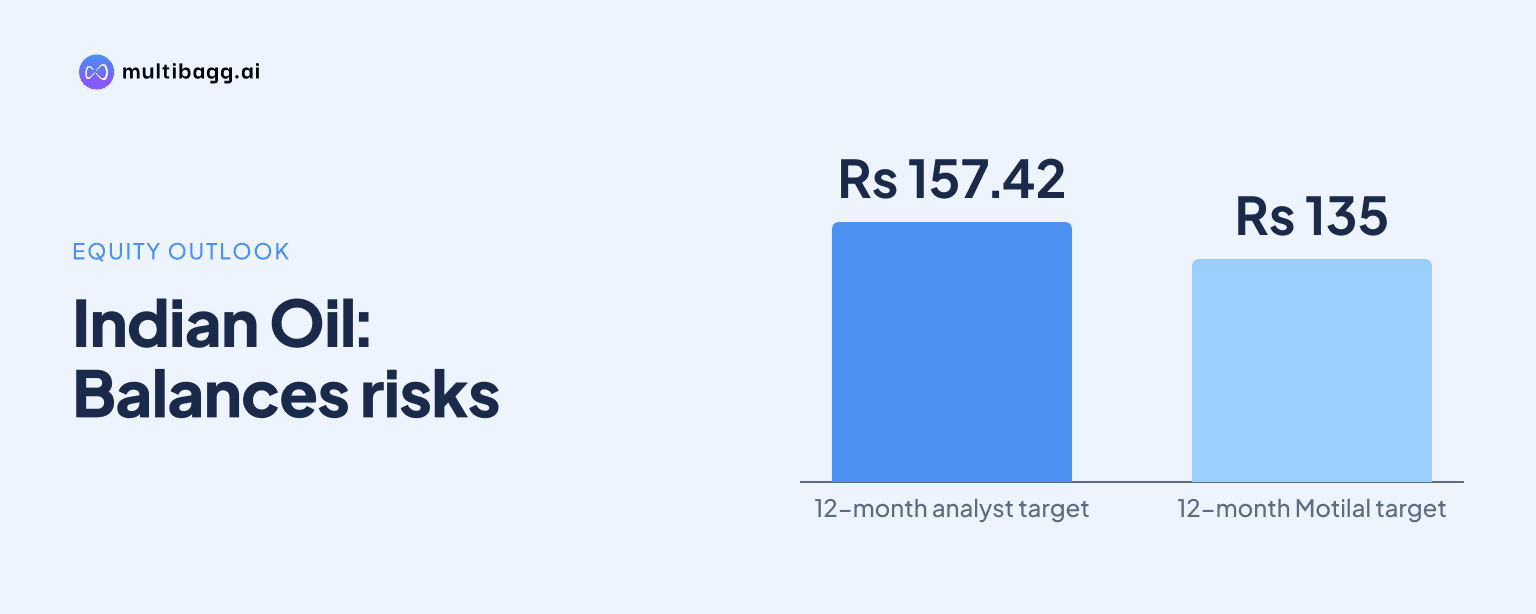
Indian Oil Corporation Limited's investment outlook is balanced by a ₹157.42 average 12-month target, while fuel under-recoveries, uncertain refining margins and planned shutdowns could constrain earnings before refinery expansions targeted for December 2026.
What do broker targets say about IOCL stock?
Broker targets show a wide range of expectations for IOCL, with the average 12-month target at ₹157.42 and individual fundamental targets reflecting a more restrained view. Morgan Stanley has maintained an Overweight rating with a ₹191 target, describing IOCL as the main beneficiary among refiners because of its scale and potential for an earnings upcycle from above mid-cycle integrated margins.
Motilal Oswal retained a Neutral rating and a ₹135 target in its November 1, 2026 update, while PL Research retained Accumulate but reduced its target to ₹145 from ₹163. SMIFS has set a shorter-term technical target of ₹160, conditional on the stock remaining above ₹137 on a closing basis. The differing targets underline the split between valuation support, a constructive chart setup and operating risks.
Why are IOCL's marketing margins under pressure?
IOCL's marketing margins face pressure because higher crude prices can increase under-recoveries on regulated fuels and LPG. Motilal Oswal noted that Brent averaged about $105 a barrel in October 2026 month to date, raising under-recoveries on LPG, motor spirit and high-speed diesel.
The recent retail fuel cut was lower than Morgan Stanley had expected, which the broker said removed a key overhang. However, Motilal Oswal still expects marketing margins to remain under pressure. PL Research has also identified disruptions linked to West Asia, fuel under-recoveries and uncertainty over gross refining margins as material risks for FY27.
These factors matter because IOCL combines refining with fuel marketing. A rise in crude oil prices does not automatically translate into stronger profitability if retail fuel pricing and regulated product economics limit recovery of costs. Selling in IOCL and other oil marketing stocks followed oil prices moving above $100 a barrel amid escalating West Asia tensions, according to the supplied discussion.
Got a follow-up? Ask IRIS
How did IOCL perform in recent results?
IOCL's reported results have shown strong profit and operating performance, although brokers remain cautious about the sustainability of margins. The company reported Q4 FY26 net profit of ₹14,458 crore, up 77.98% year on year. Another social-media data point described earnings growth of 90% over the past year.
For Q4 FY26, PL Research said standalone revenue was ₹2,078.8 billion, up 1.7% quarter on quarter and 6.6% year on year. Standalone EBITDA rose 6.2% quarter on quarter and 64.9% year on year to ₹226.1 billion, exceeding PL Research's ₹161.4 billion estimate and the ₹146.5 billion Bloomberg consensus estimate.
Motilal Oswal also described IOCL's 2QFY27 result as a strong earnings beat, driven by better-than-expected marketing performance. Yet it cut its FY27 standalone EBITDA estimate to ₹412 billion from ₹576 billion, showing that a quarterly beat has not removed concerns over the outlook for fuel marketing and refining profitability.
Can refinery expansions improve IOCL's growth outlook?
IOCL's planned refinery expansions could strengthen its longer-term growth case, with projects at Panipat, Gujarat and Barauni targeted for completion in December 2026. The company spent ₹12,162 crore in the first half of FY27, with refining and marketing receiving the bulk of investment as these projects approach completion.
The expansion programme is central to the positive argument because additional capacity may support future throughput and earnings. IOCL has also announced a ₹2,449 crore investment in the 424.5-km Kochi-Kanyakumari-Thoothukudi gas pipeline, which is planned to have capacity of 6.84 mscmd and transport regasified LNG from Kochi to demand centres in Kerala and Tamil Nadu.
The near-term issue is execution alongside existing operational pressures. PL Research expects planned refinery shutdowns to affect FY27 throughput. It forecasts consolidated FY27 revenue of ₹8,899 billion, EBITDA of ₹378 billion and profit after tax of ₹137 billion, followed by FY28 estimates of ₹9,830 billion, ₹567 billion and ₹273 billion, respectively.
Conclusion
IOCL presents a valuation-supported but operationally sensitive investment case. Motilal Oswal considers the stock inexpensive at about 6x FY28E consolidated EPS of ₹21.9 and 0.7x FY28E price to book, both below its stated 10-year averages. Still, the ₹135 to ₹145 fundamental targets and lower FY27 forecasts show that investors are assigning significant weight to under-recoveries, margin uncertainty and refinery disruptions.
The next key milestone is the targeted December 2026 completion of the Panipat, Gujarat and Barauni refinery projects. Investors will also need to watch crude oil prices, West Asia-related volatility, marketing margins and the impact of planned shutdowns on FY27 throughput, as these factors will determine whether IOCL can move toward the stronger FY28 earnings projections.