










Indian equity market's Nifty rally bypasses 769 declining stocks
Key highlights
- The Nifty gained 2,812 points, or 12.65%, between October 8 and November 8.
- ACE Equity data showed 769 stocks declined during the same October 8 to November 8 period.
- The Nifty Midcap 150 and Nifty Smallcap 250 each fell 2.74% in the preceding month.
- Foreign investors bought more than $4.1 billion of Indian equities so far in November, according to Reuters.
powered by IRIS
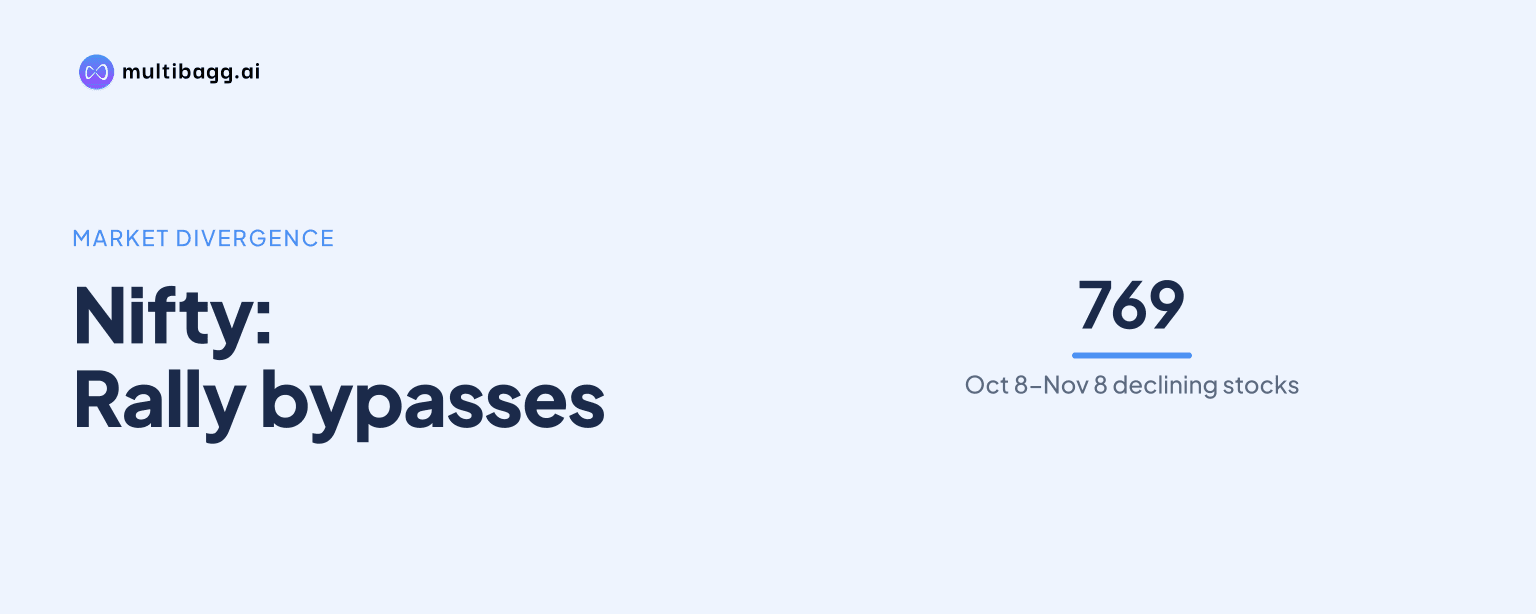
The Indian equity market's Nifty rose 2,812 points, or 12.65%, between October 8 and November 8, while ACE Equity recorded declines in 769 stocks, showing that foreign-led buying was concentrated in large, liquid shares rather than the wider market.
Why is the Nifty rising while smaller stocks fall?
The market is rising because buying has been concentrated in a limited set of heavyweight large-cap stocks. The Nifty surged 10.75% in 10 sessions and crossed 25,000, while foreign investor flows supported banking, technology, telecommunications and other large companies. This lifted the headline index without producing broad-based gains across midcap, smallcap and microcap shares.
The contrast is visible in the number of stocks that fell during the benchmark recovery. ACE Equity data showed that 769 stocks declined between October 8 and November 8, even as the Nifty gained 2,812 points. Several well-known companies lost more than 20% over that period, underlining why many retail portfolios did not reflect the benchmark's advance.
How large was the midcap and smallcap correction?
The market's broader segments declined even as the Nifty recovered. The BSE MidCap 150 and BSE SmallCap 250 were reported down 3% and 4.6%, respectively, while another October comparison showed the Nifty 50 rising 2% to 23,053 as the Nifty Midcap 150 fell 3.7% and the Nifty Smallcap 250 dropped 5.8%.
Daily moves also illustrated the same split. In one session, the Nifty Midcap 100 closed at 60,606.65, down 0.02%, and the Nifty Smallcap 100 ended at 18,975.05, down 0.82%. In another update, the Midcap 100 stood at 60,337.85, down 0.47%, while the Smallcap 100 was at 18,908.10, down 1.17%, despite a stronger benchmark index.
The selling pressure intensified in some accounts of the recent correction. The Nifty Smallcap 250 was described as down around 8% in a week, while the Nifty Midcap 100 was down 6%. This weak market breadth was also reflected in the advance-to-decline ratio, which pointed to underlying weakness despite index gains.
Got a follow-up? Ask IRIS
What is driving the market's preference for large caps?
The market's preference for large caps reflects valuations, liquidity and institutional buying patterns. Large-cap shares had fallen sharply in the correction that began in January 2026, making their valuations more attractive relative to smaller companies that entered the decline after earlier strong rallies. Earnings resilience and more reasonable valuations were cited as additional support for large companies.
Foreign institutional investors have also generally favoured stocks where large amounts can be deployed without materially affecting prices. Overseas investors bought more than $4.1 billion of Indian equities so far in November, according to Reuters, representing the strongest monthly inflow since September 2024. At the same time, domestic institutional investors were reported as sellers, adding another layer to the divergence in flows.
HSBC Mutual Fund attributed October's gap partly to better-than-expected IT earnings and a shift towards large-cap technology stocks. The Nifty IT Index rose 17.7% in October and healthcare gained 2.6%. The fund also identified elevated crude prices, higher domestic and global bond yields, foreign investor selling, heavy primary-market supply and the unwinding of leveraged retail positions as pressures on smaller companies.
Does the market rally show broad investor confidence?
The market rally does not yet show broad investor confidence because the advance has remained narrow. The Sensex rose 1,534 points and the Nifty added nearly 375 points on one Thursday, while broader indices did not participate. That pattern suggests investors were selective, with the recovery driven more by heavyweight shares than by widespread buying.
There are also differing performance windows that investors need to distinguish. The Nifty Midcap 150 was reported to have gained around 11% over the past year, compared with a 6% decline in the Nifty over that stated period. But recent monthly and weekly declines show that past outperformance has not prevented a sharp correction in smaller shares.
Conclusion
The market's recent recovery has been an index-led move rather than a broad equity-market rebound. The Nifty's 12.65% rise between October 8 and November 8 coincided with declines in 769 stocks, while reported losses in midcap, smallcap and microcap indices showed the impact of selective foreign buying, valuation concerns and pressure on retail-held smaller shares.
Investors will watch whether foreign inflows continue to favour large, liquid stocks and whether market breadth improves across midcaps and smallcaps. Crude oil prices, macroeconomic uncertainty, bond yields, earnings visibility, primary-market supply and the extent of retail deleveraging remain the unresolved factors identified in the market discussion.