










Waaree Energies: capital gains depend on 12-month holding
Key highlights
- Waaree Energies is already traded on the NSE as WAAREEENER and on the BSE as 544277.
- Shares held for more than 12 months are described as long-term for capital-gains purposes.
- The cited Section 111A disclosure states a 15% short-term capital-gains tax rate, subject to conditions.
- Waaree Energies reaffirmed FY27 operating EBITDA guidance of ₹7,000-7,700 crore.
powered by IRIS
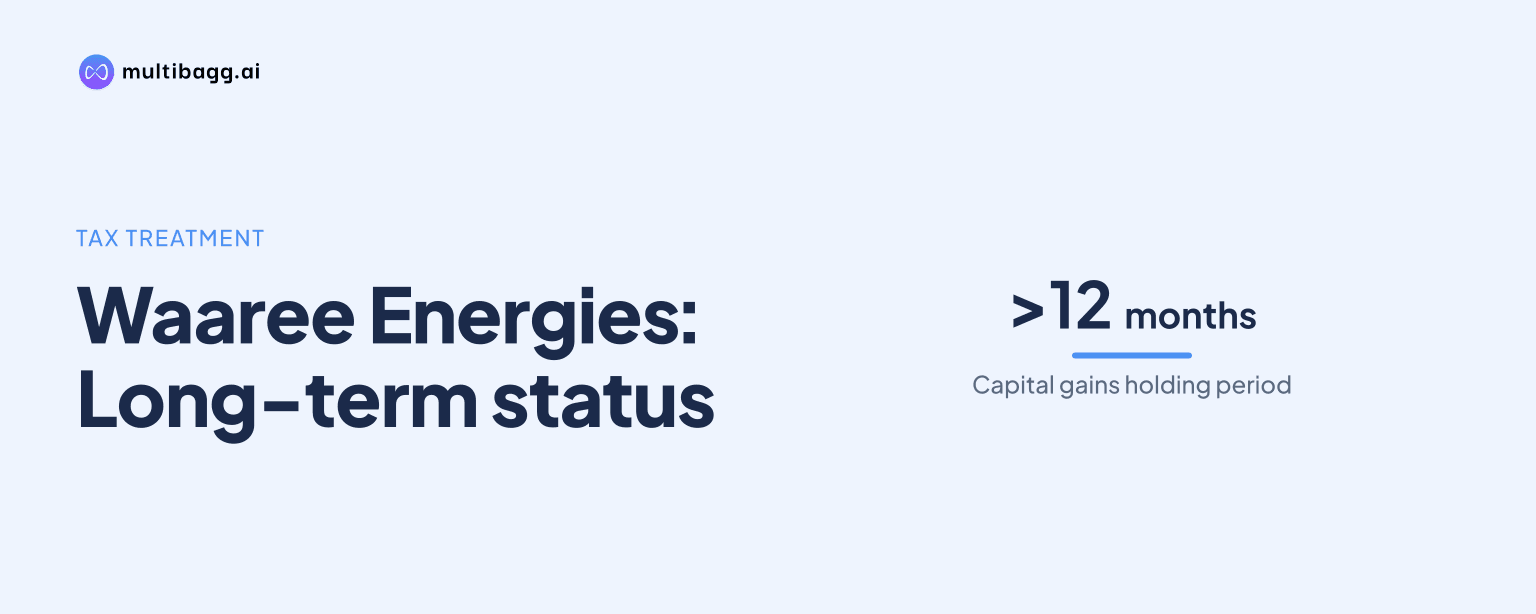
Waaree Energies Limited disclosures state that capital gains on its shares are classified by a 12-month holding period, with short-term gains taxable at 15% subject to prescribed conditions and long-term gains potentially taxable alongside securities transaction tax. The company is already traded on the NSE as WAAREEENER and on the BSE as 544277.
How are Waaree Energies share gains classified for tax?
Waaree Energies classifies gains based on whether an investor has held the equity shares for more than 12 months or for 12 months or less. Its disclosed tax language says capital gains from selling equity shares in an Indian company are generally taxable in India unless a specific exemption applies.
For a sale after a holding period of more than 12 months, the disclosure says an investor may be subject to long-term capital gains tax in India, in addition to securities transaction tax, or STT. For shares held for 12 months or less, the gain is described as short-term capital gain and is subject to short-term capital gains tax. The applicable outcome remains subject to the conditions set out under Indian tax law.
The context specifically refers to Section 112A of the Income-tax Act, 1961 for long-term capital gains and Section 111A for short-term gains on equity shares, equity-oriented fund units and business-trust units. Under the Section 111A reference, the short-term tax rate is stated as 15%, subject to fulfilment of prescribed conditions.
Has the capital gains tax rule for Waaree Energies changed?
The supplied disclosures explain the tax treatment but do not specify a new capital-gains tax change unique to Waaree Energies. Social-media discussion around the stock should therefore be separated from the company-specific disclosure, which describes the general distinction between holdings above and below 12 months.
The disclosure also notes that non-residents may seek tax-treaty benefits in relation to capital-gains income. At the same time, it says Indian tax treaties generally do not limit India’s right to impose capital-gains tax on the sale of shares in an Indian company. This is a general statement in the provided material, not an individual tax calculation.
For investors, the practical starting point is to identify the holding period and the exchange-sale conditions mentioned in the disclosure. Tax liability can depend on prescribed conditions and an investor’s circumstances, so the company’s prospectus-style language should not be treated as personalised tax advice.
Is Waaree Energies expected to list on the NSE?
Waaree Energies is already listed and actively traded on the National Stock Exchange of India under the ticker WAAREEENER. The supplied context says the Mumbai-headquartered solar company listed in October 2024 and also trades on the BSE under scrip code 544277.
References to proposed listing, in-principle approvals and commencement of trading within three working days of an offer closing date relate to offer documentation cited in the discussion. They do not indicate that a fresh NSE listing is pending for the existing Waaree Energies equity shares. The company was also described as qualifying for Nifty 500 and S&P BSE 500 rebalancing in 2024.
This distinction matters because an investor searching for an “NSE listing outlook” may be looking at older listing language alongside current market information. The present trading identifiers in the context show that the relevant issue is performance after listing, rather than whether Waaree Energies will obtain an initial listing approval.
Got a follow-up? Ask IRIS
What factors are shaping Waaree Energies market discussion?
Waaree Energies market discussion combines operational expansion, reported earnings, order visibility and regulatory developments. The company reaffirmed FY27 operating EBITDA guidance of ₹7,000-7,700 crore, reported an order book of ₹59,200 crore and began production on two new lines at its Texas plant, according to the supplied material.
The context also reports a strong Q2 net-profit growth figure of 133% to ₹842 crore. Separately, the quarterly data table shows net profit of ₹670.88 crore for September 2026, compared with ₹739.10 crore in June 2026 and ₹1,159.53 crore in September 2025. These figures appear in different items in the supplied discussion and should be read with their respective reporting references.
Share-price moves have added to investor attention. One update said the stock rose 2.29% to ₹2,500 after reaching an intraday high of ₹2,613.30, while another said it fell as much as 6% after Income Tax Department officials visited facilities. Waaree Energies said it was fully cooperating with authorities.
What regulatory matters should Waaree Energies investors track?
Waaree Energies has disclosed GST-related orders and said there was no impact on its financials, operations or other activities from the matters described. The appellate authority reduced demands for FY2017-18 and FY2018-19 to ₹23.62 lakh and ₹25.87 lakh from ₹6.95 crore and ₹6.03 crore, respectively.
The company also disclosed an assessment order aggregating ₹7.52 crore for a stated tax period, connected to observations regarding ineligible input tax credit and cross-charging of common input tax credit. It said it was taking appropriate steps, including an appeal before the appropriate authority in relation to the assessment matter.
These disclosures are separate from an investor’s capital-gains tax on selling shares. They concern the company’s indirect-tax matters, whereas capital gains and STT concern a shareholder’s transaction in the listed equity shares. Keeping the two areas separate is important when reviewing headlines and social-media posts.
Conclusion
Waaree Energies is already an NSE- and BSE-listed company, so the key listing takeaway is not a future admission to trading but the status of an established listed stock. Its capital-gains disclosure centres on the 12-month holding threshold, with short-term gains stated at 15% under the cited provision subject to prescribed conditions, while long-term gains may also be taxable along with STT.
Investors can next watch delivery against FY27 EBITDA guidance of ₹7,000-7,700 crore, the ₹59,200 crore order book and the ramp-up of the Texas production lines. They may also track updates on the disclosed tax proceedings and any further company communication on the Income Tax Department visit or related regulatory matters.