










Indian Stock Market Volatility Rises 68% Despite Nifty Gain
Key highlights
- India VIX rose 68% over the last three weeks while the Nifty gained more than 7%.
- FIIs bought ₹84,290 crore of Indian equities in the first fortnight of November.
- The Nifty closed at 25,144.30 on Friday, down 155.05 points or 0.61%.
- October retail inflation reached 6.09%, above the RBI's upper tolerance limit.
powered by IRIS
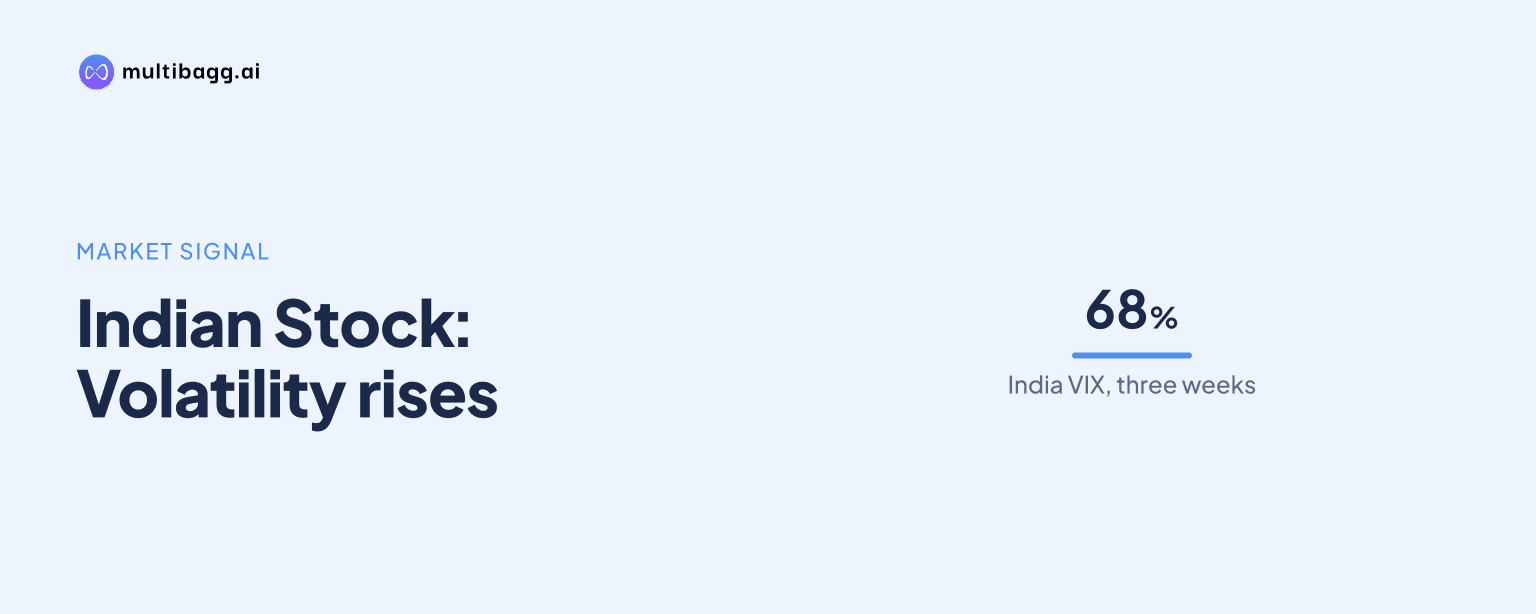
Indian stock market volatility rose 68% over the last three weeks even as the Nifty gained more than 7%, showing that renewed foreign buying and stronger September-quarter earnings have been accompanied by concern over inflation, crude oil and global AI-linked market moves.
Why has Indian stock market volatility risen?
Indian stock market volatility has risen because investors are balancing a strong rebound in benchmark indices against renewed risks from inflation, crude oil and global technology stocks. India VIX, the gauge of expected market volatility, has climbed 68% in the past three weeks, while the Sensex and Nifty gained more than 7% over the same period.
The rise in volatility does not indicate a one-way decline in equities. The context points to alternating buying and selling pressure, sector rotation and profit-booking after a sharp rally. On Friday, the Nifty fell 155.05 points, or 0.61%, to 25,144.30, while the Sensex lost 318.56 points, or 0.39%, to 81,592.45. Auto and realty shares were among the sectors facing selling pressure.
Broader markets have not matched the benchmark recovery. The BSE MidCap 150 and BSE SmallCap 250 declined 3% and 4.6%, respectively, even as the headline indices advanced. This divergence suggests investors have remained selective, with attention focused on valuations, liquidity and the durability of the recent rally.
What is driving foreign buying in Indian stock market?
Foreign buying in Indian stock market has returned as investors rotate away from crowded AI-related trades towards Indian equities, where improving earnings, lower oil prices at points during the month and large-cap valuations have supported sentiment. Foreign institutional investors bought ₹84,290 crore of Indian equities in the first fortnight of November, according to the reported figures.
Other reported estimates put foreign purchases at more than ₹75,000 crore or ₹73,261 crore during November so far, with the latter exceeding the previous monthly record of ₹66,135 crore set in December 2023. The varying figures reflect different reporting points during the month, but all point to a major reversal after foreign investors sold a record ₹2.95 lakh crore in the first 10 months of 2026.
Foreign investors were net buyers for a tenth consecutive session on Friday, purchasing shares worth ₹5,736.55 crore on a provisional NSE basis. Social-media discussion also highlighted a $316 million weekly inflow into BlackRock's iShares MSCI India ETF, its largest since June 2025. These flows have been linked to stabilisation in the rupee, although expectations of potential US interest-rate hikes remain a market consideration.
How are inflation and crude oil affecting Indian stock market?
Inflation and crude oil are affecting Indian stock market sentiment by raising concerns about future interest rates, corporate margins and India's macroeconomic outlook. Retail inflation reached 6.09% in October, breaching the Reserve Bank of India's upper tolerance limit and prompting caution after the market's recent advance.
Brent crude was hovering near $96 per barrel amid uncertainty around energy supplies and geopolitical developments in West Asia. A further rise in oil could add to inflation pressures and weigh on profitability, particularly for sectors sensitive to input costs. The reported rise in crude was one reason investors booked profits late in the week.
Oil has also been described as a support factor when prices eased earlier in the recovery. That contrast explains why crude remains a central variable rather than a settled positive for Indian equities. Investors are also tracking the US dollar, Treasury yields, wholesale inflation data and expectations for the Reserve Bank of India's December monetary policy review.
Got a follow-up? Ask IRIS
Which global events could move Indian stock market next?
Indian stock market direction could be influenced by Nvidia's scheduled November 17 quarterly earnings, US retail-sales data and Federal Reserve meeting minutes. Nvidia's results and management commentary are expected to shape global views on the AI trade, which has already contributed to shifting allocations away from technology-heavy markets.
Any sharp reaction in global AI-related stocks could affect Indian technology shares as investors reassess global growth and the competitive position of Indian IT companies. India has benefited from relatively limited exposure to AI trades, but the context makes clear that global technology sentiment can still affect domestic risk appetite.
Developments in West Asia are another key event risk because of their potential effect on crude supplies and prices. Investors will also watch whether foreign inflows continue after the recent burst of buying. The market's positive bias rests on improved earnings and domestic fundamentals, but the recent Friday decline shows that gains remain vulnerable to sudden changes in macro expectations.
What does higher trading activity indicate for investors?
Higher trading activity indicates greater investor engagement, but it also reflects a market with faster price swings and more active derivatives participation. Average daily notional turnover on the National Stock Exchange of India reached a four-month high in October, while volumes at BSE rose about 50%.
The recovery in activity followed improving sentiment, renewed foreign buying and changes to the closing-auction framework. A partial rollback is due to take effect on December 7, with market activity beginning to recover as it became clearer that regulators would revert to the earlier methodology for settling expiring derivatives contracts.
For retail investors, elevated activity does not by itself establish a lasting market direction. The available evidence shows benchmark gains alongside declines in broader indices and a sharp increase in India VIX. That combination points to a market where foreign flows and earnings support prices, while inflation, oil and global events continue to drive short-term moves.
Conclusion
Indian stock market sentiment has improved materially on the return of foreign buying, stronger September-quarter sales and profit growth, and a rotation away from global AI trades. Yet the 68% rise in India VIX, the retreat in mid- and small-cap indices, and the late-week fall in benchmarks show that investors are still pricing in substantial uncertainty.
The next signals will be the continuity of FII buying, Brent crude near $96 per barrel, wholesale inflation data, and Nvidia's November 17 results. Investors will also assess the implications of October retail inflation at 6.09% ahead of the Reserve Bank of India's December policy review and monitor the December 7 closing-auction framework change.