










National Stock Exchange tax debate remains unresolved before Budget
Key highlights
- National Stock Exchange reported Q2 FY27 consolidated net profit of ₹2,578 crore, up 23% year on year.
- Listed-equity LTCG is currently taxed at 12.5% on annual gains above ₹1.25 lakh.
- PHDCCI has sought abolition of equity LTCG tax and a cut in STCG tax to 10%.
- The cited 2027 Nifty 50 outlook identifies 28,000 as a base case and 30,000 as a bullish scenario.
powered by IRIS
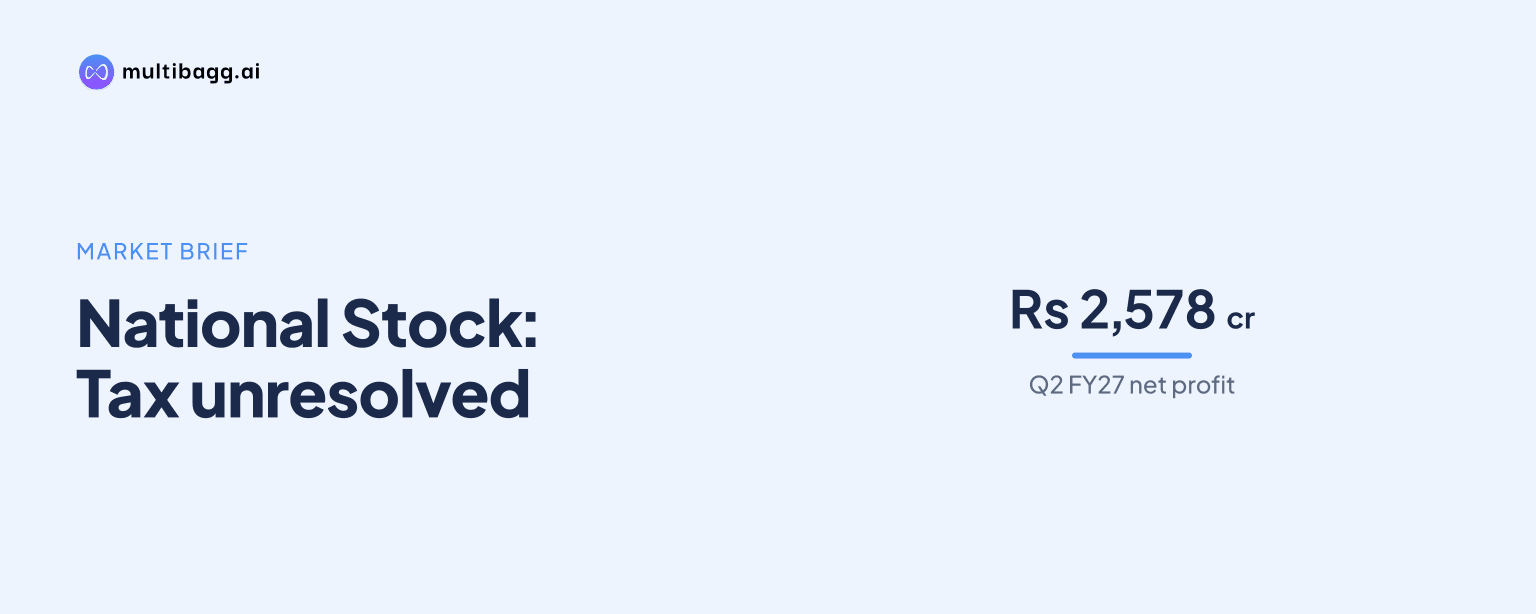
National Stock Exchange is in focus before Union Budget 2027-28 as industry groups seek lower equity capital gains taxes, while economists favour retaining them; the exchange reported a 23% year-on-year increase in Q2 FY27 consolidated net profit to ₹2,578 crore. No change to the current tax regime has been announced, leaving the policy outcome unresolved.
What is the current tax treatment for listed equity gains?
The current regime taxes long-term gains on listed equities and equity funds at 12.5% above ₹1.25 lakh in a financial year. It has applied since July 23, 2024, so the pre-Budget discussion does not alter an investor's tax return under the present rules.
Listed securities had an LTCG exemption until 2018, when a 10% tax was introduced. The rate was raised to 12.5% in the July 2024 Budget. The debate ahead of Budget 2027-28 is therefore about possible future rationalisation, rather than a change already in force.
The available discussion does not provide a confirmed Budget proposal from the government. Investors should separate industry memoranda, research suggestions and reported regulatory proposals from an enacted tax amendment. Each remains subject to the government's decision in the Budget process.
What are industry bodies asking the government to change?
Industry bodies are asking for lower taxes on equity gains, although their proposals differ on the structure and rate. PHD Chamber of Commerce and Industry has urged the government to abolish LTCG tax on listed equities, reduce STCG tax to 10%, and lower securities transaction tax rates.
FICCI has sought restoration of the full LTCG exemption on listed securities. Assocham has suggested a graded approach: a 10% LTCG rate for holdings of more than one year but less than two years, followed by nil or roughly 5% for investments held beyond two years. It has also suggested allowing securities transaction tax credit against LTCG liability on long-term holdings.
SBI Research has put forward another illustrative framework rather than a Budget proposal. Its suggestions include an inflation-linked exemption threshold, a ₹2 lakh exemption in its illustrative table, a 5% rate for holdings of two to three years, and zero tax beyond three years. It also suggested deferring proportionate LTCG where mutual fund redemption proceeds are reinvested in eligible equity mutual funds within 90 days.
Why is there resistance to scrapping equity LTCG tax?
Economists have advised Finance Minister Nirmala Sitharaman to retain capital gains tax on equities, citing the need for fiscal prudence despite industry calls for relief. Their consultations also referred to economic improvement and private investment growth, indicating that the government faces a trade-off between lower investor taxation and revenue considerations.
SBI Research estimated LTCG collections at about ₹1 lakh crore in FY26 and projected ₹40,000 crore to ₹50,000 crore in FY27. Those figures provide context for why a complete abolition could be treated differently from a targeted reduction, a higher exemption threshold, or a holding-period-based structure.
The policy case remains contested. Supporters of rationalisation argue that a competitive tax structure could improve post-tax returns, encourage long-term investment and deepen domestic capital markets. The opposing view in the discussions is that there is no compelling case to eliminate the tax entirely.
Got a follow-up? Ask IRIS
How do National Stock Exchange results fit the market discussion?
National Stock Exchange's Q2 FY27 consolidated net profit rose 23% year on year to ₹2,578 crore, driven by higher trading volumes and transaction revenue. The result puts exchange activity alongside the broader conversation about investor participation, taxation and market liquidity.
NSE also approved divesting up to 40% in its coal exchange subsidiary. Jefferies and Emkay maintained Buy ratings on NSE shares, according to the social-media context, but no target prices or valuation details were provided. The reported earnings and subsidiary decision are distinct from the pending tax-policy debate.
Market sentiment has also been influenced by overseas flows and global interest rates. In one reported session, the Sensex and Nifty rose more than 1.1% after the US Federal Reserve maintained rates, while foreign investors made net Indian-equity purchases of about ₹872 crore. Separately, foreign portfolio investors reportedly bought ₹53,739 crore of Indian equities over six trading sessions from November 2 to 9.
What could shape the market outlook through 2027?
The cited outlook places 28,000 on the Nifty 50 as a base-case expectation for 2027 and 30,000 as a bullish scenario, but both depend on supportive conditions. Alpha Capital founder and senior partner Akhil Bhardwaj linked that view to relatively low crude oil prices and global interest rates, geopolitical stability, and continued corporate earnings improvement.
Tax relief could add to sentiment, but the available commentary also states that a tax cut alone cannot guarantee foreign inflows or reverse global investment trends. Investors assessing any outlook should therefore treat tax policy as one variable among earnings, interest rates, oil prices, geopolitical developments and foreign flows.
There is no confirmed market target specifically for March 2027 in the supplied discussion. Aditya Birla Capital's stated plan to expand its branch network to 200 to 300 in key markets by March 2027 is a separate company expansion plan, not a forecast for the Indian equity market or National Stock Exchange.
Conclusion
National Stock Exchange's 23% Q2 FY27 profit growth to ₹2,578 crore reflects stronger trading volumes and transaction revenue, while the capital-gains debate highlights the policy questions facing equity investors. Industry groups want reductions in LTCG, STCG and STT, whereas economists have argued for retaining equity capital-gains taxation in the interest of fiscal prudence.
The next key development is the Union Budget 2027-28 decision after pre-Budget consultations with capital-market representatives. Investors should watch whether the government proposes any change to the 12.5% LTCG rate above ₹1.25 lakh, the treatment of shorter holding periods, or a more targeted mutual-fund switching framework.