










Long-Term Capital Gains Tax Review Awaits Budget 2027-28
Key highlights
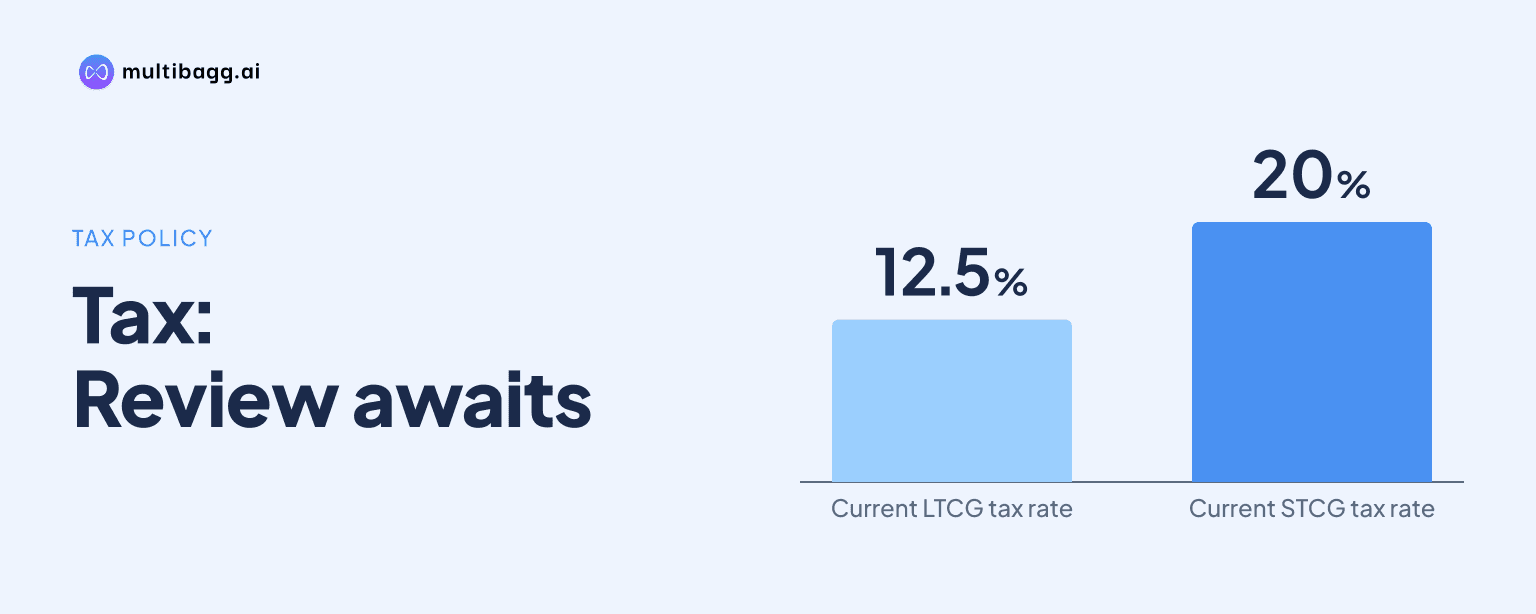
- LTCG above ₹1.25 lakh on eligible listed equities and equity mutual funds is currently taxed at 12.5% plus surcharge and cess.
- Eligible equity investments must be held for more than 12 months to receive LTCG treatment under current rules.
- STCG on eligible equity investments sold within 12 months is generally taxed at 20%.
- The government is expected to disclose any tax changes in the Union Budget on February 1, 2027.
powered by IRIS
Long-Term Capital Gains Tax (LTCG) rules on listed equities and equity mutual funds will remain unchanged until the Union Budget 2027-28, with gains above ₹1.25 lakh still taxed at 12.5% plus applicable surcharge and cess. The Finance Ministry is examining industry representations, but CBDT Chairman Ravi Agrawal has indicated that any decision will come through the Budget process.
When could LTCG rules change?
LTCG rules could change only when the government presents the Union Budget on February 1, 2027, based on the indication from Ravi Agrawal. The Central Board of Direct Taxes chairman said the ministry is reviewing suggestions received in pre-budget consultations and will examine the wider tax implications before taking a decision.
This means investors should not assume an immediate reduction or removal of LTCG. The current discussion has generated market interest because industry chambers and participants have sought changes that they believe could reduce the tax burden and make Indian equities more attractive to domestic and foreign investors. However, the review is still at the consultation stage.
What are the current LTCG and STCG rules for equities?
LTCG applies when eligible listed equity shares and equity-oriented mutual funds are held for more than 12 months, while gains from a sale within 12 months are generally treated as short-term capital gains, or STCG. Under Section 112A, LTCG above ₹1.25 lakh in a financial year is taxed at 12.5%, along with applicable surcharge and cess.
STCG on these investments is generally taxed at 20% under Section 111A, subject to applicable conditions. The tax distinction makes the holding period important for investors considering a sale, particularly where gains are close to the annual LTCG threshold.
The rates were increased from 10% to 12.5% for LTCG and from 15% to 20% for STCG. Social-media discussion around the review has focused on whether the higher tax burden has affected investor appetite and whether a revised framework could support market participation.
Got a follow-up? Ask IRIS
Which LTCG changes are industry groups seeking?
Industry groups are seeking abolition of LTCG on equities, a lower STCG rate, changes to Securities Transaction Tax, or a combination of these measures. PHDCCI has proposed removing LTCG and suggested reducing STCG from 20% to 10%, or alternatively reducing Securities Transaction Tax rates.
Stakeholders have argued that charging both Securities Transaction Tax and capital gains tax results in a double-taxation concern for equity investors. Some proposals also seek a separate tax treatment for foreign portfolio investors, noting that LTCG on equities is tax-exempt for such investors in several emerging markets.
Another proposal would lengthen the qualifying holding period for LTCG from more than 12 months to 18 or 24 months. This would mean investors would need to hold eligible shares and equity mutual funds for longer before accessing LTCG treatment, even if the tax rate itself were reduced or removed. No proposal has been accepted, and the government has not announced any preferred option.
The potential market impact remains uncertain. Supporters say lower taxes could improve foreign investor sentiment and increase interest in Indian equities. Finance Minister Nirmala Sitharaman has also noted that India received strong foreign portfolio investment inflows under the same capital gains tax structure in 2023-24, and that market fundamentals matter alongside tax policy.
Conclusion
The LTCG review has become a closely watched policy issue because it covers returns on listed shares and equity mutual funds, short-term trading taxes, and Securities Transaction Tax. For now, the applicable structure remains clear: gains above ₹1.25 lakh that qualify for LTCG face 12.5% tax, while qualifying STCG is taxed at 20%.
Investors should watch the Union Budget on February 1, 2027, when the government is expected to disclose whether it will retain the current framework or act on proposals involving LTCG abolition, STCG rationalisation, Securities Transaction Tax, a longer holding period, or different treatment for foreign portfolio investors.